
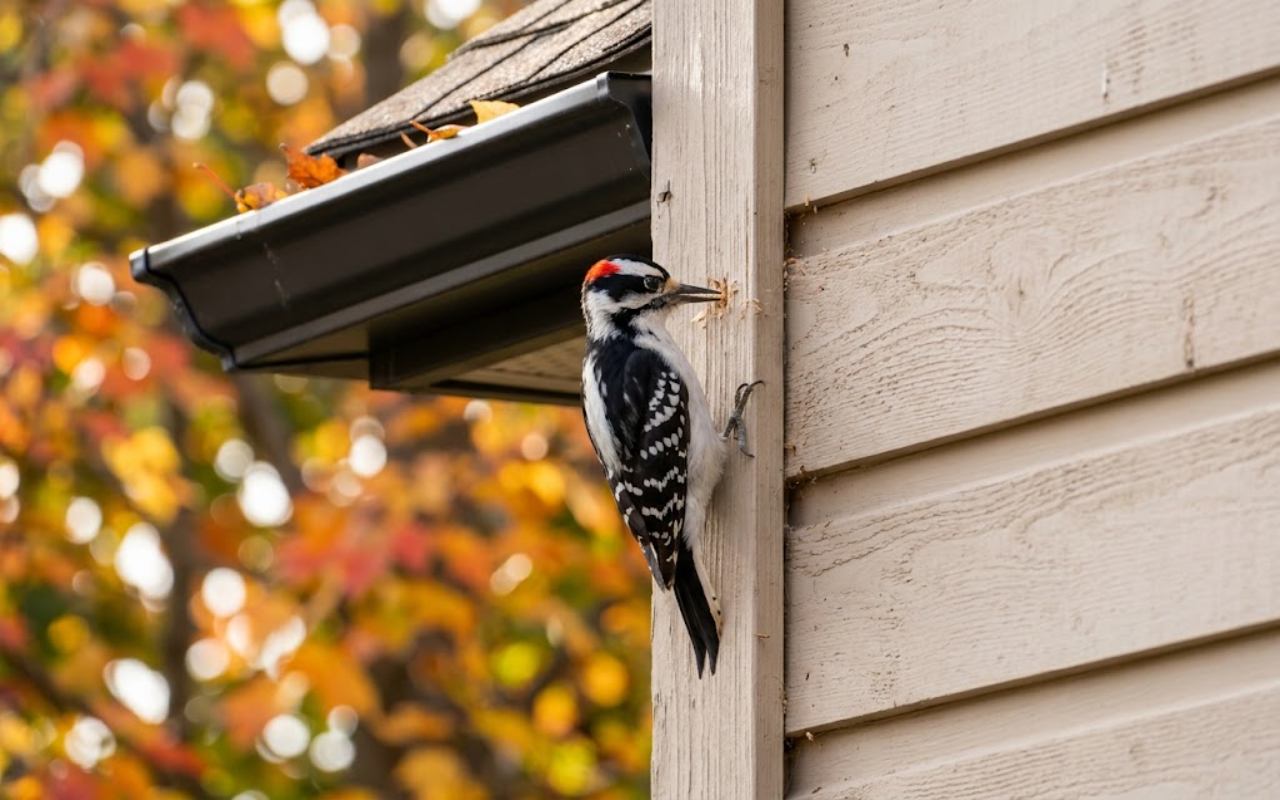
Learning how to manage woodpeckers drumming on house siding and gutters in fall requires an understanding of avian communication and seasonal shifts. Property owners often awaken to rapid, jackhammer sounds echoing through bedrooms as birds strike exterior metal or cedar. This jarring noise is rarely random; it is driven by deliberate biological instincts.
While drumming peaks during the spring mating window, autumn brings a noticeable secondary surge across North America. Grasping why these birds choose resonant home structures allows you to stop the noise without harming the birds.
Understanding Fall Woodpecker Drumming and Territorial Behavior
Woodpeckers do not drum on hard surfaces exclusively to seek food or excavate cavities. In autumn, juveniles disperse from natal ranges, while resident adults aggressively re-establish territory boundaries ahead of scarce winter resources. Drumming serves as an acoustic broadcast that communicates strength and ownership across a wide radius.
Several widespread species commonly engage in this behavior across residential neighborhoods during autumn months. These birds select materials that generate maximum resonance, carrying their acoustic signals far across suburban yards.
- Downy Woodpecker (Dryobates pubescens), known for testing aluminum trim and downspouts.
- Hairy Woodpecker (Dryobates villosus), which favors resonant fascia boards and house corners.
- Northern Flicker (Colaptes auratus), frequently targeting chimney caps and metal roof flashings.
- Red-bellied Woodpecker (Melanerpes carolinus), known to broadcast from gutters and cedar siding.
Under the federal Migratory Bird Treaty Act, all native woodpecker species receive legal protection. It is unlawful to capture, harm, or destroy these birds or their active nests, making non-lethal management your only option.
Why Woodpeckers Target Metal Gutters and Fascia Boards
When a bird strikes metal downspouts or gutters, the primary motivation is almost never food extraction. Hollow metal sheets amplify mechanical vibrations, allowing a bird to produce deafening sound bursts with minimal energy expenditure. A flicker pounding against a clean gutter can produce sound audible for nearly half a mile.
Aluminum and galvanized steel do not harbor hidden grubs or carpenter bee larvae. Homeowners can rest assured that gutter drumming causes zero structural wood rot or insect infestation beneath the metal. The real consequence is acute auditory disturbance and occasional superficial cosmetic denting.
Inspecting Wood Siding for Structural Excavation and Insects
Pounding on cedar, pine, or synthetic siding requires closer scrutiny than gutter drumming. If the bird produces a slow, irregular tapping rather than a rapid rhythmic roll, it is likely foraging for hidden prey. Woodpeckers can detect the movement of carpenter bees, leafcutter bees, and beetle larvae hidden inside exterior wall voids.
Fall is also the period when resident woodpeckers excavate winter roosting cavities to shelter from freezing nights. Deep, rounded holes measuring 1.25 to 2.5 inches across signify cavity excavation rather than acoustic drumming. If you notice structural holes, check the area for insect frass or tunneling immediately.
Quick-Reference Diagnostic & Fix Guide
To solve your woodpecker problem quickly, you must first identify why the bird is targeting your home. Pounding on a gutter requires a completely different solution than drilling into wood siding. Use this diagnostic table to identify the behavior and deploy the correct, humane fix.
| Sound & Visual Signs | Core Motivation | Primary Targets | Recommended Action & Products |
|---|---|---|---|
| Rapid, rhythmic drumming (sounds like a jackhammer; no structural damage) | Acoustic Signaling Establishing territory and communicating strength. | • Metal gutters • Chimney caps • Metal flashings • Cedar corner boards | • Deadbird the sound by stuffing outdoor foam insulation behind hollow gutter corners. • Install motion-based deterrents like the WCS Avian Spinner or The Intimidator Avian Deterrent. |
| Slow, irregular tapping (accompanied by small, messy, or linear holes) | Foraging for Food Hunting for hidden overwintering insects. | • Cedar siding • Pine fascia boards • Stucco | • Inspect the wood immediately for insect frass, carpenter bee tunnels, or beetle larvae. • Treat the underlying insect issue and block immediate access using heavy-duty hardware cloth. |
| Deep, clean, rounded holes (measuring 1.25 to 2.5 inches in diameter) | Cavity Nesting Excavating a warm shelter for freezing winter nights. | • Softwood siding • Shingles • Eaves | • Hang lightweight polypropylene netting (0.75-inch mesh) suspended 3 inches away from the siding. • Install a specialized wooden woodpecker nest box directly over or near the area to redirect their nesting instinct. |
| Flashing, random movements (bird flies away but returns when quiet) | Visual Curiosity / Habit The bird has normalized the site as a safe zone. | • Rooflines • Window casings | • Hang high-visibility reflective materials like MP Mypole Bird Scare Tape to flash and twist in the wind, breaking the bird’s comfort zone. |
Humane Physical and Visual Deterrents for Siding and Gutters
Effective mitigation requires swift action before the selected drumming station becomes an entrenched daily habit. Deploying physical barriers and light-reflecting materials changes the acoustic and visual appeal of the site.
- Lightweight polypropylene netting with a 0.75-inch mesh, suspended three inches away from wood siding.
- Heavy aluminum foil strips measuring two inches wide and three feet long, hung to twist in the breeze.
- Commercial Mylar reflective tape installed along roof edges and gutter runs.
- Fine wire screening or hardware cloth affixed directly over damaged corner boards.
For gutters, you can temporarily muffle resonance by padding hollow corners with outdoor foam insulation. Eliminating the metallic ringing sound quickly causes the bird to seek another acoustic platform elsewhere.
Fall Habitat Modifications and Alternative Acoustic Sites
Redirecting woodpecker activity away from residential siding works best when combined with natural habitat solutions. Providing dedicated foraging stations and natural perches satisfies biological drives away from the home facade.
High-energy food resources help birds build fat reserves without foraging through residential fascia boards. Position suet cakes in hanging wire cages at least thirty feet away from affected exterior walls. Clean these feeding stations regularly using a standard solution of one part bleach to nine parts warm water.
If property safety permits, leave dead tree snags intact at the perimeter of your yard. A dead pine or oak trunk offers ideal resonant wood, encouraging birds to drum naturally in the woods rather than on your home.