
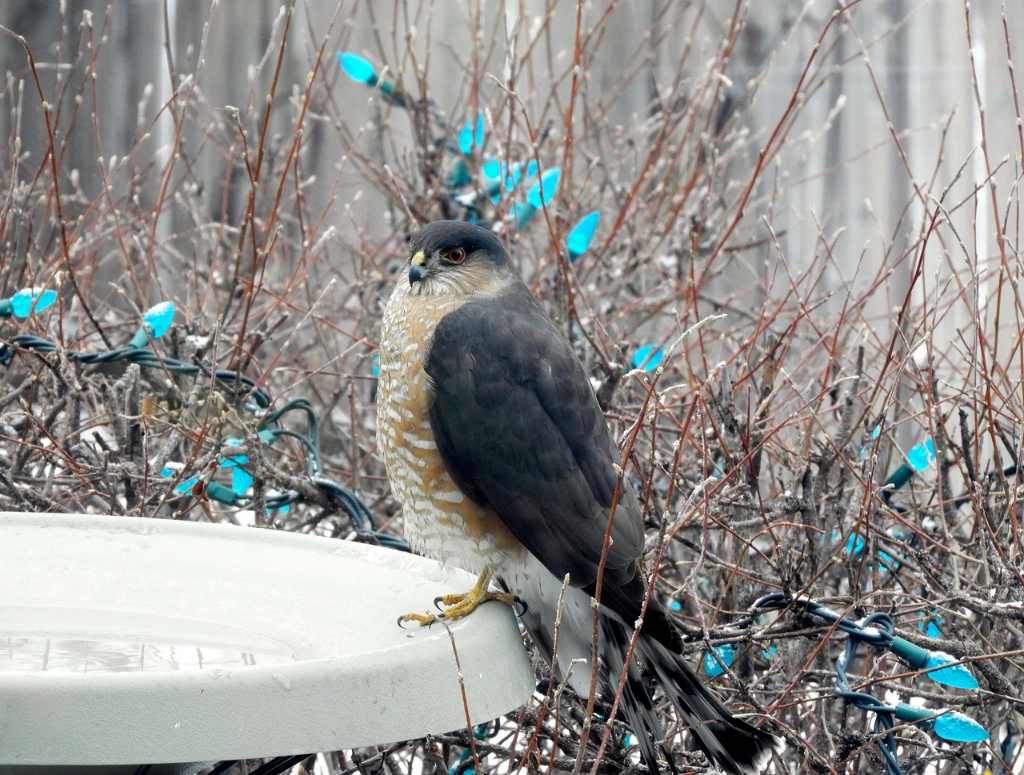
Understanding the danger of sharp-shinned hawks is essential for backyard naturalists who maintain busy feeding stations during the cold months. These agile raptors specialize in hunting songbirds, viewing high-density winter feeding stations as natural hunting grounds. When an accipiter discovers your yard, common visitors like juncos, goldfinches, and chickadees face immediate predatory pressure.
While predation is a natural ecological process, backyard feeding stations artificially concentrate prey in open spaces. Landowners can easily balance the needs of winter songbirds by deploying proven habitat modifications and equipment safeguards recommended by field ornithologists.
Understanding Sharp-Shinned Hawk Hunting Behavior at Winter Feeders
Sharp-shinned hawks (Accipiter striatus) rely on stealth, short bursts of high-speed flight, and remarkable agility in tight spaces. Unlike larger soaring buteos, these woodland hunters navigate dense vegetation easily to surprise flocking songbirds on perches or feeding platforms. They often watch feeding yards from concealed evergreen branches before launching a low, rapid attack.
Distinguishing the sharp-shinned hawk from its closely related cousin, the Cooper’s hawk, requires attention to specific anatomical features:
- Square tail tips with sharp outer corners visible in perched and gliding birds
- Thin legs and spindly toes suited for snatching small songbirds
- Smaller overall body mass roughly comparable to a blue jay
- Distinctly rapid, snappy wingbeat patterns alternating with short glides
Because these raptors operate visually, disrupting their direct lines of sight is the most effective way to protect smaller backyard flocks. When songbirds possess early visual warning, their survival rates during an ambush increase significantly.
Strategic Feeder Placement to Shield Backyard Songbirds
Proper hardware placement reduces sudden panic collisions and limits a hawk’s flight clearance during an approach. Feeders positioned directly in wide-open lawns leave songbirds exposed with no viable escape routes.
Ornithological organizations such as the Cornell Lab of Ornithology recommend positioning feeders close to structures:
- Within three feet of window glass to eliminate fatal strike velocities during panic flights
- Beyond thirty feet from glass if close mounting is impossible
- Underneath wide porch eaves or architectural overhangs to block vertical diving trajectories
- At least five feet off the ground on metal baffle poles to deter terrestrial ambush
Placing feeders under structural overhangs forces a raptor to pull up or slow its approach speed. This fractional delay provides small birds sufficient reaction time to drop down into ground cover or disperse safely.
Physical Exclusions and Protective Cages for Small Bird Flocks
Physical barriers provide small songbirds with secure feeding sanctuaries that exclude larger raptors entirely. Commercial or homemade wire guards permit small birds to pass freely while physically blocking predatory raptor access.
Effective exclusion guards incorporate specific physical parameters:
- Heavy gauge wire cages with mesh openings measuring 1.5 inches square
- Ample internal clearance maintaining at least six inches between the outer cage and internal seed ports
- Sturdy dome baffles mounted above hanging feeders to deflect aerial stoops
- Hopper feeder models featuring weight-activated perches that close during sudden impacts
The internal clearance prevents a sharp-shinned hawk from reaching through the wire with its long, slender talons. This ensures that finches and nuthatches can feed safely within the protected zone without panic.
Providing Dense Natural Cover to Thwart Hawk Ambush Tactics
Natural vegetation serves as the primary defense mechanism for winter flocks against fast accipiters. Small passerines can maneuver through thick, thorny brambles that would damage a hawk’s flight feathers.
Creating effective microhabitats requires intentional landscape choices:
- Dense native brush piles constructed with crisscrossed hardwood branches and evergreen boughs
- Native evergreen shrubs such as junipers, yews, and arborvitae planted ten to fifteen feet from feeders
- Bramble patches composed of native blackberries or wild roses
- Downed tree tops anchored near ground level to offer immediate low-level shelter
Maintaining a distance of ten to fifteen feet between the cover and feeding stations is critical. Placing cover too close allows a hawk to stage a close-range ambush, while placing it too far leaves small birds stranded in open terrain.
Feeder Downtime and Long-Term Winter Safety Protocols
If a sharp-shinned hawk establishes a daily hunting pattern in your yard, proactive management is necessary. Temporarily taking down all seed and suet stations disrupts the hawk’s hunting routine without harming local bird populations.
Songbirds are resilient foragers that readily locate alternative wild seed sources during feeder removals. Removing feeders for three to five days encourages the raptor to move on to broader hunting territories across the landscape.
When restoring feeders, take the opportunity to maintain strict yard hygiene:
- Rake and remove discarded seed hulls from ground areas beneath feeding stations
- Wash all tube, hopper, and platform feeders in a mild 1:9 bleach-to-water solution
- Rinse thoroughly with clean water and dry completely before refilling with fresh seed
- Reinstall feeders gradually over two days to monitor returning avian activity
Once the predator shifts its routine, your winter flocks can return safely to a clean, well-protected feeding environment. Responsible management ensures a healthy, biodiverse yard that respects the natural ecology of all native avian species.