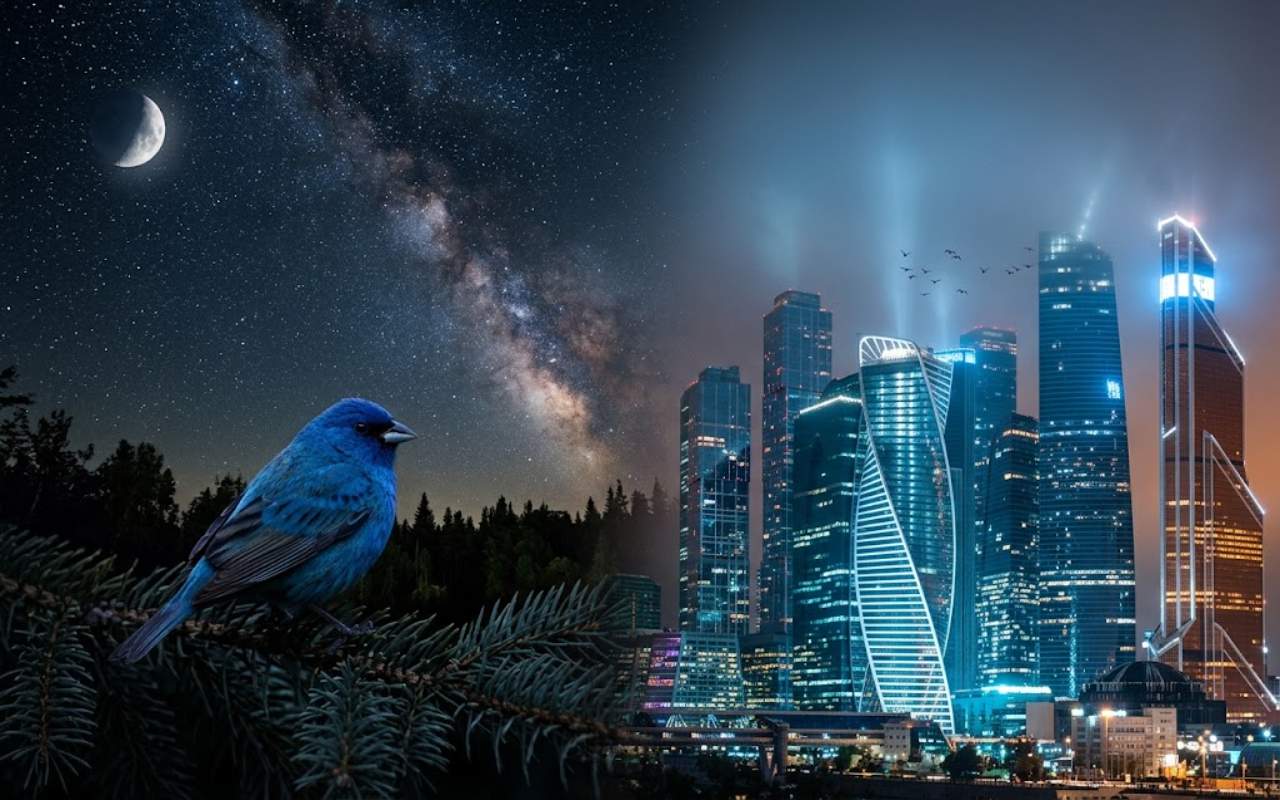
Backyard birders across the country are witnessing firsthand the devastating light pollution effects on birds as our night skies grow brighter each year. What used to be an issue confined to downtown city skylines has spilled directly into suburban backyards and quiet rural roosts.
Artificial light at night scrambles migration routes, disrupts natural sleep patterns, and drains crucial energy reserves that songbirds need to survive. Understanding how excessive outdoor lighting alters bird behavior is the first step toward making our neighborhoods safer for migratory and resident species alike.
How Artificial Glow Hijacks Night Migration
Most North American songbirds do not travel by day when predators are active and atmospheric turbulence is high. Warblers, thrushes, vireos, and sparrows migrate predominantly under the cover of darkness, taking advantage of cooler air and calmer winds. They rely on celestial cues, including the patterns of the stars and the setting sun, alongside an internal magnetic compass to navigate across continents.
Bright beams from commercial buildings, unshielded streetlights, and harsh residential floodlights create what scientists call phototaxis, or fatal light attraction. Migrating birds get lured into brightly lit areas, where they become disoriented and circle endlessly inside illuminated light beams. This entrapment causes birds to waste critical fat stores that they need to complete their journeys across severe ecological barriers like the Gulf of Mexico.
Exhausted birds trapped in illuminated suburban corridors face severe hazards before the sun even rises:
- Depleted fat reserves from circling lights leave birds too weak to forage effectively the next morning.
- Birds drop into unfamiliar suburban landscapes that offer little cover from feral cats and local predators.
- Disoriented flocks become separated, breaking up groups that travel together for safety.
- Lower flight altitudes over brightly lit neighborhoods place birds directly in the path of utility wires, communication towers, and vehicles.
Research tracked by the Cornell Lab of Ornithology and the BirdCast project shows that billions of birds traverse the United States each spring and autumn. When these travelers encounter unnatural light domes over our towns, their navigational systems fail, pulling them down into dangerous urban environments.
Disrupted Circadian Rhythms and the False Dawn Chorus
Artificial illumination does not just impact long-distance travelers passing overhead. Resident birds that sleep in our hedges, nest boxes, and trees experience severe circadian rhythm disruptions from nearby streetlights and security lamps. Even low levels of ambient night light suppress melatonin production, a critical hormone that regulates natural sleep cycles and immune health in birds.
Many backyard enthusiasts notice robins, northern mockingbirds, and European starlings singing vigorously at two o’clock in the morning. While hearing a midnight song might seem charming at first, it is actually a symptom of chronic sleep deprivation and hormonal confusion. Male birds tricked by light pollution begin their dawn singing routines hours before natural daylight, burning valuable calories when they should be resting.
This premature singing disrupts natural mating dynamics and increases exposure to nocturnal predators like owls. Female birds often choose mates based on the strength and timing of their territorial songs, but artificial lights distort these honest biological signals. Over time, chronically sleepless parent birds show higher stress hormone levels and weaker immune responses against common avian parasites.
Window Collisions and the Trap of Urban Skyglow
The combination of artificial light and reflective glass creates one of the leading causes of human-related bird mortality in North America. Estimates compiled by the American Bird Conservancy indicate that up to one billion birds die from window strikes in the United States every single year. Light pollution acts as the primary trigger that draws nocturnal migrants directly toward glass-heavy residential and commercial structures.
When morning arrives, disoriented birds trapped in artificial light pools attempt to fly toward reflections of trees, sky, and shrubs in glass windows. Glass is invisible to birds, and illuminated indoor plants make the barrier appear like a viable refuge. Stunned birds strike the glass at full speed, suffering fatal concussions, broken beaks, and internal bleeding.
Backyard birders often discover window casualties underneath their picture windows during peak spring and fall migration weeks:
- Mirrored window reflections trick exhausted birds into flying toward false open spaces.
- Transparent glass breezeways and corner windows lure birds trying to reach greenery seen on the other side.
- Bright indoor lights left burning all night illuminate glass panes from within, pulling nocturnal flyers directly into the exterior glass surface.
- Unmonitored ground strikes leave stunned birds completely helpless against neighborhood outdoor cats.
If you find a bird that has collided with your window, do not release it immediately into the yard. Place the bird carefully in a dark, ventilated cardboard box lined with a paper towel, keep it quiet, and contact a licensed wildlife rehabilitator if it does not recover within an hour.
What Scientific Studies Reveal About Nesting Success
Light pollution interferes heavily with seasonal breeding schedules and chick rearing in suburban habitats. Studies published by researchers at the Cornell Lab of Ornithology show that birds exposed to artificial night light often lay eggs several days to weeks earlier than birds nesting in naturally dark environments. While early breeding might sound harmless, it creates a severe mismatch between chick hatching dates and the peak availability of caterpillar populations.
Baby songbirds require massive quantities of soft insects to grow their feathers and build skeletal strength within their first two weeks of life. If eggs hatch before leaf-eating caterpillars emerge on native oak and maple trees, parents struggle to find sufficient food. This timing disconnect frequently leads to smaller clutch sizes, lower chick weights, and higher nestling mortality rates.
Furthermore, bright security lights pointed directly at shrubbery and nesting boxes reveal vulnerable nests to nocturnal predators. Raccoons, opossums, and domestic cats use ambient residential light to hunt active nests that would otherwise remain hidden in the dark. A nest that seems safely concealed during the afternoon becomes fully visible when an unshielded neighbor floodlight clicks on at dusk.
Practical Backyard Fixes to Dim the Lights for Wildlife
Tackling light pollution does not mean living in total darkness or sacrificing home security. Simple adjustments to your yard fixtures can dramatically improve night conditions for local wildlife while preserving effective property illumination. The primary goal is keeping light directed downward where humans walk, rather than allowing it to scatter outward and upward into the sky.
Bird-friendly lighting strategies rely on proper fixture choices, warm color profiles, and smart timing controls:
- Shielded downlight fixtures stop upward light spill and keep beams focused solely on paths and steps.
- Bulbs with a warm color temperature under 3000 Kelvin produce fewer harmful blue wavelengths than stark daylight white bulbs.
- Motion-activated sensor lights illuminate property boundaries only when needed, remaining dark the rest of the night.
- Mechanical plug-in timers shut off decorative landscape and tree-uplighting fixtures completely by 11:00 PM.
- Drawn curtains, indoor blinds, and window shades prevent indoor living area illumination from beaming out into tree canopies.
Applying patterned external decals, dot arrays, or hanging paracord screens on your large exterior windows will also prevent fatal daytime strikes after birds land in your yard. Keeping your window screens installed year-round provides a soft exterior cushion that dramatically softens accidental impacts. By dimming unnecessary lights and breaking up exterior glass reflections, you turn your yard into a genuine sanctuary for resting birds.