
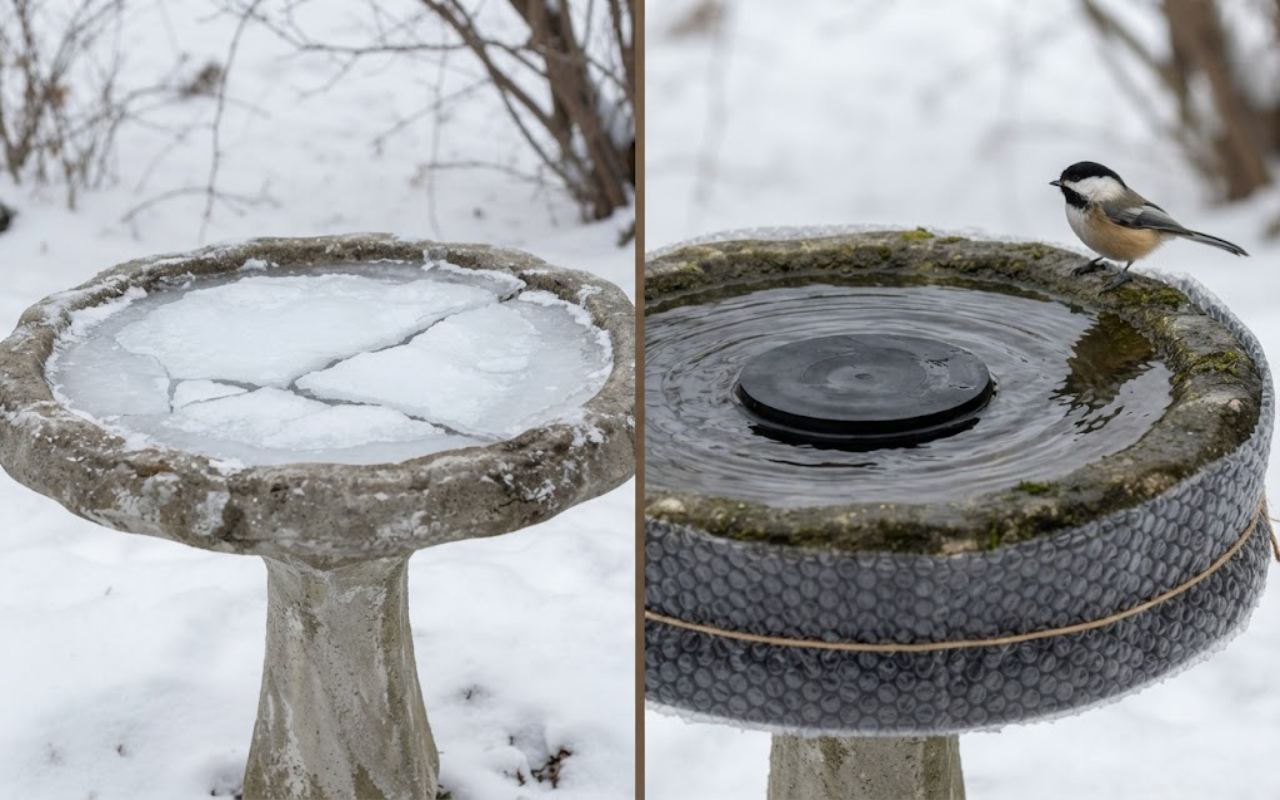
Implementing reliable freezing bird bath fixes protects your local flock without costly commercial heaters during sudden freeze warnings tonight. Backyard birds require unfrozen drinking water in sub-freezing weather to metabolize fat reserves and maintain internal thermoregulation. Deploying fast, safe household improvisations prevents total ice lockup before morning temperatures drop to their lowest point.
Understanding how basic thermodynamics and kinetic energy interact with open water keeps vital stations functional using common everyday items. Deploying localized insulation wraps or passive black solar absorbers maintains fluid motion across the surface layer. These quick, intentional adjustments transform standard backyard basins into resilient, life-saving winter oases.
Quick-Glance Field Summary
Implementing emergency freeze protection requires non-toxic thermal retention, localized water movement, and structural wind deflection before dusk. The following specifications detail the safe thresholds, materials, and measurements required to deploy these overnight interventions safely.
- Saturated saline agitation container: 16 to 20 ounce plastic bottle packed with 0.25 cup rock salt, filled with warm water, and sealed tightly.
- Optimal thermal basin depth: 1.5 to 2.0 inches maximum water depth to balance bird safety with localized heat retention.
- Thermal rock heat sink: Smooth, dark basalt or river stones measuring 3 to 5 inches across, set in direct sun during late afternoon.
- Critical temperature baseline: Interventions delay surface skimming down to roughly 24 degrees Fahrenheit (-4.4 degrees Celsius) under light wind conditions.
- Strictly prohibited additives: Never add glycerin, anti-freeze, salts, or sugars directly into the open basin fluid.
Saturated Brine Agitator Bottles for Zero-Chemical Surface Disruption
One of the most reliable community-tested methods across backyard wildlife forums involves creating a completely sealed saline displacement buoy. On forums like r/backyardbirds, keepers frequently encounter the problem of ice crystals bridging across shallow margins as ambient temperatures fall. Floating a clean, sealed 20-ounce plastic beverage bottle filled with high-concentration saltwater disrupts this surface crystallization.
Because saltwater possesses a far lower freezing point than freshwater, the liquid inside the bottle remains completely fluid well below 20 degrees Fahrenheit. The slightest breeze rolls the floating bottle across the basin, generating kinetic ripples that delay needle-ice formation along the perimeter. Most importantly, because the saline solution stays hermetically sealed inside the capped container, birds cannot consume the salt.
When constructing this agitator, run a ring of standard exterior duct tape or silicone around the bottle cap to prevent any accidental leakage. Leave a small air pocket at the top of the bottle so it floats halfway out of the water rather than sinking to the basin bottom. This vertical flotation maximizes water movement across the entire surface profile.
- Vessel profile: Smooth plastic 16 to 20 ounce sports drink bottle stripped clean of exterior paper labels.
- Salt concentration: One quarter cup of non-iodized coarse salt per two cups of hot tap water, shaken until fully dissolved.
- Flotation balance: Approximately 85 percent liquid fill with a 15 percent air buffer to maintain continuous bobbing.
| Winter Water Fix | Physical / Thermal Property | Avian Safety Benefit | Primary Operational Risk |
|---|---|---|---|
| Low-Wattage De-Icer | Submerged thermostatic heater element cycles on automatically at 35°F. | Guarantees wide open liquid areas through severe sub-zero stretches. | Requires an outdoor GFCI outlet and a heavy-duty extension cord. |
| Passive Black Disk | Submerged dark rubber disc absorbs ambient daytime solar heat radiation. | Zero-cost energy alternative that safely delays early morning freezing. | Ineffective during complete cloudy overcasts or deep nighttime drops. |
| Floating Aerator Ball | Bouncing lightweight tennis ball breaks surface tension via kinetic ripples. | Completely chemical-free option to stall light frost crusts. | Fails entirely when ice loads overwhelm low wind surface movement. |
Thermal Mass Anchors and Dark Substrate Radiation
Thin plastic and ceramic bird baths bleed heat rapidly into the ambient air, dropping to freezing temperatures shortly after sunset. Field observers on birding subreddits routinely note that shallow concrete or glazed basins lose latent heat far faster than setups incorporating dark, high-density river stones. Placing several dark slate rocks or basalt river stones in the basin acts as a low-tech passive thermal reservoir.
Position these dark stones in direct afternoon sunlight so they soak up solar infrared radiation before you submerge them at dusk. As ambient temperatures plummet overnight, the dense geological mass slowly bleeds stored heat upward into the boundary layer of the water. This thermal bleeding keeps a small zone surrounding the stones liquid long after shallow edges skim over.
The stones also serve an essential safety function during winter by reducing overall water depth. Deep winter water is hazardous because songbirds that submerge their contour feathers risk lethal hypothermia within minutes. Providing stable, rough-textured perches allows species like chickadees and nuthatches to drink from the rock edge without entering deeper water.
- Rock selection: Dark grey or black basalt, slate, or dense granite stones free of limestone dust.
- Rock dimensions: Three to five inches in diameter, positioned to protrude slightly above the water surface.
- Surface clearance: Maintain safe drinking water depths between 1.0 and 1.5 inches around the perimeter of the stones.
Perimeter Windbreak Skirting and Pedestal Ground Decoupling
Convective heat loss driven by steady winter wind accelerates evaporative cooling and freezes open water much faster than calm air. Discussions in regional wild bird forums reveal that elevated pedestal bird baths freeze significantly faster than ground-level water sources. The elevation exposes the underside of the basin to wind chill, cooling the entire container like a vehicle radiator.
Decoupling the bird bath from cold winds begins by lowering the basin directly to ground level near natural shelter. Relocate the shallow dish near dense conifer shrubs or against a south-facing exterior building wall to block prevailing northern drafts. If the basin cannot be moved, wrap the exterior base in dry burlap or bubble wrap to eliminate wind exposure underneath.
Surrounding the outer rim of the basin with dry straw or wood mulch forms a protective thermal collar. This insulating skirt shields the edges from frost development while keeping the perimeter access paths dry for visiting birds. Avoid covering the open water surface itself, keeping sightlines clear so visiting birds can detect stalking predators.
- Windbreak clearance: Position baths five to eight feet away from dense brush to mitigate predator ambush risks while blocking wind.
- Substrate insulating barrier: Place an inch of outdoor plywood or thick cardboard beneath ground basins to stop conduction into frozen dirt.
- Skirting materials: Natural straw, untreated pine shavings, or double-wrapped coarse burlap tied off with twine.
Lethal Cold-Weather Pitfalls: Glycerin Toxicity and Feather Barbule Collapse
A persistent and hazardous myth often resurfaces on amateur gardening blogs suggesting that adding glycerin to bird baths prevents freezing safely. Professional field ornithologists and rehabilitation centers stringently warn against adding any chemical antifreeze substitute to wildlife water sources. Glycerin does lower the freezing point of water, but its physiological consequences for avian plumage are catastrophic.
When songbirds bathe or splash in water containing glycerin, the oily compound coats their delicate microscopic feather barbules. Unlike pure water, glycerin does not evaporate cleanly, causing downy insulation to mat and collapse. Without dry, interlocking feather structures, a bird cannot trap body heat against its skin and rapidly dies of hypothermia.
Similarly, adding table salt, alcohol, or refined sugars directly to the basin fluid introduces severe metabolic hazards. Ingesting salted water causes rapid cellular dehydration and toxicosis in small songbirds. High-sugar mixtures fuel dangerous fungal outbreaks, including Candida albicans, and can coat winter plumage in sticky residues that impair flight performance.
- Banned water additives: Commercial automotive antifreeze, glycerin, rock salt, table salt, and alcohol solutions.
- Plumage hazards: Sticky chemical residues destroy interlocking barbule geometry, causing irreversible wetting and rapid freezing of down.
- Sanitation protocol: If a basin was treated with additives, scrub it thoroughly using a 1:9 household bleach-to-water dilution before refilling.
Electrical Immersion Deicers and Wattage Calibration Safeguards
When emergency hacks must transition into long-term winter care, installing a properly calibrated immersion heater provides permanent freeze prevention. Many backyard birders report breaker tripping, thermal shutoff failures, and cracked ceramic basins caused by utilizing unrated livestock equipment. Purpose-built wild bird deicers operate via built-in thermostats, cycling power only when water temperatures dip toward 35 degrees Fahrenheit.
A standard garden bird bath demands a deicer calibrated between 44 and 75 watts to prevent ice without warming the water excessively. Unregulated high-wattage stock tank heaters evaporate water rapidly and can dangerously warp light polycarbonate reservoirs. Always route outdoor power through an active ground-fault circuit interrupter (GFCI) outlet sealed inside a weatherproof connection box.
For best results, pair your mechanical heating elements with a grounded aluminum or cast-aluminum base frame. Elevating the heating element slightly off the plastic basin floor protects the synthetic material from hot-spot degradation. Regular inspection prevents mineral scale buildup, ensuring clean, unfrozen drinking water remains available through severe sub-zero weather events.
- Ideal heater calibration: 44 to 75 watts for shallow basins holding less than two gallons of water.
- Electrical code requirement: Dedicated outdoor GFCI outlet paired with an in-use weatherproof cover housing.
- Thermal threshold: Internal thermostat activation calibrated to initiate heat cycling at 35 degrees Fahrenheit.