
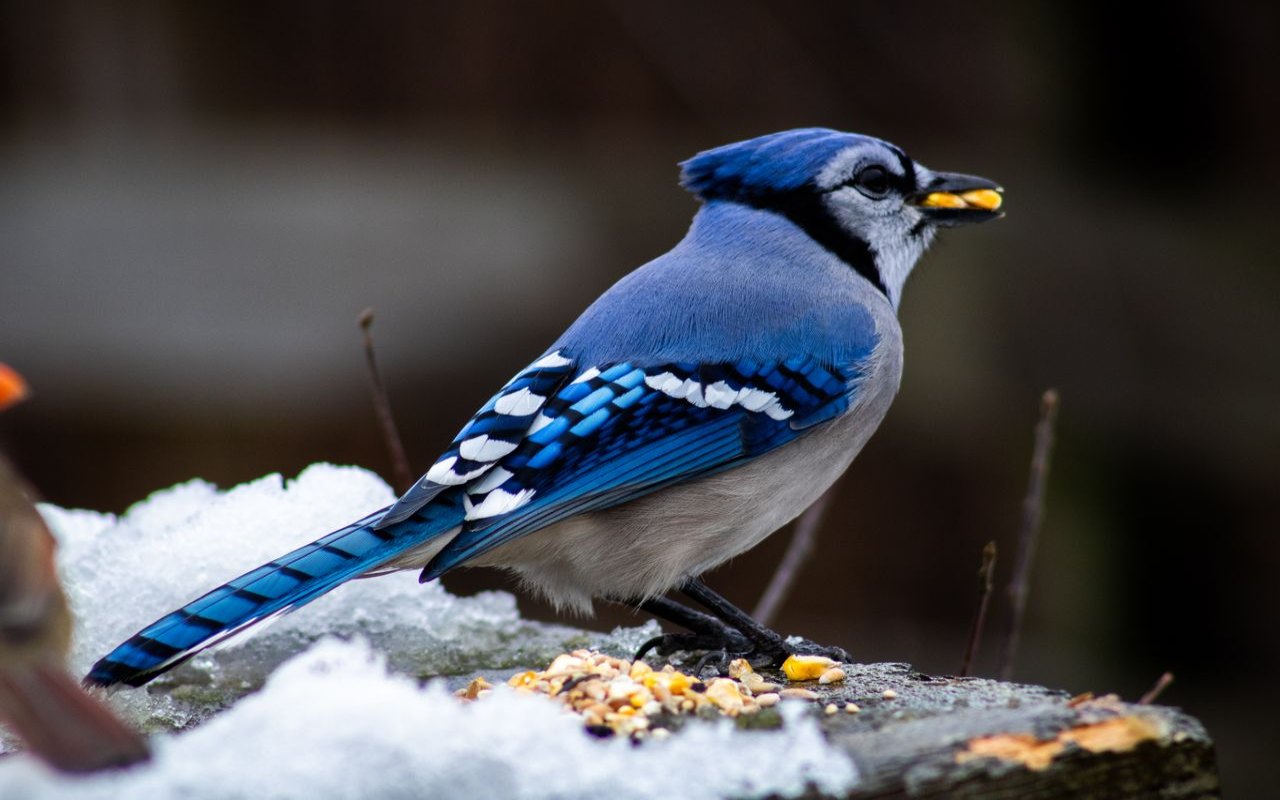
Offering whole corn for winter blue jays is one of the most reliable strategies for drawing these vibrant corvids to your backyard during harsh weather. While many backyard birders default to standard commercial seed blends, feeding birds raw corn serves as an exceptional way to provide dense, substantial food sources that winter jays actively seek out for immediate energetic returns.
Blue jays possess specialized anatomical adaptations designed to handle large, tough foods that smaller backyard birds cannot manage. Understanding how to deploy whole kernel corn correctly transforms a standard feeding station into an active winter haven for this intelligent species.
Winter Blue Jay Foraging Behavior and Dietary Needs
Blue jays (Cyanocitta cristata) belong to the family Corvidae, a group renowned for high cognitive capacity, complex social dynamics, and opportunistic feeding habits. During the winter months, natural food supplies such as wild acorns, beechnuts, and dormant insects decline significantly across their geographic range.
To survive extended periods of sub-freezing temperatures, these birds shift their behavior toward high-yield foraging opportunities. Whole corn kernels closely mimic the mass and density of native mast tree nuts, making them an instinctive favorite.
- Blue jays establish regular morning and late afternoon foraging rounds to replenish caloric deficits.
- Flocks operate with sentinel birds that scan for predators while others feed on the ground or open trays.
- Individual jays test the weight of multiple kernels before selecting the densest items to carry away.
Because winter flocks cover substantial territory, providing a consistent, recognizable food source helps establish your feeding station as a permanent stop on their daily flight path.
Recommended Feeders and Hardware for Whole Corn
Whole corn kernels are too heavy and bulky for traditional tube feeders or narrow hopper ports, which quickly clog when filled with large grains. To feed blue jays successfully, birders must deploy hardware designed to accommodate both the weight of the feed and the physical size of the bird.
Platform feeders, large hopper feeders with broad perches, and open ground trays represent the most effective equipment choices. Solid wood construction using cedar or cypress ensures long-term weather resistance, while heavy-duty recycled plastic models offer non-porous surfaces that are easy to clean.
- Platform trays should feature a perforated metal screen base made of rust-proof wire to promote instant drainage.
- Hopper feeders require a minimum discharge gap of one inch to allow unobstructed grain flow.
- Heavy-gauge hanging chains or solid steel mounting brackets prevent swinging under the weight of multiple landing corvids.
Avoid using wire mesh peanut feeders for whole corn, as the tight wire grid can trap a jay’s bill or damage feather shafts during feeding attempts.
Feeder Placement and Spatial Dimensions
Blue jays require generous clearance zones to land comfortably, assess surroundings, and launch quickly when startled. Placing feeders too close to dense brush can invite ambush predators like feral cats, while positioning them in totally barren open fields increases vulnerability to Cooper’s hawks.
Position your platform feeder roughly ten to twelve feet away from the nearest evergreen trees or sturdy shrubs. This distance grants the birds a rapid retreat pathway without giving predators concealing cover directly beneath the feeder.
- Mount platform feeders between five and six feet above the ground on a rigid metal pole to deter non-climbing animals.
- Maintain a minimum horizontal clearing radius of six feet around the tray to give incoming jays ample flight clearance.
- Install a heavy steel squirrel baffle with a minimum diameter of eighteen inches directly below the feeder platform.
Proper vertical and horizontal spacing also protects visiting birds from domestic threats while providing unobstructed viewing opportunities for the homeowner.
Nutritional Science and Caching Physiology
Whole dried corn provides an exceptional concentration of complex carbohydrates and vegetable fats that wild birds rapidly convert into metabolic heat. During freezing winter nights, small birds can lose significant body mass simply shivering to maintain their core temperature of roughly 105 degrees Fahrenheit.
Blue jays possess an expandable gular pouch, an anatomical pocket in the throat that allows them to collect multiple large food items at once. A single jay can swallow or store several whole kernels before flying off to stash them in tree crevices, under leaf litter, or in soft soil.
- Whole corn contains complex starches that digest gradually, providing steady caloric output through the night.
- The tough outer pericarp of the kernel resists moisture absorption, delaying spoilage when jays cache feed outdoors.
- The strong, chisel-shaped bill of the blue jay allows it to pin large kernels against tree branches and hammer them into consumable fragments.
This unique combination of gular storage and caching behavior means that blue jays do not merely eat at the feeder; they actively stock your entire yard with decentralized winter survival reserves.
Sanitation Protocols and Deterring Unwanted Pests
While whole corn is a fantastic food source, improper management can attract unwanted mammalian visitors such as rodents, raccoons, and white-tailed deer. Furthermore, damp corn can foster the growth of Aspergillus molds, which produce harmful mycotoxins that threaten wild avian respiratory health.
To minimize these risks, offer only the quantity of whole corn that resident birds can clean up completely before dusk. Storing surplus corn in airtight, galvanized metal containers prevents nocturnal pests from chewing into your grain reserves.
- Inspect feeding trays daily and immediately remove any clumped, wet, or discolored grain.
- Disinfect platforms every two weeks by soaking them in a solution of nine parts water to one part household chlorine bleach.
- Rinse the cleaned equipment thoroughly with clean hot water and allow it to dry completely in the sun before refilling.
Consistent feeder maintenance preserves the health of local bird populations, ensuring that your winter feeding station remains a clean, safe refuge for visiting blue jays all season long.