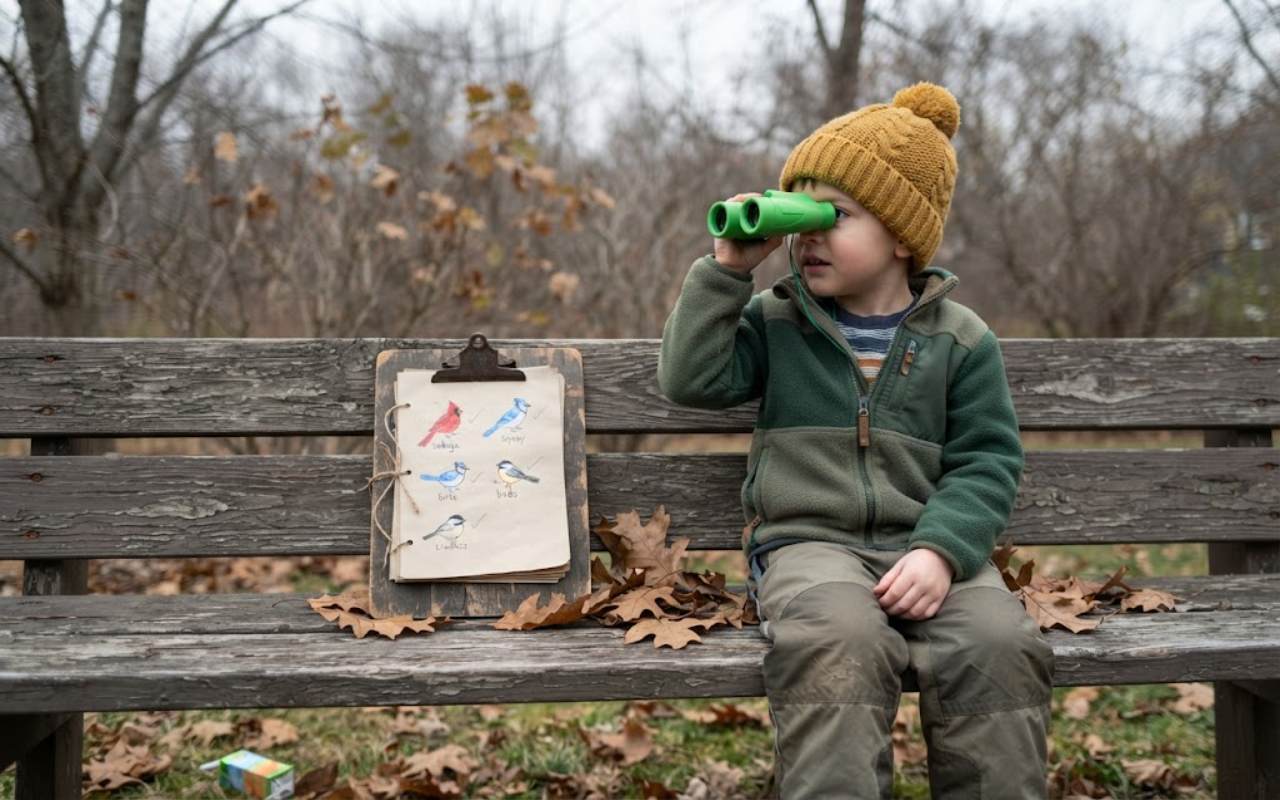
Introducing young naturalists to reliable fall bird watching with kids turns seasonal yard chores and weekend trail walks into rigorous, hands-on field science. Autumn brings massive shifts in avian physiology and navigation, creating peak windows to observe dynamic plumage changes, territorial feeding, and continental migrations right outside your door.
Many families struggle when standard birding setups fail, resulting in dropped optics, frustrated children, or empty backyard feeding stations. By shifting away from passive looking and adopting tested field methods, you can transform backyard birding into an engaging, multi-sensory scientific routine that keeps children engaged all season.
Quick-Glance Field Summary
Engaging children in autumn ornithology requires matching their physical ergonomics with durable gear while managing real ecological hazards like feeder mold and window strikes. By deploying tactile field experiments alongside sound recording tools, families can track seasonal migration changes without expensive equipment.
- Child optic baseline: 7×21 or 8×25 reverse-porro prism binoculars with a minimum 50 mm interpupillary distance adjustment
- Feeder sanitation protocol: 1:9 unscented household bleach to water dilution soak every 14 days; avoid boiling water on polycarbonate plastics to prevent warping
- Collision safety buffer: Feeders positioned strictly within 3 feet of glass panes or beyond 30 feet to eliminate fatal strike velocities
- Window grid spacing: External tempera paint or decal markers placed on a strict 2-inch by 2-inch grid to disrupt reflections
- Late-season nectar ratio: Standard 4:1 water-to-white-sugar solution until freezing, transitioning to 3:1 solution to depress freezing down to 22 degrees Fahrenheit
- Seed storage safety: Discard any clumped grain showing grey-green discoloration from Aspergillus flavus to eliminate fatal aflatoxin exposure
Hardware Calibration: Solving Kid Binocular Interpupillary Distance and Exit Pupil Frustrations
Standard adult binoculars routinely ruin birding excursions for young children. On community forums like r/birdwatching, parents frequently note that children shut one eye, complain of dark black rings, or drop heavy 8×42 roof-prism units entirely. Most adult chassis cannot bridge narrow child interpupillary distances, which often measure under 55 millimeters.
When a binocular cannot narrow sufficiently, the child sees split images rather than a unified field of view. Equipping children with compact reverse-porro prism models, such as an 8×21 or 6×21 configuration, solves this optical geometry issue immediately.
Lower magnification also widens the field of view, making it far easier for shaky hands to lock onto hyperactive autumn warblers darting through bare canopy branches.
Before heading into the field, spend ten minutes practicing target acquisition in the yard without optics. Have your child spot a stationary object, point their index finger directly at it, and then raise the binocular straight to their eyes without moving their head.
This simple neuromuscular training eliminates the frantic, disorienting scanning that leads to frustration on the trail.
| Youth Activity Name | Active Learning Mechanism | Developmental Learning Benefit | Primary Engagement Challenge |
|---|---|---|---|
| Visual Scavenger Hunt | Matching physical field marks like crests, beak shapes, and tail lengths to picture cards. | Sharpens raw shape recognition and fine spatial detail observation skills naturally. | Rapidly flying birds can frustrate toddlers if checklist sheets are too complex. |
| Vocal Sound Mapping | Sitting completely blindfolded to sketch intersecting compass lines toward bird calls. | Builds auditory processing boundaries and increases deep listening stamina. | Requires a high baseline of quiet patience that can challenge hyperactive groups. |
Backyard Foraging Chemistry: Pinecone Suet Pressing and Aflatoxin Prevention
Crafting pinecone hanging feeders is a classic autumn project, but conventional craft recipes present hidden physiological dangers to wild birds. Frequent discussions on wild bird forums warn against using sticky peanut butter spreads or soft store-bought fats during warm autumn afternoons.
Soft vegetable shortening and cheap oils smear onto avian flight feathers, destroying their insulating micro-structure and inducing lethal hypothermia during frosty autumn nights.
A safer method involves rendering pure beef kidney tallow or using cold-pressed, non-hydrogenated lard mixed with high-lipid black oil sunflower seeds. Black oil sunflower seeds provide dense caloric fats and thin outer shells that fall migrants can crack with minimal energy expenditure.
Blend the tallow with coarse cornmeal and hulled sunflower chips, pressing the stiff paste deep into open pinecone scales with your fingers.
- Raw open pinecones gathered from white pine or spruce trees, air-dried for 48 hours to open scales
- Rendered beef tallow melted at low heat and cooled to room temperature until semi-solid
- Black oil sunflower seeds and cracked corn added at a 2:1 dry ratio
- Heavy cotton twine cut to 18-inch lengths, anchored firmly under the top scales
Monitor these natural feeders closely for moisture infiltration after autumn rains. Damp conditions encourage Aspergillus flavus, a toxic fungus that generates deadly aflatoxins within warm, wet seed clusters. If a seed cone smells musty, feels slimy, or shows clumping, discard it immediately rather than risking toxicosis in visiting nuthatches and chickadees.
Window Collision Mitigation: Applying Audubon Spacing Rules to Fall Strike Zones
Fall brings an influx of inexperienced juvenile birds navigating unfamiliar migration corridors, sharply increasing fatal window strikes. Backyard forum contributors often report sudden thuds against patio doors during autumn, especially when bird feeders are placed in arbitrary yard locations. You can turn window safety into an engaging outdoor physics and art project with your children.
According to research documented by the American Bird Conservancy and Audubon, bird feeders must sit either within 3 feet of glass or farther than 30 feet away. When a feeder sits within 3 feet, a startled bird cannot build enough flight speed to sustain a fatal collision if it flies toward the glass.
At distances beyond 30 feet, birds possess sufficient clearance to bank away from false reflections of open sky and tree foliage.
Have your kids test window visibility using tempera paint markers, washable chalk pens, or external friction-tape grids. Children can map and apply the validated 2-inch by 2-inch rule across the external pane, drawing dots, vertical tracks, or autumn leaf patterns.
This visual grid breaks up the polarized mirror reflection of the sky, teaching children how light refraction affects avian perception while immediately safeguarding visiting migrants.
Acoustic Migration Monitoring: Gamifying Merlin Audio IDs and Flight Call Sonograms
Autumn bird watching can prove difficult visually because molting warblers trade bright breeding plumages for subdued, cryptic olive tones. Shifting your family approach from visual identification to bioacoustic hunting keeps kids engaged even when birds remain hidden in deep brush.
Mobile sound tools, such as the Cornell Lab Merlin Bird ID engine, allow children to watch incoming sound waves transform into real-time digital sonograms.
In backyard birding forums, experienced parents suggest running the acoustic recorder during peak morning foraging hours, typically between dawn and 9:00 AM. Turn identification into a cooperative scavenger hunt where children listen for discrete chips, trills, or flight calls before the software displays the species profile.
Children quickly learn to differentiate the harsh scold of a Carolina Wren from the metallic tinking call of a White-throated Sparrow.
- Download regional offline bird identification packs to avoid mobile service dropouts on forest trails
- Position your phone microphone toward vegetative corridors while shielding the lower port from autumn wind gusts
- Compare the real-time visual sonogram peaks on screen with the pitch and rhythm of the calls heard overhead
- Cross-reference audio hits with local field guides to verify whether the identified bird is a permanent resident or an active latitudinal migrant
Do not allow children to loop loud digital playback calls into the trees to lure birds closer. Forcing birds to defend their territory against simulated rivals wastes vital metabolic reserves that migrants require to survive long journeys. Treat the technology strictly as an acoustic microphone and learning tool, teaching ethical observation standards from the start.
Thermal Water Stations: Calibrating Sugar Ratios and Evaporation Basins for Late Migrants
Clean liquid water is often far scarcer than food during late autumn, making a well-maintained bath the most active station in your yard. As night temperatures drop, backyard birders frequently report frozen bird baths and slushy hummingbird nectar.
Managing these stations offers an exceptional platform to teach children applied physics, fluid mechanics, and seasonal animal care.
Late-lingering hummingbirds require high-energy fuel, but standard 4:1 water-to-sugar mixtures begin to freeze into unworkable slush around 27 degrees Fahrenheit. In regions experiencing early frost snaps, you can safely boil and cool a richer 3:1 sugar concentration.
This specific ratio depresses the liquid freezing point down to roughly 22 to 25 degrees Fahrenheit, keeping high-calorie sucrose available for rapid tongue uptake via elastic capillary groove mechanics.
- Clean backyard basins thoroughly using a 1:9 bleach-to-water dilution to eliminate dangerous pathogens like Salmonella and Candida albicans
- Rinse thoroughly and dry completely, avoiding boiling water baths on thin polycarbonate reservoirs that readily crack under thermal shock
- Add large, flat river stones inside the basin to provide shallow step points measuring less than 1.5 inches deep for smaller songbirds
- Never add chemical additives, anti-freeze solutions, or glycerin to water stations, as glycerin destroys feather barbules and leads to fatal exposure
To keep standard bath water from freezing without expensive heating cables, have your children float a dark, clean rubber ball inside the basin. Gentle autumn breezes roll the ball continuously across the surface, creating surface ripples that slow ice sheet formation while breaking polarized light glare for passing migrants. These subtle engineering tweaks keep your yard safe, functional, and teeming with activity all season long.