
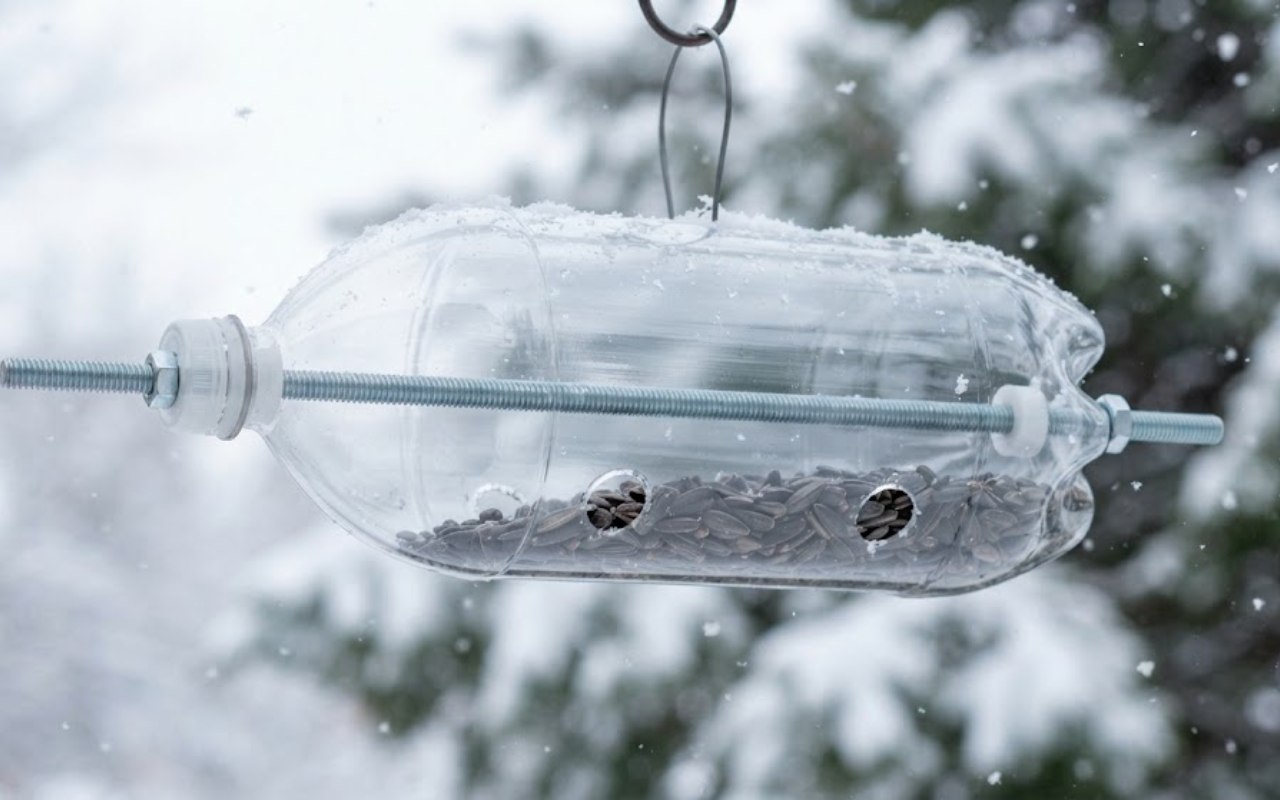
Freezing rain instantly bonds to static metal or rigid plastic substrates below 32 degrees Fahrenheit, causing commercial acrylic feeders to crack under sudden ice expansion. Assembling a flexible DIY winter bird feeder from a recycled soda bottle solves this issue completely.
When mounted on a free-spinning horizontal axle, the continuous shifting movement introduces mechanical shear stresses that crack forming ice crusts right off the cylindrical curve, keeping your seed dry and flowing freely through the worst winter cold snaps.
Quick-Glance Field Summary
This rotating feeding rig uses the smooth curves of a plastic container mounted along a horizontal axis to prevent glaze ice from locking food access ports. The assembly forces ice to shear along rotational balance lines while shielding dry seed from high-humidity winter winds.
- Outer shroud: Standard 2-liter polyethylene terephthalate (PETE 1) soda bottle
- Axle shaft: 0.1875-inch (3/16-inch) zinc-plated threaded steel rod, 14 inches in length
- Bearing spacers: 0.25-inch inner diameter nylon sleeve bushings
- Feeding port clearance: Two 0.375-inch (3/8-inch) circular holes drilled 1.5 inches above bottle base
- Weather shield clearance: Minimum 2.5 inches of overhang past the main feeding apertures
- Thermal operational threshold: Functional down to -20 degrees Fahrenheit without structural failure
How to Keep a DIY Bird Feeder From Freezing in Winter
Freezing rain instantly bonds to static surfaces when incoming liquid water drops hit cold metal or rigid plastic substrates below 32 degrees Fahrenheit. Posts on the BirdForum winter feeding board regularly note that rigid commercial acrylic feeders crack under sudden ice expansion, whereas flexible plastic bottles bend slightly without rupturing.
A horizontal bottle mounted on a free-spinning central axle changes the surface angle continuously whenever perching birds land or winter winds push against the outer ridges.
This motion introduces mechanical shear stresses between the flexible plastic wall and the forming ice crust. Because thin sheet ice has weak tensile strength when bent across a cylindrical curve, the glaze cracks and drops off instead of forming an unbroken shell.
- Coat the outer bottle body with a dry food-grade silicone spray to lower surface energy and stop ice sheet adhesion.
- Avoid rough sanding or scoring of the bottle exterior, as micro-grooves give freezing rain secure mechanical purchase points.
- Maintain a minimum internal clearance of 0.0625 inches around all rotational pass-through points to ensure small frost crystals cannot jam the axle.
Applying these physical clearances prevents total freeze-up during prolonged winter precipitation events.
Where to Place Hanging Rig Hardware to Stop Winter Wind Damage
High winter winds turn suspended bird feeders into wild pendulums, throwing seed onto snowbanks and driving freezing moisture straight into access ports. Builders on the r/birding community frequently report that hanging lightweight plastic feeders from flexible nylon paracord causes severe line wrapping around tree limbs during January blizzards.
Rigid bracket framing provides far greater mechanical resistance to crosswinds than loose rope or monofilament ties. Mounting the horizontal spin feeder directly inside a rigid rectangular wooden or PVC pipe frame stabilizes the entire assembly.
This perimeter frame should be anchored securely to a solid 4×4-inch wooden post rather than dangling freely from high tree branches.
- Orient the horizontal axle parallel to prevailing winter winds to minimize the surface area hit by incoming horizontal gusts.
- Keep the entire spinner unit between 5 and 6 feet above ground level to prevent snowdrifts from burying the lower rotational arc.
- Install the assembly at least 10 feet away from dense roof eaves where falling icicles or sliding snow loads can crush the plastic shroud.
Securing the rig within these structural boundaries isolates the rotating core from wind-driven mechanical fatigue.
Best Recycled Plastic Options for Cold Weather Durability
Material selection determines whether a plastic container survives freezing weather or fractures on impact from winter perching birds. Most consumer soda bottles use polyethylene terephthalate, labeled under recycling code 1, which retains impact flexibility down to -40 degrees Fahrenheit.
Conversely, clear polystyrene containers, often used for disposable deli packaging, turn brittle and shatter when subjected to sub-freezing point impacts.
High-density polyethylene containers, such as translucent milk jugs, offer high cold endurance but lack the glass-like transparency required for visual monitoring of internal seed levels. Thick-walled carbonated beverage bottles handle internal air pressure up to 150 psi, which translates into heavy structural sidewall resistance against winter storms.
- Choose smooth-walled 2-liter soda bottles over deeply contoured water bottles to eliminate ice catch basins.
- Check the bottle base for the standard triangular recycling stamp showing the number 1 code.
- Avoid using thin single-use plastic water bottles because their walls crush inward under moderate ice weight.
The uniform wall thickness of standard soda containers ensures reliable structural stability throughout repeated freeze-thaw cycles.
How to Modify Gravity Feed Ports to Prevent Seed and Nectar Spoilage
Moisture migration into internal seed reservoirs leads to fungal development and clumps the seed, which completely blocks the ports. Community members on the BackyardChickens forum note that open feed troughs act as funnels for blowing sleet, turning cracked corn and sunflower seeds into useless frozen slush.
Eliminating open grain bays preserves internal food stores even during heavy freezing mist.
Drilling precise, hooded intake holes along the lower third of the horizontal bottle ensures food remains shielded from falling precipitation. Adding interior baffle washers limits the volume of seed exposed directly behind each hole, stopping moisture from wicking throughout the entire internal dry mix.
- Drill two 0.375-inch feed holes on the bottle bottom, placing them 180 degrees opposite the windward approach side.
- Bore three 0.125-inch weep holes along the lowest bottle ridge to allow internal condensation to escape freely.
- Install thin rubber gaskets cut from old inner tubes around the central axle entry holes to block moisture leaks.
These drainage and baffling modifications maintain dry internal conditions during sleet and melting ice cycles.
How to Build a Weatherproof DIY Winter Bird Feeder
Assembling the rotating freezing-rain feeder requires basic shop hand tools, standard threaded steel rod, and matching hardware fasteners. Clean and completely dry a smooth 2-liter soda bottle, removing all labels and residual glue with isopropyl alcohol before beginning assembly.
Follow this sequential fabrication process to ensure exact axle alignment and balanced rotational symmetry.
- Measure and mark the exact dead-center of the plastic bottle cap and the center of the indented bottom base.
- Drill a 0.25-inch diameter hole through both marked points using a high-speed steel brad-point bit running at low RPM.
- Thread one 0.1875-inch steel rod through the bottle cap, running it lengthwise through the bottle interior and out the bottom hole.
- Thread a zinc washer, a nylon spacer bushing, and a standard hex locking nut onto each exterior end of the rod.
- Tighten the locking nuts until they sit flush against the nylon bushings, leaving 0.03125 inches of end-play so the bottle spins freely on the axle.
- Drill the dual 0.375-inch feed ports 1.5 inches away from the bottom ridge on opposite sides of the bottle circumference.
- Secure the protruding ends of the threaded rod into an external U-shaped wooden frame using standard eye bolts and lock washers.
Once mounted onto the support frame, test the bottle manually to confirm that it spins smoothly on the nylon bushings. The finished feeder will deflect ice buildup, protect the internal seed from moisture, and provide wild birds with accessible food throughout severe winter weather.
Common Winter Bird Feeder Troubleshooting Questions
Why does my bird seed clump and freeze inside the feeder?
Seed clumps when blowing sleet enters open feeding ports or when cold rain mixes with ambient humidity inside the reservoir. Without dedicated bottom weep holes, this trapped moisture pools in the base, triggers fungal development, and turns the seed core into a solid block of frozen slush during overnight drops.
Will freezing temperatures crack plastic beverage bottle feeders?
Standard code 1 PETE plastic soda bottles are highly durable and retain their structural impact flexibility down to -40 degrees Fahrenheit. They will easily withstand repeated freeze-thaw cycles without shattering, unlike rigid polystyrene deli plastics or thin single-use water bottles which turn brittle and crack under ice weight.
Can cooking spray keep bird feeder ports from freezing shut?
Never apply cooking sprays, glycerin, or petroleum jelly to any part of a bird feeder. If these non-evaporating oily residues rub off onto visiting birds, they coat the delicate feather barbules, collapse the plumage’s natural dead-air insulation layer, and cause the bird to die rapidly from cold exposure.