Learning how to attract birds to an apartment balcony comes down to solving three high-rise challenges: zero natural tree cover, wind gusts that toss lightweight gear, and strict landlord cleanliness rules. Unlike a ground-level yard, an elevated balcony lacks insects and berries, meaning passing chickadees, finches, titmice, and hummingbirds need clear visual cues, wind-stable perches, and fresh water before they will drop down to visit.
By pairing shell-free foods with heavy-duty railing brackets or suction-cup window feeders rated for wind, plus potted native plants for hawk cover, you can build a thriving, easy-to-clean balcony bird station on almost any floor.
Quick-Glance Summary: Best Balcony Bird Attractants by Setup Type
| Balcony Upgrade | Best Mounting Style | Target Bird Species | Key High-Rise & Safety Rule |
|---|---|---|---|
| 1. Shell-Free Hulled Seed | Tray, tube, or window feeder | Finches, chickadees, cardinals, nuthatches | Eliminates dropped shells on neighbors’ balconies below |
| 2. Suction-Cup Window Feeder | Direct exterior glass mount | Chickadees, titmice, wrens, house finches | Clean glass with rubbing alcohol; mount within 3 feet |
| 3. Railing-Clamp Shepherd’s Hook | Deck railing C-clamp (no drilling) | Goldfinches, woodpeckers, warblers | Angle feeder inward over your own balcony floor |
| 4. Shallow Railing Birdbath | Clamp-on basin with solar dripper | Robins, bluebirds, warblers, cedar waxwings | Keep water depth at 1 to 2 inches; scrub twice weekly |
| 5. Potted Shrubs & Perennials | Rail planters & weighted floor pots | Hummingbirds, sparrows, migrating warblers | Creates essential hawk cover and landing perches |
| 6. High-Contrast Window Markers | Exterior white decals or paracord | All balcony visitors | Space markers 2 inches apart vertically by 4 inches horizontally |
1. Switch Exclusively to Shell-Free Hulled Bird Seed
The number one reason apartment managers ban bird feeders is discarded sunflower shells and sprouted millet piling up on lower balconies. Using hulled bird seed eliminates 100 percent of shell debris because songbirds eat the entire kernel.
- Best Shell-Free Seeds. Stock hulled sunflower hearts (or fine sunflower chips), shelled peanut splits, and hulled white proso millet.
- Built-In Cost Efficiency. While hulled seeds cost slightly more per pound than in-shell black oil sunflower seeds, you pay nothing for inedible hulls and avoid sweeping shell piles off your deck every afternoon.
2. Mount a Heavy-Duty Suction-Cup Window Feeder
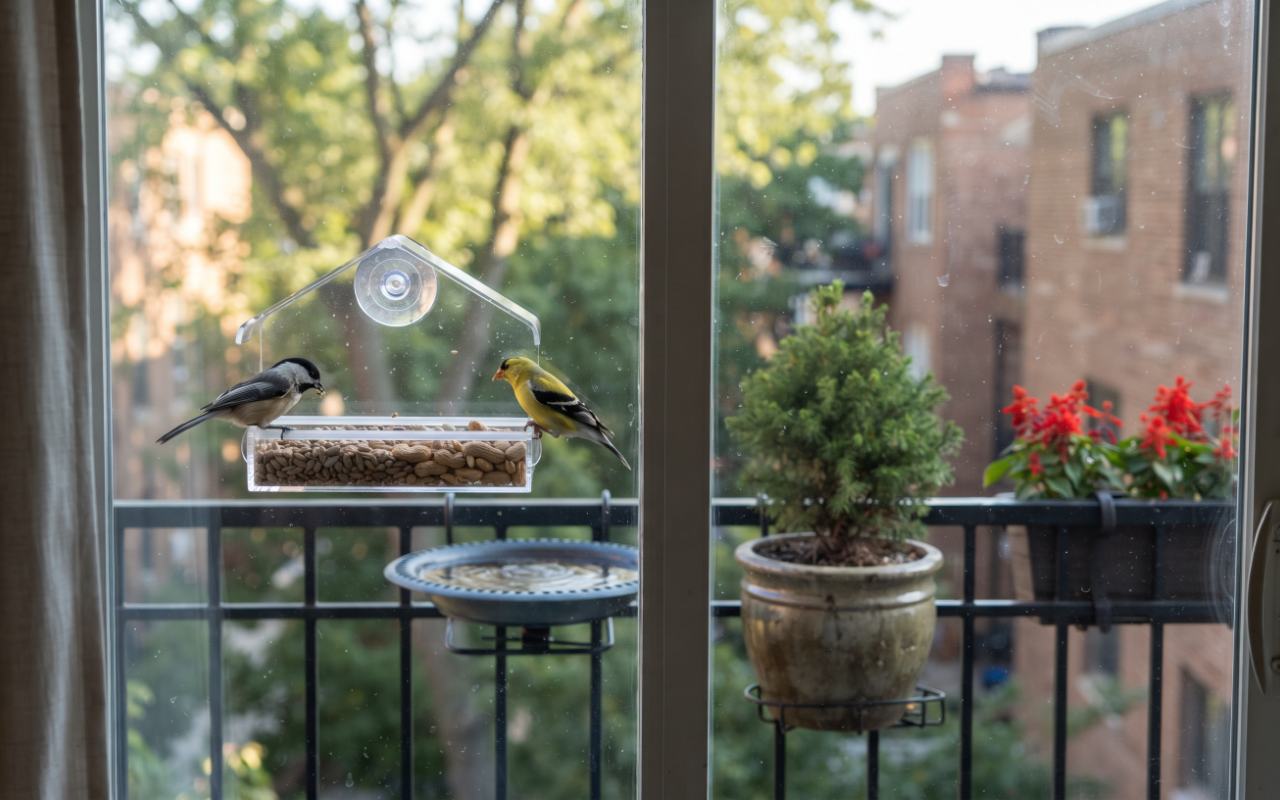
If your lease prohibits clamping hardware onto balcony railings, a clear acrylic window feeder attached directly to your sliding glass door or living room window offers zero-footprint installation and close-up viewing.
- Proven Wind-Resistant Models. Standard two-cup feeders often pop loose when overnight temperatures drop or wind gusts hit 15+ mph. Choose a multi-cup feeder with a removable slide-out tray and drainage holes, such as the Nature’s Hangout Window Bird Feeder (which uses three heavy-duty suction cups and a slide-out tray) or the Nature’s Way Clear View Window Feeder (which lifts off four mounted suction cups for fast washing).
- Preventing Suction Failures. Clean the exterior glass with 70% isopropyl rubbing alcohol first, warm the suction cups in lukewarm water, and press out every air bubble before filling.
- Built-In Window Safety. Placing a feeder directly on the glass keeps birds within 3 feet of the pane, meaning startled birds cannot build up enough flight speed to suffer fatal glass collisions.
3. Use No-Drill Railing Clamps Oriented Inward
Adjustable C-clamp deck hooks and railing brackets attach tightly to metal or wood balcony rails without drilling holes or risking your security deposit.
- Check Railing Width & Weight Limits. Most standard balcony C-clamps fit horizontal top rails up to 2 to 2.5 inches thick and safely hold 10 to 15 pounds. Measure your top railing before ordering, and place a thin rubber furniture pad between the clamp screw and painted aluminum rails to prevent scratches.
- The Inward-Angle Rule. Always angle your clamp hook so the feeder hangs over your own balcony floor rather than dangling out over the exterior edge. Keeping the feeder inside your balcony perimeter ensures any stray seed crumbs land on a washable mat on your deck instead of drifting down onto downstairs neighbors.
4. Lay a Washable Catchment Mat and Follow a Sanitization Schedule
Even when using shell-free sunflower hearts, enthusiastic feeders like House Finches and chickadees still flick tiny seed crumbs aside while sorting for favorite pieces, and close-quarter balcony feeders can spread avian conjunctivitis or salmonellosis if left unwashed.
- Easy Cleanup Setup. Lay a small, hose-washable outdoor runner mat directly beneath your hanging feeder, or attach a snap-on seed catcher tray to the bottom of tube feeders.
- Feeder Sanitization Cadence. Following Birds Canada feeding best practices, wash seed and suet feeders every 1 to 2 weeks with warm soapy water, then disinfect by soaking for 10 minutes in a diluted bleach solution (1 part bleach to 9 parts water), rinsing thoroughly, and letting them dry completely before refilling.
- Safe Balcony Droppings Removal. Avoid pouring strong liquid bleach onto apartment concrete or composite decking, as runoff can drip onto downstairs neighbors’ plants. Instead, spray deck droppings with a bird-safe enzymatic cleaner or a 1:1 white vinegar and water soak for 5 minutes before wiping clean with paper towels.
5. Add a Clamp-On Railing Birdbath with Moving Water
High-rise birds spot shimmering water from hundreds of feet away, making a shallow railing-mounted birdbath one of the strongest magnets for migrating warblers, orioles, and robins that ignore seed feeders.
- Best Balcony Water Setup. Choose a shallow metal or heavy-duty resin railing basin (1 to 2 inches deep) and add a small solar-powered fountain bubbler or battery-operated water wiggler. Moving water ripples catch sunlight, draw birds down from nearby treetops, and prevent mosquitoes from laying eggs.
- High-Floor Wind Tip. On breezy upper floors, keep the water level half an inch below the rim and weigh down lightweight plastic basins with two smooth river stones so wind gusts do not slosh water over the edge. Refresh water every 2 days and scrub the basin weekly.
6. Create Vertical Cover with Weighted Potted Evergreens and Shrubs
A bare concrete balcony feels exposed to passing songbirds, which constantly scan the sky for Cooper’s Hawks and Peregrine Falcons. Adding container plants turns an open ledge into a safe staging area while blocking hawks from using your open railing as an ambush perch.
- Best Container Plants. Place a potted dwarf Alberta spruce, arborvitae, or boxwood in a heavy ceramic or weighted resin pot (lightweight plastic pots tip over easily in high-rise wind gusts) so chickadees and titmice have dense branches to land on before hopping over to your feeder.
- Native Nectar Flowers. Secure railing planters with zip ties or under-rail brackets and fill them with red salvia, cardinal flower, coral honeysuckle, or native columbine to attract Ruby-throated Hummingbirds even on 10th- to 15th-floor balconies.
7. Offer No-Melt Suet Nuggets or Bark Butter Plugs
Suet is a calorie-dense winter and spring staple that produces zero seed hulls and attracts clinging birds like Downy Woodpeckers and White-breasted Nuthatches.
- Balcony-Friendly Formats. Instead of greasy raw suet blocks that can drip onto concrete in warm sun, offer no-melt suet nuggets mixed into a shallow tray or press spreadable bark butter into the holes of a wooden suet log feeder.
8. Use High-Contrast Window Markers to Prevent Collisions
Large balcony sliding doors act like mirrors reflecting sky and nearby trees, creating a severe collision hazard for visiting songbirds. According to U.S. Fish & Wildlife Service glass collision guidelines, breaking up exterior reflections is essential wherever feeders draw birds near glass.
- Why High-Contrast Markers Beat UV-Only Decals. While static-cling UV decals work in bright midday sun, urban bird-safe glass guidelines note that UV-only stickers lose visibility during low-UV early morning hours when songbird collisions peak. Apply high-contrast white or frosted exterior decals, tempera paint dots, or hanging Zen wind curtains (1/8-inch paracord strips) spaced no more than 2 inches apart vertically and 4 inches horizontally (or 2 by 2 inches to protect tiny hummingbirds and kinglets).
9. Hang a Saucer Hummingbird Feeder for High-Floor Balconies
If you live above the fifth floor, ground-foraging birds like Mourning Doves and juncos rarely climb that high, whereas Ruby-throated Hummingbirds and House Finches routinely patrol upper-story balconies (documented up to 16 to 20+ stories high) in search of nectar and seeds.
- Preventing Wind Leaks. Choose a flat saucer-style hummingbird feeder (such as the Aspects HummZinger Mini or HummZinger HighView) rather than a tall inverted bottle feeder. Inverted bottle feeders rely on internal vacuum pressure that frequently leaks sticky sugar water onto balcony floors when wind rocks the feeder or afternoon sun warms the air inside.
- Simple Nectar Formula. Mix 1 part plain white granulated sugar with 4 parts boiled, cooled water (1/4 cup sugar to 1 cup water) with zero red dye. Clean and refill every 3 to 4 days (every 1 to 2 days in hot summer weather).
10. Serve Rehydrated Mealworms for Bluebirds, Wrens, and Robins
Offering mealworms brings insect-eating birds to your balcony without scattering seed hulls.
- How to Serve Them. Place live mealworms, or freeze-dried mealworms soaked in warm water for 10 minutes, inside a small, smooth-sided ceramic cup clamped to your railing. Carolina Wrens, Eastern Bluebirds, and mockingbirds quickly learn to check mealworm cups every morning.
11. Use 1.5-Inch Caged Feeders or Short Perches to Deter Pigeons
Large flocks of feral pigeons can overwhelm a small balcony feeder and trigger sanitation complaints from property management.
- Pigeon-Proofing Adjustments. Skip cracked corn, bread, and wide open platform trays, which attract pigeons immediately. Stick to compact tube feeders with short perches, caged feeders with 1.5-inch wire mesh spacing (which admits chickadees, finches, and nuthatches while physically blocking bulky pigeons), or small window-mounted feeders.
12. Start with One Compact Station and Secure Everything Against Wind
Before buying multiple feeders, review your building’s HOA or lease rules regarding balcony attachments, exterior visibility, and weight limits.
- Wind-Safe Starter Setup. Start with a single three-suction-cup window feeder filled with hulled sunflower hearts and a small stone-weighted railing water dish. Always attach a short safety tether (such as a braided stainless-steel lanyard) from hanging feeders to your railing so a sudden storm gust can never send a feeder falling below.
Frequently Asked Questions
How high up will backyard birds fly to visit an apartment balcony?
Small songbirds such as chickadees, finches, nuthatches, and hummingbirds routinely visit balconies up to the 5th through 10th floors, especially when nearby trees reach mid-building height or when moving water and bright flowers are visible. Urban birding records have documented House Finches visiting feeders above the 20th floor and Ruby-throated Hummingbirds patrolling balconies up to 16 stories high.
What is the best bird seed for an apartment balcony with minimal mess?
Hulled sunflower hearts (or fine sunflower chips) are the best low-mess bird seed for apartment balconies because the outer shells are already removed. Birds eat 100 percent of the kernel, eliminating discarded shells that blow onto neighboring patios or clog balcony drains, while a small washable mat underneath catches any stray crumbs.
How do I keep pigeons away from my apartment balcony bird feeder?
Avoid scattering seed on the floor or using wide open trays, and never put out cracked corn or bread. Instead, use vertical tube feeders with short perches, caged feeders with 1.5-inch wire spacing, or small suction-cup window feeders filled with sunflower hearts or nyjer seed, which allow lightweight songbirds to perch while excluding heavy pigeons.