These 10 no-tools DIY bird feeders take 5 minutes or less to assemble and hang using everyday household items you already own, with zero drills, saws, hammers, glue, or scissors required.
Whether you want to welcome migrating songbirds before work, test which seed blends your yard prefers, or set up a quick feeding station on a rental balcony, each design hangs securely using built-in handles, center funnels, or simple knots.
Every feeder below uses wildlife-safe materials (avoiding sticky honey, bread, sharp metal edges, and stretchy produce netting) and includes field-tested stability notes so birds feed safely from day one.
Quick-Glance Summary: 10 Instant No-Tools DIY Bird Feeders
| No-Tools Feeder Idea | Time | Wind & Rain Rating | Top Visiting Birds |
|---|---|---|---|
| 1. Wire Whisk Suet & Peanut Cage | 3 mins | High (drains & grips in wind) | Downy Woodpeckers, chickadees, nuthatches |
| 2. Bundt Pan or Ring Mold Platform | 3 mins | Moderate (best under porch eave) | Cardinals, Blue Jays, grosbeaks, orioles |
| 3. Cooling Rack Vertical Cling Wall | 3 mins | High (flush against trunk/post) | Woodpeckers, Blue Jays, nuthatches, titmice |
| 4. Tilted Ceramic Coffee Mug Feeder | 2 mins | High (deep bowl shields seed) | Chickadees, nuthatches, titmice, wrens |
| 5. Mesh Strainer Drainage Tray | 2 mins | High (instant rain drainage) | Cardinals, juncos, finches, doves |
| 6. Teacup & Saucer Rain-Shield Cradle | 4 mins | Moderate (3-cord cradle holds steady) | Bluebirds, Carolina Wrens, chickadees |
| 7. Mason Jar Lid Mini Mealworm Cup | 4 mins | Moderate (best for sheltered hook) | Eastern Bluebirds, wrens, mockingbirds |
| 8. Deep Soup Ladle or Slotted Spoon Scoop | 2 mins | High (slotted bowl sheds rain) | American Goldfinches, House Finches, chickadees |
| 9. Pinecone & Seed-Butter Drop | 4 mins | High (scales lock seed in place) | Nuthatches, woodpeckers, pine siskins |
| 10. Whole Apple or Pear Skewer Branch | 3 mins | High (wedged tight on stout twig) | Baltimore Orioles, Cedar Waxwings, robins |
1. Wire Whisk Suet and Peanut Cage
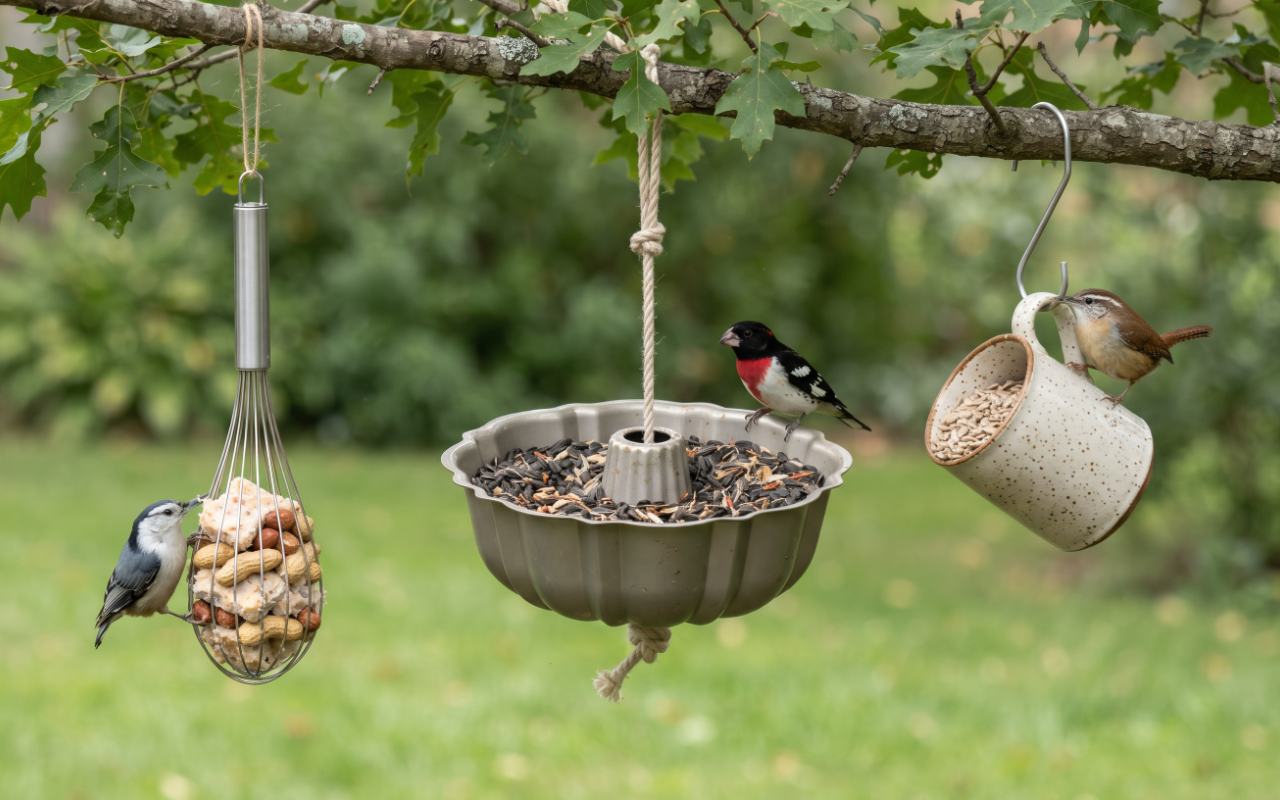
A standard stainless-steel balloon whisk already has flexible wire loops designed to hold food securely while letting clinging birds grip from every angle.
- Time & Gear. 3 minutes | 1 balloon wire whisk and 1 pre-cut 12-inch length of cotton twine or a metal S-hook.
- How to Assemble & Hang. Gently spread two adjacent wire tines apart with your fingers and push chunks of commercial suet cake, shelled unsalted peanuts, or hardened suet-oat balls into the center cavity until the wires snap back closed. Thread twine through the hanging loop at the end of the whisk handle and suspend from a tree limb.
- Field-Test Note. Because metal wires conduct cold in winter and heat in summer, stick to coated stainless-steel whisks and stuff the wires with untreated dry moss in spring so chickadees and titmice can pull nesting material through the gaps.
2. Bundt Pan or Ring Mold Platform Feeder
Metal or silicone fluted tube pans have a built-in center chimney that makes hanging level effortless with a single piece of rope, requiring zero drilling or cutting.
- Time & Gear. 3 minutes | 1 fluted Bundt pan or ring mold and 1 pre-cut 30-inch cotton rope.
- How to Assemble & Hang. Thread the rope straight up through the center funnel of the pan, tie a bulky double overhand stopper knot underneath the bottom opening so it cannot slip back through the tube, and tie the top end over a sturdy branch. Fill the circular trough with black oil sunflower seeds, safflower seeds, or halved grapes.
- Field-Test Note. In gusty wind, a single center rope allows the pan to rotate slowly without tipping over, which actually helps deter heavy squirrels from jumping onto the rim. Hang it under a covered porch eave or dense evergreen branch so rainwater does not collect in the solid trough.
3. Cooling Rack Vertical Cling Wall
A standard wire baking cooling rack hung vertically against a fence post or tree trunk mimics natural furrowed bark for woodpeckers and nuthatches.
- Time & Gear. 3 minutes | 1 metal wire cooling rack, 1 pre-cut 24-inch cotton cord, and suet cakes or whole unsalted in-shell peanuts.
- How to Assemble & Hang. Tie the two ends of the cord to the top two corners of the wire rack and hang it flush against a fence hook, nail, or rough tree trunk. Wedge suet chunks or whole in-shell peanuts firmly between the grid squares (or sandwich a suet cake between two small racks tied together).
- Field-Test Note. Resting the bottom edge of the rack against a tree trunk stops the feeder from swinging when Downy or Hairy Woodpeckers drum against the suet.
4. Tilted Ceramic Coffee Mug Feeder
A sturdy ceramic mug with a wide D-shaped handle hangs naturally at a slight horizontal tilt when suspended by its handle, turning an unused cupboard mug into a weather-sheltered nook for small songbirds.
- Time & Gear. 2 minutes | 1 heavy ceramic mug (12 to 16 oz) and 1 metal S-hook or pre-cut 18-inch cotton twine.
- How to Assemble & Hang. Press a firm mixture of plain unsalted peanut butter, cornmeal, and hulled sunflower hearts into the bottom half of the mug so seeds stay put while tilted. Loop twine tightly through the mug handle (or clip an S-hook directly onto the handle) and hang from a branch or shepherd’s hook.
- Field-Test Note. Choose a heavy stoneware mug with a thick rolled rim rather than thin porcelain so chickadees and nuthatches get a secure foothold and light breezes do not spin the cup.
5. Mesh Strainer Drainage Tray
Kitchen wire mesh strainers are among the most practical instant bird feeders you can hang because built-in drainage holes keep birdseed dry after rainstorms.
- Time & Gear. 2 minutes | 1 wire mesh strainer (with handle and opposite resting hook) and 1 pre-cut 24-inch cotton twine.
- How to Assemble & Hang. Tie one end of the twine to the strainer’s main handle and the other end to the small opposite resting loop on the rim so the bowl hangs horizontally. Fill with black oil sunflower seeds, safflower seeds, or white proso millet.
- Cleaning Advantage. Lift the strainer down once a week and rinse it under a garden hose in 10 seconds to prevent mold buildup.
6. Teacup and Saucer Rain-Shield Cradle
Using a three-strand knotted hanger cradle locks both a teacup and an overhead saucer in place without drilling holes in ceramic or risking unstable center-knot balancing.
- Time & Gear. 4 minutes | 1 handled teacup, 1 small saucer, and 3 pre-cut 24-inch cotton cords (no scissors needed).
- How to Assemble & Hang. Tie all three cords together at the top with an overhand knot. Slide the teacup into the bottom of the three-cord cradle, tying a second set of three overhand knots around the cords 4 inches above the cup rim. Set the saucer flat on top of those three upper knots so it acts as a stable overhead rain roof, and fill the cup below with soaked mealworms or hulled sunflower chips.
- Field-Test Note. Using three spaced cords around the saucer perimeter keeps the roof level in wind so it never tilts or dumps seeds.
7. Mason Jar Lid Mini Mealworm Cup
A two-piece metal canning jar band and flat disc snap together by hand into a shallow, rust-resistant dish ideal for serving mealworms to bluebirds and wrens.
- Time & Gear. 4 minutes | 1 wide-mouth canning jar ring and flat lid, plus 3 pre-cut 12-inch cotton cords.
- How to Assemble & Hang. Press the flat lid inside the threaded metal band. Knot all three pre-cut cords together at the top, then loop each bottom strand evenly around the underside rim of the jar band using a simple lark’s head hitch (pulling tight so the band sits level). Fill with live or rehydrated mealworms.
8. Deep Soup Ladle or Slotted Spoon Scoop
A long-handled metal soup ladle or slotted serving spoon with a hanging hole at the top of the handle becomes a sleek single-bird feeding station in under two minutes.
- Time & Gear. 2 minutes | 1 deep soup ladle or slotted spoon with a handle hole, and 1 metal S-hook or pre-cut 12-inch twine.
- How to Assemble & Hang. Clip an S-hook straight through the hanging hole at the top of the handle (or thread twine through it), hang it from a low branch, and fill the bowl with hulled sunflower chips or dried mealworms. Slotted spoons work especially well because rainwater drains straight through the slots.
9. Pinecone and Seed-Butter Drop
Open dry pinecones need zero tools or prep because their woody scales naturally lock seed butter and sunflower hearts in place.
- Time & Gear. 4 minutes | 1 large open dry pinecone, 1 pre-cut 12-inch cotton twine, 2 tbsp plain unsalted peanut butter or sunflower seed butter, and 1/2 cup sunflower chips.
- How to Assemble & Hang. Wrap twine twice around the top scales of the pinecone and tie a tight square knot. Spread seed butter into the open scales with a butter knife, roll the cone in sunflower chips, and tie the twine over a branch.
- High-Heat Swap. During summer temperatures above 80°F (27°C), use a no-melt commercial suet dough instead of peanut butter so the binder does not soften and drip.
10. Whole Apple or Pear Skewer Branch
If you have fruit trees or yard shrubs with sturdy upward-pointing twigs, you do not even need string because spearing firm fruit onto a stout twig feeds orioles, waxwings, and mockingbirds instantly.
- Time & Gear. 3 minutes | 1 firm apple, pear, or halved orange, and a sturdy, blunt-tipped tree branch or wooden garden stake.
- How to Assemble & Hang. Push a halved orange (cut-side facing outward) or a cored apple onto a stout, upward-angled twig 5 to 6 feet off the ground so the fruit locks securely against the bark. Replace the fruit every 2 to 3 days before it ferments or attracts wasps.
4 Essential Safety & Placement Rules for Instant DIY Feeders
Even a 5-minute homemade feeder needs safe placement and basic hygiene to keep backyard birds healthy:
- Follow the 3-Foot Window Rule. According to Cornell Lab of Ornithology window collision guidelines, hang feeders within 3 feet of a window (or more than 30 feet away) so startled birds cannot build up enough flight speed to suffer lethal glass strikes.
- Leave 10 to 12 Feet from Ground Shrubs. Place hanging feeders 5 to 6 feet high and at least 10 to 12 feet away from dense ground-level bushes so outdoor cats cannot ambush feeding birds, while keeping elevated tree branches nearby for quick hawk cover.
- Never Use Honey, Bread, or Plastic Mesh Bags. According to wildlife rehabilitators and avian safety guidelines (including National Audubon Society feeding recommendations), sticky honey can damage bird feathers and encourage fungal growth, bread offers empty calories without vital fats or protein, and stretchy plastic produce bags can trap birds’ claws and toes.
- Clean or Replace Feeders Regularly. Wash reusable mugs, strainers, and ladles every 1 to 2 weeks (or weekly during wet weather) with hot soapy water or a diluted 1-part bleach to 9-parts water soak, rinsing thoroughly and drying completely before refilling. Compost disposable pinecones or fruit halves after 5 to 7 days so wet seed never turns moldy.
Frequently Asked Questions
What is the fastest homemade bird feeder you can make without tools?
A kitchen mesh strainer or deep slotted spoon is the fastest no-tools DIY bird feeder. Simply tie pre-cut twine to the handle (and opposite rim loop on a strainer), fill with black oil sunflower seeds, and hang it on a branch in under 2 minutes, with built-in drainage holes that keep seeds dry after rain.
Can I use peanut butter on a no-tools DIY bird feeder?
Yes, plain unsalted peanut butter is safe and high in energy for wild birds when spread thinly or mixed with dry ingredients. Mixing 1 part peanut butter with 5 parts cornmeal (or rolling spread peanut butter in hulled sunflower chips and rolled oats) keeps the texture crumbly so birds swallow easily.
How do I keep squirrels off a quick hanging DIY bird feeder?
Hang your feeder from a smooth metal shepherd’s hook fitted with a wrap-around squirrel baffle (mounted 4 to 5 feet off the ground) and keep the feeder at least 8 to 10 feet away from jumping launch points like fences, deck railings, and tree trunks. Filling the feeder with safflower seeds also deters squirrels, since squirrels dislike safflower’s bitter taste while cardinals, chickadees, and titmice eat it readily.