
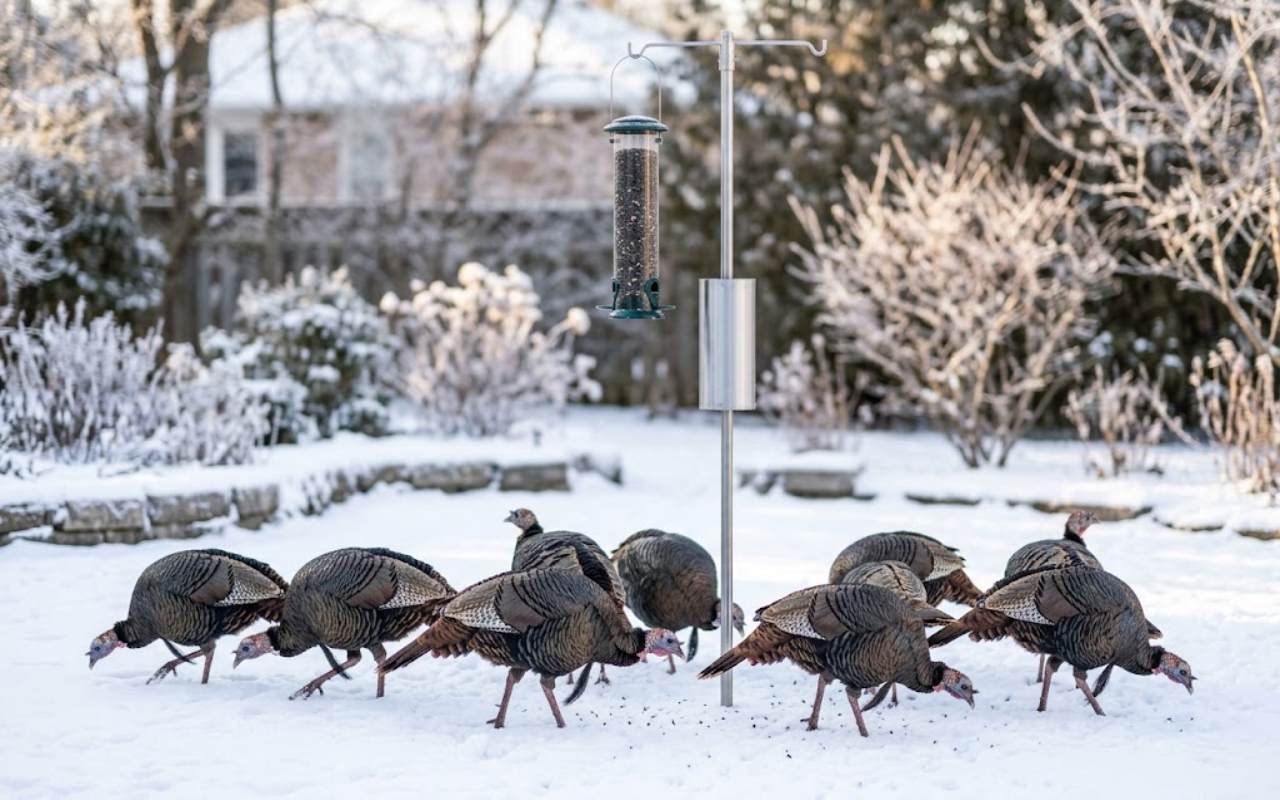
Learning how to keep wild turkeys away from bird feeders this winter is one of the most common challenges backyard birders face as temperatures plunge. When deep snow covers their natural foraging grounds in fields and woodlands, these massive birds quickly learn that residential feeding stations offer an effortless daily buffet.
While a solitary turkey strolling through the woods looks picturesque, a winter flock of twenty birds can decimate your birdseed supply in minutes and push smaller songbirds completely out of the area. Taking control of the situation requires practical adjustments to your feeding routine, smart yard maintenance, and persistent hazing before habits fully form.
Rethinking Your Winter Feeder Setup and Seed Choices
Turkeys are ground-foraging birds that rarely exert energy climbing or perching on small contraptions if they can avoid it. Most winter turkey invasions start because seed accumulates under elevated bird feeders where finches and sparrows carelessly kick it out. Eliminating that carpet of dropped food removes the primary temptation that draws the flock to your property every morning.
Switching up your feed offerings also makes a substantial difference in how appealing your yard seems to a hungry flock. Certain grains function as high-value magnets for wild turkeys, whereas other seeds are completely ignored by them. Consider swapping out problematic feeds for varieties that songbirds love but turkeys actively avoid:
- Safflower seed, which has a bitter outer shell that turkeys and squirrels generally dislike.
- Nyjer seed, also known as thistle, served in narrow mesh socks or finch tube feeders.
- Plain suet cakes suspended in upside-down cages that force birds to cling from below.
- High-grade black oil sunflower seeds placed exclusively inside hopper feeders equipped with broad spill trays.
Avoid economy seed mixes that contain significant percentages of cracked corn, wheat, oats, or red milo. Cracked corn is notoriously irresistible to turkeys, and scattering it anywhere near the ground guarantees return visits.
If your target songbirds still spill seeds, install wide hopper catch-trays directly beneath your hanging stations to capture stray hulls and kernels before they hit the snowpack.
Managing Ground Debris and Natural Winter Food Sources
Bird feeders are rarely the only nutritional source keeping wild turkeys anchored to your property throughout the winter. Turkeys possess remarkable spatial memory, and they consistently return to residential lots where mature trees drop mast crops in the autumn. Identifying and eliminating these auxiliary food sources will make your yard far less attractive.
During late autumn and early winter, raking up fallen nuts and fruits prevents turkeys from scratching through the snow layer on your lawn. Pay close attention to these specific natural food sources that commonly sustain winter flocks:
- Acorns dropped by red and white oak varieties.
- Hickory nuts and beechnuts scattered across wooded borders.
- Soft fruits left clinging to ornamental crabapples, serviceberries, and hawthorns.
- Lingering compost piles containing discarded kitchen produce and grain scraps.
If you maintain a home compost system, ensure it is fully enclosed within a secure, rigid bin rather than left as an open heap. Turkeys will gladly tear through loose compost looking for rotting vegetables, seeds, and insects. Clearing these natural windfalls before the first sustained snowfall deprives the flock of a secondary reason to loiter.
Physical Barriers and Yard Modification Strategies
While wild turkeys can fly short distances to roost in mature trees overnight, they prefer to travel and forage on foot to conserve critical calories. You can exploit this biological preference by installing physical barriers that interrupt their walking lanes. Even modest structural barriers can redirect a flock toward easier travel corridors along your neighborhood perimeter.
Fencing does not always need to be eight feet tall to deter a flock, provided it is designed correctly. Turkeys look for sturdy perches or flat sightlines before attempting to fly over an obstacle. Incorporating the following structural adjustments will help keep them on the outside of your property:
- Welded wire fencing at a height of at least four to five feet around gardens and feeder zones.
- Monofilament fishing line strung tightly along the top rail of wooden fences to prevent landing.
- Low perimeter hedges planted closely together to eliminate visible walking paths into your lawn.
- Temporary deer netting staked loosely around low-growing evergreen shrubs and groundcover plants.
Loose, wobbly barriers are psychologically unappealing to heavy ground birds because they do not provide stable footing. If a turkey cannot comfortably hop onto a fence rail, it will usually turn around and walk in another direction. Keep your fence lines clear of brush piles that could otherwise serve as launch ramps into your protected garden spaces.
Safe Hazing Techniques That Actually Work
Passive deterrents alone are rarely enough once a flock has established a predictable feeding pattern in your yard. Humane hazing teaches turkeys that your property is an unpredictable, stressful environment rather than a safe haven. The key to successful hazing is consistency; you must apply pressure the moment the birds appear rather than allowing them to settle.
Many birders attempt to use automated motion-activated water sprinklers, only to discover that freezing temperatures render these units completely useless. The internal valves freeze solid, plastic housings crack under ice pressure, and water lines burst. Instead of relying on vulnerable seasonal tech, implement these proven physical hazing tactics:
- Opening and closing a large, brightly colored umbrella rapidly while walking toward the birds.
- Shaking a sealed aluminum can filled with coins or small stones to generate a sharp, metallic racket.
- Using brief blasts from an air horn or a high-decibel handheld marine safety whistle.
- Allowing a household dog to run inside a securely fenced run whenever the flock gathers nearby.
Forum regulars frequently note that static plastic decoys, such as fake owls or faux coyotes, fail within forty-eight hours. Turkeys quickly recognize that stationary plastic predators pose zero actual threat. If you choose to use predator decoys, you must reposition them twice daily and pair them with sudden noise hazing to maintain the illusion of danger.
Stopping Vehicle and Window Aggression in Late Winter
As winter begins to transition toward early spring, hormonal changes prompt male turkeys to establish territory and social dominance. During this period, toms frequently attack shiny surfaces, confusing their own reflections with intruding rival males. This behavior leads to scratched car paint, damaged hubcaps, broken low-level windows, and endless nuisance noise.
If a tom begins pacing around your vehicle or pecking at your low basement windows, scaring him away will only provide temporary relief. You must eliminate the reflective surface that is triggering his territorial drive in the first place. You can quickly neutralize these reflections using simple, inexpensive household items:
- Covering car doors and hubcaps with specialized canvas vehicle covers, tarps, or moving blankets.
- Rubbing a solid bar of soap or applying glass chalk over the exterior of low ground windows.
- Hanging burlap, exterior sunshades, or fine wire mesh screens across reflective glass panels.
- Parking vehicles inside a closed garage or behind a fenced screening area during peak morning hours.
Never attempt to approach an aggressive male turkey with your bare hands, as their spurs can inflict painful scratches through heavy winter denim. Use a sturdy broom or snow shovel as a personal barrier to guide the bird away if it corners you near your car.
Once the reflective stimulus is eliminated for several consecutive days, the turkey will abandon the area and redirect its competitive energy elsewhere.