
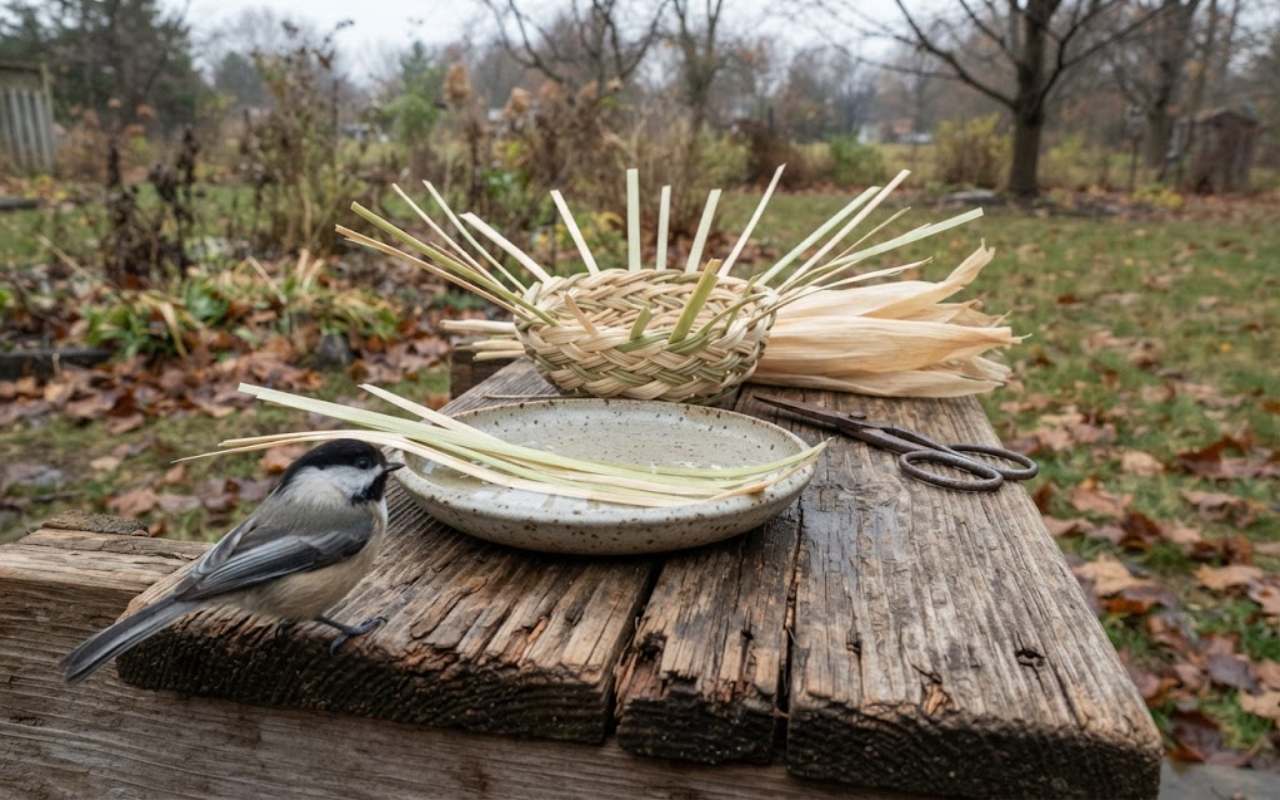
Crafting an authentic native corn husk bird feeder weaving basket provides backyard birds with a biodegradable, textured foraging station that blends traditional fiber arts with functional wildlife support. Handcrafted natural fibers offer clinging songbirds, such as nuthatches, titmice, and chickadees, exceptional tactile purchase that slick commercial plastics cannot replicate.
When constructed properly, these organic vessels hold solid suet cakes, whole black oil sunflower seeds, or clean nesting fibers through variable seasonal weather.
Traditional twined husks offer a zero-waste alternative to synthetic feeders, decomposing naturally at the end of their operational lifecycle. Understanding the unique tensile behavior and moisture absorption of dried corn leaves ensures the vessel remains structurally sound while safeguarding visiting birds from biological hazards.
Quick-Glance Field Summary
Weaving an avian-safe feeder basket requires pliable inner corn husks twined under firm, uniform tension around a reinforced radial base to prevent claw entrapment. Suspending the completed basket beneath a dedicated weather baffle prevents premature fiber rot and stops moisture from pooling inside the seed reservoir.
- Material selection: Untreated, chemical-free inner husks soaked 10 to 15 minutes in lukewarm water
- Base framework: 6 to 8 radial warp spokes crafted from twisted husk cordage or flexible dogwood runners
- Structural weave spacing: Maximum 0.125-inch twining gap to stop songbird toe and talon snagging
- Vessel dimensions: 5-inch diameter base with 2.5-inch vertical sidewalls for balanced weight distribution
- Environmental protection: Minimum 18-inch weather dome suspended 4 inches above the basket rim
- Maintenance standard: Bi-weekly inspections for fungal colonization and full seasonal replacement after 4 months
Fiber Hydration and Mold Prevention in Untreated Husks
Experienced crafters on natural fiber forums frequently warn beginners about the dangers of over-soaking corn husks prior to twining. Submerging dry husks for hours causes the cellular structure to swell excessively, leading to dramatic shrinkage, warping, and loose structural gaps as the finished weave dries. A targeted soak of 10 to 15 minutes in lukewarm water softens the fibers sufficiently without saturating the core tissue.
Working with partially damp material prevents brittle leaf tearing along parallel veins while maintaining tight, uniform friction between wraps. Commercial ornamental husks purchased from craft stores often contain sulfur bleaching agents or chemical fungicides that can rub off on bird feathers. Always source untreated agricultural husks, field-harvested sweet corn coverings, or culinary tamale wrappers devoid of chemical preservatives.
Damp fiber craft left in enclosed storage quickly harbors environmental pathogens like Aspergillus flavus, a dangerous mold that produces lethal aflatoxins when consumed by wild birds. Before weaving, lay soaked husks on clean cotton towels to remove standing surface water. If an unfinished basket must sit overnight, place it in an open, high-airflow space rather than inside a plastic bag.
- Select pale, pliable inner husks rather than coarse, papery outer leaves for the primary twining elements.
- Strip leaves lengthwise into uniform 0.5-inch ribbons to maintain consistent fiber density throughout the project.
- Wrap damp ribbons in a damp tea towel while working to maintain elasticity without oversaturating the fiber.
- Discard any individual leaves displaying localized gray spotting, black specks, or foul, fermented odors.
Inspect raw husk bundles carefully before beginning construction to ensure total purity. Maintaining clean raw materials protects both the human crafter and the foraging birds that will visit the finished vessel.
| Weaving Fiber Type | Structural Flexibility & Strength | Ventilation & Drainage Window | Primary Avian Visitors |
|---|---|---|---|
| Twined Corn Husks | High; broad, flat overlapping ribbons compress into thick, toothsome load-bearing walls. | Elite; open-wrap weave allows autumn downpours to drain through instantly without clogging. | Chickadees, tufted titmice, nuthatches, and small native sparrows. |
| Coarse Pine Needles | Medium; stiff, narrow uniform shafts that require close, continuous thread bindings. | Moderate; tightly coiled rows hold seeds cleanly but shed water slower. | Finches, siskins, and lightweight clinging songbirds. |
Radial Warp Geometry and Claw-Safe Twining Tension
One prevalent concern raised on wildlife rescue forums involves backyard birds catching their toes in loose, sloppy fiber weaves. When a bird lands on a feeder rim, loose strands can separate and form mechanical pinch points that snare tiny hallux talons. Utilizing a balanced radial warp framework ensures that every intersecting weft strand stays locked firmly in place under physical pressure.
Begin the structural base by crossing three pairs of soaked, corded husk strips into a symmetrical six-point star. Secure the center intersection using a traditional two-strand pairing weave, crossing the working strands over each other between every warp spoke. Pull each twist firmly toward the center hub, eliminating gaps larger than 0.125 inches to guarantee avian foot safety.
As the circular base expands outward toward a five-inch diameter, the distance between warp spokes naturally widens. Prevent structural thinning by splicing secondary warp spokes into the weave once the spoke gaps exceed 0.75 inches. Maintaining uniform spacing across the basket base ensures even weight support when multiple birds perch along the perimeter.
- Anchor the central hub with a double half-hitch knot using fine, unbleached jute twine to lock the origin spokes.
- Maintain perpendicular tension on warp spokes during the initial four rounds to keep the bottom platform flat.
- Alternate the thick butt ends and thin tips of the husk strips to create a smooth, consistent wall thickness.
- Lock every splice point by overlapping fresh husk ends by at least one full inch inside the inner basket cavity.
Consistent mechanical tension during the initial layout prevents future warp distortion. A tightly twined floor creates a stable foundation that resists seed weight and turbulent winds.
Weight-Bearing Base Reinforcement and Seed Aeration Drainage
Platform style feeding stations fail rapidly if rainwater cannot drain freely through the floor of the vessel. In bird feeding communities on Reddit, hobbyists frequently report that homemade woven baskets turn into dense, sour seed paste after heavy rainfall. Incorporating targeted bottom drainage prevents standing water from fermenting the contents and rotting the husk base.
As you conclude the flat base at five inches, transition your weaving upward at a 90-degree angle to build the sidewalls. Create natural drainage channels by leaving microscopic gaps along the floor perimeter using an alternating open-twine stitch. These small apertures allow driven moisture to evacuate without letting small seeds, like nyjer or millet, slip through the bottom.
Reinforce the critical junction between the floor and sidewalls by integrating a three-strand border braid. This raised perimeter rim bears the mechanical stress applied by heavier visitors, such as blue jays or mourning doves. A rigid boundary keeps the basket from sagging inward, maintaining an open, aerated chamber for bulk seed presentation.
- Weave vertical sidewalls to a height of exactly 2.5 inches to shield seed from horizontal wind gusts.
- Introduce three-strand husk braiding along the outer base rim to resist structural flattening under load.
- Space drainage perforations around the floor perimeter at regular intervals to prevent center pooling.
- Trim internal splice tails flush against the interior floor so moisture cannot wick down into the fiber joints.
Proper aeration channels keep the feeding basin dry during sudden squalls. Well-drained bases dramatically extend the functional lifespan of organic plant materials exposed to outdoor conditions.
Weather Dome Shielding and Aflatoxin Decontamination Protocols
Because untreated corn husks are completely organic, persistent moisture inevitably leads to fiber degradation and fatal fungal outbreaks. Backyard birding groups emphasize that wild seed left wet for more than 48 hours becomes a breeding ground for Candida albicans and harmful bacteria. Suspending the woven basket underneath a wide, transparent weather dome eliminates direct overhead rainfall exposure.
Position an 18-inch polycarbonate weather baffle roughly four to six inches above the top rim of the feeder basket. This overhead clearance preserves open flight lines for approaching songbirds while blocking driving rain and falling debris. The dome also functions as a physical climbing baffle against squirrels and raccoons attempting to raid the organic vessel.
Routine maintenance demands dry mechanical cleaning rather than destructive liquid soaking. High-temperature water or harsh scrubbing breaks down the cellular integrity of woven husks, causing immediate fiber fraying. Use a stiff, dry wire brush weekly to dislodge stale seed hulls, dried suet residue, and avian droppings from the woven crevices.
- Suspend the basket using multi-strand natural hemp cord with an overhead 18-inch clear weather dome.
- Hang the vessel at least ten feet away from dense vegetation to minimize predatory domestic cat ambushes.
- Adhere to Audubon collision guidelines by mounting the feeder within 3 feet or beyond 30 feet from windows.
- Perform a thorough bi-weekly dry scrubbing using an untreated natural bristle brush to clear fiber gaps.
Consistent overhead protection keeps delicate woven fibers operating smoothly across unpredictable seasonal transitions. Strategic yard placement reduces outdoor hazards and keeps backyard flocks safe from common predators.
Seasonal Foraging Wear and Nesting Material Stripping Dynamics
Field observations reveal that wild birds interact with natural corn husk baskets differently throughout the calendar year. In early spring, backyard enthusiasts frequently notice titmice and goldfinches actively pulling loose fibers from basket rims. Songbirds naturally recognize untreated corn fibers as superior insulating lining for their breeding nests and egg chambers.
Rather than fighting this natural behavior, reinforce the top finishing rim with a tightly bound continuous coil. Weave a protective rim border using a heavy, rolled husk cord secured with hidden figure-eight stitches. This structural binding stops birds from unraveling the vertical sidewalls while foraging for wild seeds or tallow suet.
During autumn and winter, switch to energy-dense feeds that resist moisture retention, such as raw black oil sunflower or safflower seeds. Avoid adding crushed corn or powdery millet blends, which absorb ambient humidity and clump along the textured fiber floor. When the basket naturally reaches the end of its structural viability, remove the suspension cords and compost the entire assembly directly in your garden.
- Inspect the top rim weekly during peak spring nesting months for structural thread breakage.
- Transition feed mixtures to high-lipid, whole-shell black oil sunflower seeds to prevent interior clumping.
- Avoid all synthetic water repellents, mineral oils, or chemical sealants that could coat avian plumage.
- Compost the degraded basket immediately when sidewall integrity fails or persistent mold appears.
Building with pure botanical materials creates a harmonious relationship between your backyard wildlife and traditional craft methods. Proper construction safeguards local bird populations while providing rich foraging observation all year long.