
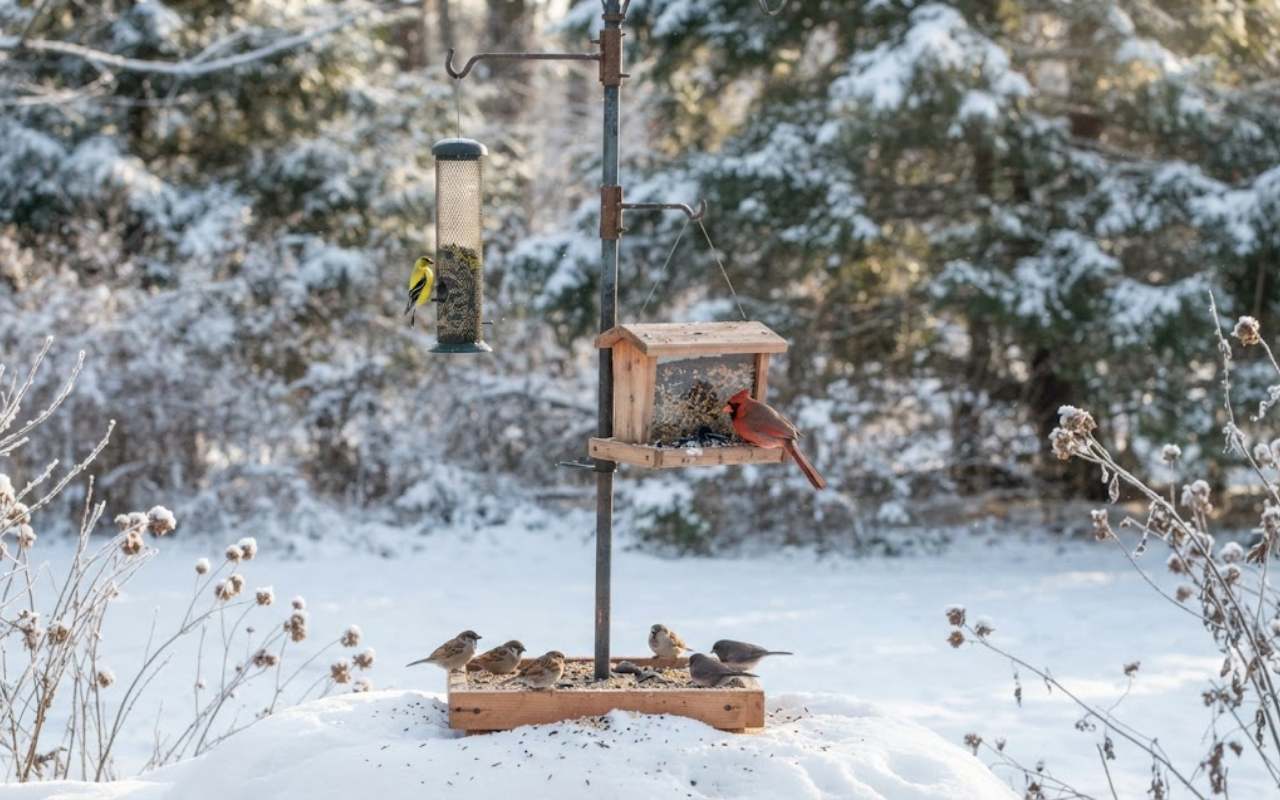
Setting up staggering bird feeders by height is the easiest way to disrupt aggressive displacement hierarchies across mixed winter flocks while maximizing foraging efficiency during freezing weather. Most backyard setups place every feeder at a uniform five-foot level, creating a localized choke point that forces smaller passerines to expend irreplaceable calories in evasive flight.
Separating your food presentation across vertical ecological strata mimics natural forest foraging zones, ensuring subordinate species safely maintain their daily lipid reserves through the coldest months.
Quick-Glance Field Summary
Vertical stratification separates competing avian species across micro-elevations to eliminate direct sightlines and spatial bottlenecks. Positioning food sources across ground, mid-story, and canopy zones mirrors natural foraging niches while safeguarding subordinate songbirds.
| Feeding Zone Stratum | Recommended Elevation | Target Avian Species | Ideal Feed Types | Structural Hardware Match | Layout & Microclimate Rules |
|---|---|---|---|---|---|
| High Canopy Mast | 7.5 to 8.5 Feet | Blue Jays, Woodpeckers, Nuthatches | Whole Peanuts, Tallow Suet Blocks, Striped Sunflower | Heavy-Duty Triple-Hook Pole Assembly | Horizontal Separation: 10 to 12 feet between distinct vertical stations. |
| Mid-Story Core | 4.5 to 5.5 Feet | Goldfinches, Chickadees, Titmice | Nyjer Seed, Shelled Sunflower Chips | Weight-Sensitive Squirrel-Proof Tube Feeder | Solar Alignment: South-southeast orientation to capture morning radiant heat. |
| Ground Platform | 8 to 12 Inches | Juncos, Native Sparrows, Towhees | White Proso Millet, Cracked Corn, Hulled Seeds | Perforated Screen Ground Tray with Cover Dome | Cover Clearance: 8 to 10 feet from dense shelter plants like Winterberry (Ilex verticillata). |
How to Prevent Blue Jays and Starlings From Causing Fights in Winter
Data from Project FeederWatch dominance rankings confirms that larger species routinely win physical confrontations over smaller songbirds at clustered feeding stations. A single Blue Jay or a wandering flock of European Starlings can shut down an entire feeding station by occupying perches and aggressively jabbing at lower-ranking birds.
On the r/birding community forum, backyard birders frequently complain that bully birds sweep through single-tier pole systems, scattering mixed flocks and monopolizing suet blocks for hours.
Vertical separation diffuses this competitive pressure by dividing food access into distinct foraging zones. Suspending high-energy suet cages and whole-nut feeders at 7.5 to 8.5 feet attracts woodpeckers and jays to the highest tier, where their natural preference for open scanning perches is satisfied.
Mid-sized birds feel exposed on low perches, so elevating their primary food sources keeps them out of the lower flight corridors.
Smaller passerines such as American Goldfinches and Dark-eyed Juncos occupy lower feeding strata without triggering the defensive reactions of larger birds overhead. Mid-story feeders mounted at 4.5 to 5.5 feet cater specifically to nimble clingers that utilize weight-sensitive perches or fine-mesh ports.
Low ground platforms elevated just 8 to 12 inches accommodate juncos and native sparrows, allowing subordinate birds to feed continuously beneath the sightlines of upper-tier foragers.
Where to Place Baffle Poles to Stop Local Yard Damage
Improper placement of multi-feeder pole assemblies concentrates bird droppings, seed hull waste, and rodent excavation in tight areas of the yard. On the BirdWatching community boards, hobbyists regularly report deep lawn kill rings and structural soil erosion beneath crowded feeder arrays that lack proper spacing.
Concentrated waste builds up nitrogen hotspots that scorch underlying turf grasses while creating mud pits during winter freeze-thaw cycles.
Preventing structural landscape damage requires distributing feeder poles across an alternating grid with a minimum horizontal clearance of 10 to 12 feet between masts. Each individual pole should stand at least 10 feet away from horizontal tree limbs, fence rails, or rooflines to neutralize squirrel launch trajectories.
Mounting a wide cylinder baffle at a height of 4.5 to 5 feet shields the upper feeder hardware while preventing raccoons and squirrels from chewing through hanging mounts.
The surrounding ground cover should consist of resilient, low-growing native plantings that tolerate heavy foot traffic and seed debris. Establishing beds of Blue Rug Juniper (Juniperus horizontalis) or Kinnikinnick (Arctostaphylos uva-ursi) under the flight path absorbs dropped seed hulls without suffocating the root zones.
These woody ground covers form a living structural carpet that prevents mud development and stops aggressive soil compaction during wet winter months.
Best Powder-Coated Steel Options for Cold Weather Durability
Winter conditions place severe mechanical stress on backyard feeder setups through ice accumulation, heavy snow loads, and high wind gusts. Cheap aluminum tubing and thin shepherd hooks regularly snap or bend when loaded with heavy winter feed and multiple large birds.
Hardware deployed in freezing climates must maintain structural integrity under continuous, unbalanced dynamic loads.
- Cold-rolled 16-gauge tubular steel with a continuous diameter of at least 1 inch
- Industrial thermoset powder coating to prevent moisture penetration and rust flaking
- Threaded swaged joints that eliminate play and prevent ice from splitting the pole sleeves
- Heavy-duty steel auger bases driven at least 20 to 24 inches into the subsoil
- Stainless steel quick-links and carabiners rated for dynamic loads exceeding 50 pounds
Rigid hardware prevents pole wobble, which is a major factor that spooks wary winter birds during high-wind feeding sessions. Solid anchor systems also maintain strict vertical alignment, keeping squirrel baffles level and fully functional throughout severe blizzards.
Investing in industrial-grade structural steel ensures that height-staggered configurations remain safe, stationary, and plumb through repeated winter storms.
How to Modify Hopper Feeders to Prevent Food Spoilage
Damp winter seed provides the primary breeding ground for Aspergillus flavus, a cold-hardy mold that produces lethal aflatoxins in bird populations. When hopper feeders receive poor winter airflow and zero direct morning sun, condensation rapidly forms against the interior reservoir walls.
Wet seed cakes together at the bottom discharge slots, restricting food flow and fostering toxic fungal blooms that kill visiting songbirds.
Orient all hopper and tube hardware toward a south-southeast compass azimuth to catch low-angle morning sunlight. Morning solar exposure raises internal feeder temperatures, melting peripheral frost and evaporating nocturnal condensation within the seed chamber.
Ensure that neighboring evergreens block biting prevailing northwest winds without casting persistent afternoon shade over the feeding stations.
Physical modifications to the hopper hardware further eliminate moisture accumulation before it compromises seed quality. Replacing solid wooden or plastic hopper floors with perforated, marine-grade stainless steel mesh allows water to drain freely away from the food supply.
Installing a secondary polycarbonate weather dome measuring 14 to 18 inches in diameter directly over the hopper repels freezing rain, keeping the feeding ports dry and functional throughout extended winter precipitation.
Clear Step-by-Step Instructions to Arrange the Weatherproof Layout
Careful execution of this staggered yard blueprint establishes an optimized foraging microclimate that minimizes territorial conflicts and protects flock health all winter long.
- Measure a clear open area measuring at least 24 by 12 feet with direct morning sun exposure.
- Dig a foundational hole 24 inches deep for the primary high-mast station.
- Secure a heavy-duty 1-inch powder-coated steel pole into the ground using a twist-in ground auger.
- Mount an 8-inch diameter cylinder baffle exactly 5 feet above the turf line on the high mast.
- Hang high-energy suet and whole-nut hopper feeders at an elevation of 7.5 to 8.5 feet.
- Space a secondary mid-story feeder pole exactly 10 to 12 feet away from the central mast.
- Attach specialized finch tubes and clinging mesh feeders at an elevation of 4.5 to 5.5 feet.
- Place a low, screened ground platform feeder 10 feet away at a height of 8 to 12 inches.
- Prune nearby woody shelter shrubs like Winterberry (Ilex verticillata) to maintain an 8-foot escape buffer.
- Inspect all seed reservoirs daily at dawn to clear blocked drainage holes and remove frozen crusts.
Staggered Winter Bird Feeders: Frequently Asked Questions
Can you mix suet and loose wild bird seed on the same multi-feeder pole?
Yes, provided they are separated by vertical strata. Mount high-energy suet cages at the apex of the pole (7.5 to 8.5 feet) to satisfy the open scanning preferences of dominant woodpeckers and jays, while placing loose seed tube feeders lower down (4.5 to 5.5 feet) to accommodate smaller, clinging songbirds.
How close can different bird feeder poles be placed without causing territorial fights?
Maintain a minimum horizontal separation distance of 10 to 12 feet between distinct vertical stations. This clearance breaks direct avian sightlines, eliminates spatial bottlenecks, and prevents aggressive dominant flock members from guarding multiple food sources simultaneously.
Will ground platform feeders attract rodents and squirrels during freezing winter weather?
Ground platforms can attract pests if unmanaged. To mitigate this risk, deploy a low, screened ground tray elevated 8 to 12 inches off the turf, keep it 10 feet away from tree launch points, and use a dedicated clear plastic cover dome over the tray to block squirrels while keeping weather-sensitive ground seed dry.