
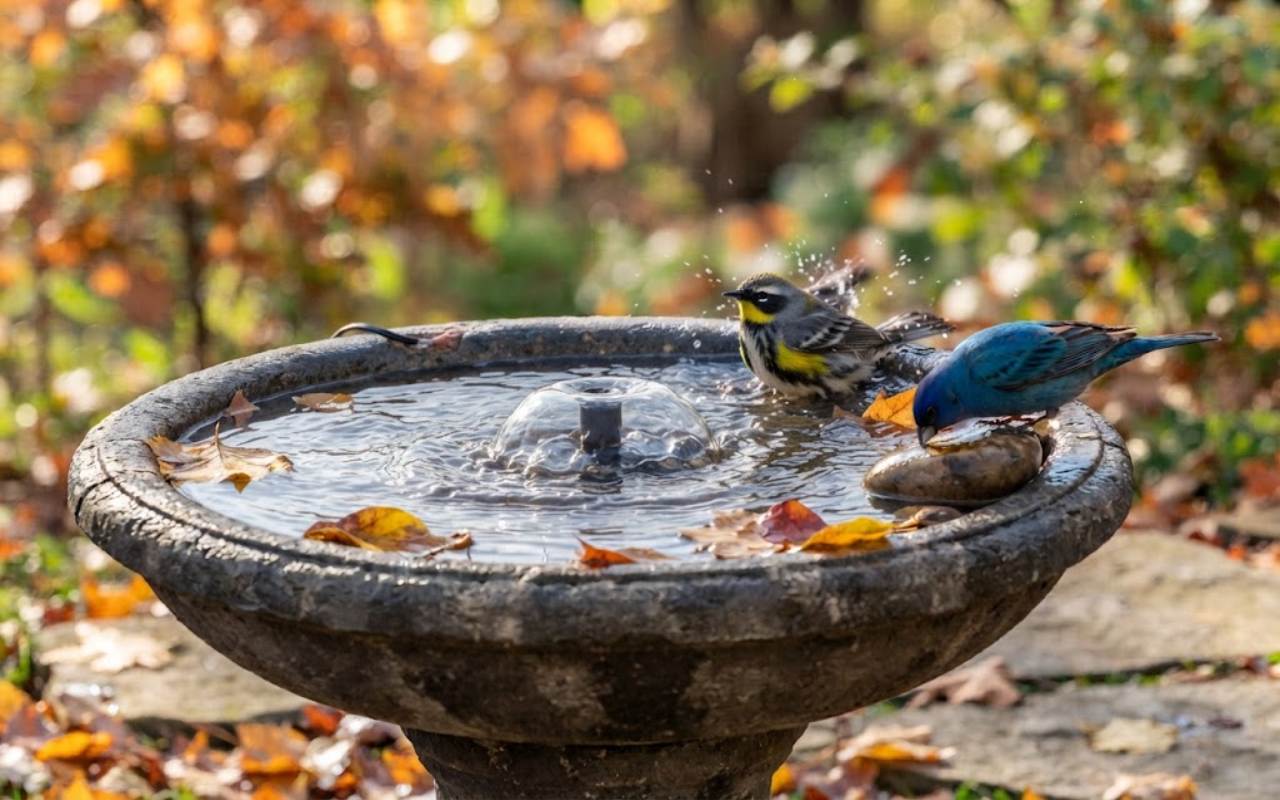
Have you ever wondered why deploying moving water for bird bath setups is the absolute best way to attract high-altitude autumn migrants? Transforming an ordinary basin into a moving oasis taps directly into the evolutionary instincts of tired, dehydrated birds traveling hundreds of miles along continental flyways. This low-cost physical adjustment alters your yard’s acoustic signature, creating a noticeable visual and auditory target that breaks up stale lawn reflections.
While resident backyard birds rely on established seed feeders, transient passerines like wood warblers, vireos, and thrushes rarely consume grains and navigate primarily by sound. Adding a simple solar fountain, a hanging dripper, or a rolling water wobbler creates continuous surface ripples that echo up into the canopy line. This simple mechanical upgrade successfully intercepts passing flocks, drawing unique migratory species that would otherwise bypass your yard entirely.
Quick-Glance Field Summary
Sound and light reflection generated by agitated water attract high-canopy migrants down to ground level far more reliably than static basins. Proper system execution balances audible splash resonance with safe landing geometry and daily pump maintenance to prevent equipment burnouts and disease transmission.
- Basin water depth: 0.5 to 1.5 inches maximum for passerines
- Window strike safety buffer: within 3 feet or beyond 30 feet from glass
- Ideal drip rate: 30 to 60 drops per minute for continuous acoustic signaling
- Submersible pump rating: 40 to 70 gallons per hour with adjustable flow control
- Sanitization ratio: 1 part plain white vinegar to 9 parts water for routine biological scrubbing
- Safety restriction: zero percent glycerin or chemical antifreeze additives in cold snaps
Polarized Light, Surface Agitation, and Visual Decoys
High-altitude migrants scan the landscape below for the distinct glare of open water bodies to initiate their descent. Static bird baths often fail this visual test because undisturbed water can appear opaque, stagnant, or completely invisible beneath a dense forest canopy. Agitating the surface with an active dripper or bubbler fractures incoming sunlight, creating oscillating flashes of polarized light that migrating flocks detect from significant elevations.
In discussions on r/birdwatching, backyard birders frequently report that adding a mechanical dripper brought immediate flurries of Cape May and Black-throated Blue warblers to yards where standard baths sat untouched for months. The movement disrupts the reflective surface tension, signaling fresh, aerated, unpolluted water to species that avoid standing pools prone to parasite proliferation.
To maximize this visual signature, position your water feature where morning sunlight penetrates mid-level canopy gaps. A rough-textured basin surface beneath shallow water enhances contrast, showing traveling birds that the landing floor is stable and safe for perching.
- Sun angle exposure: 2 to 4 hours of direct morning light to illuminate water refraction
- Basin substrate texture: unglazed terra cotta or river slate to prevent slippage
- Surface ripples: minimum continuous wave cycle across at least 80 percent of the water surface
Acoustic Resonance and Auditory Attraction Mechanics
Sound travels farther than sight in residential neighborhoods and woodland edges where dense vegetation blocks visibility. Migrating warblers and thrushes actively listen for the distinct sound of trickling brooks or splashing rivulets as they navigate overhead during pre-dawn drop-downs. Static water produces zero decibels, effectively rendering it undetectable to tired birds resting in the canopy.
Forum contributors on r/backyardbirds consistently point out that low-frequency hums from cheap, vibrating fountain pumps fail to attract birds while active water dripping onto a broad, flat rock succeeds within hours. The frequency of a dripping or falling droplet cuts through urban ambient noise far better than a continuous mechanical hum. A sharp, rhythmic plop generates a higher acoustic frequency that mirrors natural forest seepages.
You can modify an existing basin by elevating a perforated bucket or installing an external dripper bracket above a broad, smooth stone. When the falling droplet impacts the stone just above the water line, it creates an amplified, natural resonant chime that projects cleanly through the neighborhood canopy.
- Audio projection radius: 50 to 100 feet through standard backyard tree cover
- Target drop height: 6 to 12 inches above the basin surface for crisp acoustic output
- Impact point: broad flat flagstone submerged halfway to maximize tonal variety
Impeller Pump Clogging and Biofilm Debris Management
The primary operational failure during autumn involves falling deciduous leaves, blowing dust, and organic shedding that choke small fountain impellers. Submersible 5V USB and low-voltage pumps lack the torque to process organic debris, resulting in motor burnout within days if left unprotected. Furthermore, decomposing autumn leaves rapidly leach tannins, turning clean water acidic and promoting slimy bacterial mats.
Wildlife rehabilitators frequently warn that stagnant biofilms harbor avian pathogens like Salmonella and protozoal organisms that cause avian trichomonosis. To maintain optimal flow without burning out pump motors, experienced hobbyists install a mechanical pre-filter cage around their pump intake. A simple sleeve made of coarse aquarium foam or 0.25-inch stainless hardware mesh blocks large leaf litter while preserving adequate fluid intake.
Routine maintenance must be mechanical and non-toxic rather than reliant on harsh commercial pool chemicals. Flush out the impeller housing every four to seven days to remove trapped silt and pine needles that cause magnetic rotor drag.
- Daily debris protocol: skim floating leaves using a handheld nylon mesh net
- Deep sanitization schedule: weekly soak using a 1:9 bleach-to-water dilution followed by exhaustive rinsing
- Impeller maintenance: pull and wipe the magnetic drive rotor every two weeks to prevent calcification
- Pre-filter dimension: 30-pore-per-inch reticulated foam sleeve over pump intake
Perch Geometry, Water Depth, and Predator Cover
Migrating passerines are small, exhausted, and acutely vulnerable to domestic cats, Cooper’s hawks, and sharp-shinned hawks. A basin that is too deep or placed too close to dense, ground-level brush creates a lethal predator trap. Small warblers will not enter water that exceeds their tarsus height, which means depths over one inch will deter them from bathing.
Field ornithologists emphasize safe basin geometry to support frantic, energy-depleted migrants. Provide a tiered slope or stack variable-thickness river stones so birds can wade from a mere damp edge out to an absolute maximum depth of 1.5 inches. Surrounding perches should offer an unobstructed 360-degree view of approaching predators while still providing nearby canopy escape routes.
Follow the standardized Audubon window placement recommendations to eliminate fatal glass collisions when birds flush unexpectedly from the bath. Place moving water features either within 3 feet of your home windows or well beyond 30 feet away to nullify fatal flight impact speeds.
- Water depth zones: 0.25 inches for hummingbirds, 0.5 inches for warblers, 1.25 inches for thrushes
- Escape cover distance: 10 to 15 feet from dense ground-level shrubs to foil lurking domestic cats
- Perching staging: dry wooden branches positioned 12 to 24 inches directly above the spray zone
Thermal Regulation and Cold Front Operational Adjustments
Fall migration extends well into late autumn when overnight temperatures routinely plunge below freezing. Running moving water features during cold snaps presents unique physical chemistry hazards that demand calculated hardware adjustments. While the kinetic energy of circulating water delays surface crusting, sub-freezing winds will rapidly freeze pump discharge nozzles and spray heads.
Never add commercial chemical antifreeze, salt, or glycerin to an avian water source. Glycerin coats and matts down flight and down feathers, destroying their microscopic barbule structure and causing fatal hypothermia within hours. In contrast to winter hummingbird nectar, which lowers freezing points down to roughly 27 degrees Fahrenheit for a standard 4:1 sucrose mix, pure bird bath water turns directly to solid ice at 32 degrees Fahrenheit.
When hard frosts arrive, swap fine misters for low-profile submersible water wigglers or cast-iron heated bases paired with standard drippers. Bird bath heaters rated between 50 and 150 watts with integrated thermostatic switches keep water liquid without heating it to unpalatable temperatures.
- Minimum operating wattage: 50 watts for shallow basins; 150 watts for broad stone baths
- Thermostat trip threshold: automatically engages power when water approaches 35 degrees Fahrenheit
- GFCI requirement: plug all thermal and moving water equipment into outdoor-rated ground fault circuit interrupters
- Critical fluid prohibition: absolute zero tolerance for chemical additives, alcohols, or water-softening salts