
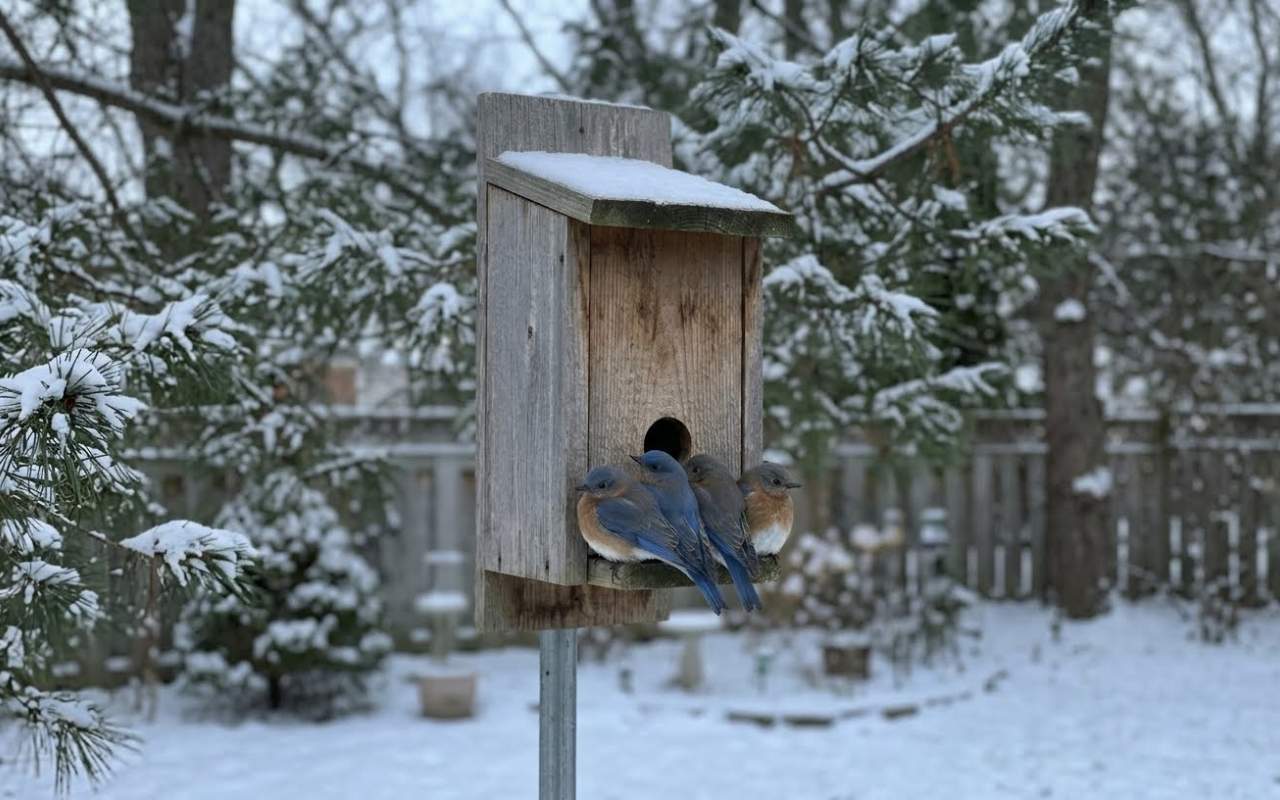
Observing huddling behaviour in winter birds reveals one of nature’s most effective survival strategies against sub-zero nights. When temperatures drop, small backyard songbirds lose body heat rapidly because their high surface-area-to-volume ratio causes warmth to escape quickly.
To survive until dawn without burning through all their fat reserves, several cavity-roosting species temporarily set aside territorial behavior and pack tightly together inside tree hollows and roost boxes.
Eastern Bluebirds, Pygmy Nuthatches, Golden-crowned Kinglets, Brown Creepers, and Carolina Wrens are the primary North American species known to huddle in communal groups.
By sharing body heat and minimizing exposed plumage, these birds conserve vital metabolic energy during freezing winter storms.
Quick-Glance Field Summary
Communal roosting relies on physical contact and enclosed spaces to trap warm air around resting birds. Understanding which species huddle helps you set up safe backyard roosting shelters before winter freezes arrive.
- Primary biological purpose: Reduces convective heat loss and lowers overnight energy expenditure
- Top huddling backyard species: Eastern Bluebirds, Pygmy Nuthatches, Golden-crowned Kinglets, Brown Creepers, Carolina Wrens
- Typical roosting group size: 3 to 20 birds depending on species and cavity dimensions (with rare Pygmy Nuthatch records exceeding 100)
- Thermal cavity gain: Tightly packed bluebird and nuthatch huddles can raise internal cavity temperatures by 20°F to 40°F above freezing outside air depending on huddle size and box insulation
- Preferred shelter types: Natural woodpecker cavities, insulated wooden roost boxes, and dense evergreen boughs
- Non-huddling species: Black-capped Chickadees and Tufted Titmice (prefer solitary roosting paired with nocturnal hypothermia)
- Optimal roost box features: Bottom entrance hole, staggered interior wooden dowels, and zero open top ventilation slots
Top Backyard Bird Species That Huddle for Warmth
Several small songbirds depend on communal roosting to survive freezing nights, though their exact group sizes, geographic ranges, and roosting postures vary by species. Cavity-nesting birds naturally gravitate toward enclosed spaces, while tiny foliage-gleaning birds pack shoulder-to-shoulder on sheltered branches.
- Eastern Bluebirds (Eastern & Central North America): Territorial during spring breeding, bluebirds become highly social in winter and regularly cram 5 to 15 individuals into a single nest box or tree hollow on freezing nights, often consisting of a mated pair and their late-season offspring.
- Pygmy Nuthatches (Western Pine Forests): Among the most extreme communal roosters in North America, Pygmy Nuthatches pile into old ponderosa pine cavities in groups of 10 to over 100 birds while simultaneously lowering their body temperatures.
- Golden-crowned Kinglets (Widespread Boreal & Backyard Forests): Weighing less than a quarter of an ounce (0.1–0.3 oz), these tiny birds press tightly side-by-side in groups of 3 to 5 deep inside dense conifer branches to stay warm.
- Brown Creepers (Widespread Woodlands): Rather than piling randomly, Brown Creepers form organized, circular clusters under loose tree bark or inside roost boxes, arranging themselves like spokes on a wheel with their bellies pressed against the wood and their heads facing outward.
- Carolina Wrens (Eastern & Southern Yards): Pairs and small family groups frequently huddle inside roosting pockets, hanging flower baskets, porch corners, or dense evergreen shrubs during cold snaps.
Winter Bird Group Huddling Comparison Matrix
| Bird Species & Range | Typical Huddle Size | Preferred Roost Site | Secondary Survival Strategy |
|---|---|---|---|
| Eastern Bluebird (Eastern/Central) | 5 – 15 Birds | Nest boxes & tree cavities | Switches diet to winter berries |
| Pygmy Nuthatch (Western Pines) | 10 – 100+ Birds | Old pine snags & cavities | Controlled nocturnal hypothermia |
| Golden-crowned Kinglet (Widespread) | 3 – 5 Birds | Dense conifer boughs | Continuous daytime insect foraging |
| Brown Creeper (Widespread) | 4 – 12 Birds | Loose bark & roost boxes | Wheel-shaped outward head huddle |
| Carolina Wren (Eastern/Southern) | 2 – 6 Birds | Roost pockets & dense shrubs | Shelters in covered porch corners |
Why Some Backyard Birds Do Not Huddle
Not every small winter bird uses group huddling to survive freezing temperatures; many common feeder visitors roost strictly alone and rely on physiological adaptations instead. Solitary roosting prevents predators like screech-owls or raccoons from wiping out an entire local flock in a single attack.
- Black-capped Chickadees: Chickadees roost individually inside tiny tree cavities or dense conifer needles and enter regulated nocturnal hypothermia, dropping their body temperature by up to 12°F to 15°F below their daytime normal of 108°F to conserve fat reserves.
- Tufted Titmice: Like their chickadee relatives, titmice sleep alone in narrow bark crevices or small holes rather than forming communal piles.
- Northern Cardinals: Cardinals roost individually deep inside thick evergreens, thorny shrubs, or dense vine tangles, fluffing their contour feathers to trap insulating air pockets.
- Downy Woodpeckers: Woodpeckers excavate individual winter roost cavities in dead snags, sleeping vertically while braced by their stiff tail feathers.
How Huddling Saves Energy on Freezing Nights
Huddling reduces heat loss by shrinking the amount of exposed surface area each bird presents to the freezing night air. When a group of birds presses tightly together inside a small wooden cavity, their combined metabolic heat warms the trapped air inside the chamber—raising internal box temperatures by 20°F to 40°F above freezing outside air depending on huddle size and box insulation—while blocking wind drafts.
According to winter bird survival guidance from the National Audubon Society, clustering together to share body heat works alongside feather fluffing and dense shelter to help birds endure sub-zero conditions.
Furthermore, life history records from the Cornell Lab of Ornithology note that species like the Pygmy Nuthatch combine communal roosting with controlled hypothermia to cut overnight energy demands dramatically.
How to Build and Set Up a Safe Winter Roost Box
You can support huddling birds by building a dedicated winter roosting box from untreated 3/4-inch cedar (nominal 1×8 lumber, which measures 0.75″ × 7.25″)—or converting an empty bluebird house, and mounting it in a sheltered, predator-safe spot before freezing weather sets in.
Standard spring nest boxes are built to release heat for baby birds, so winter boxes use thicker wood, zero top vents, and a bottom entrance hole to trap rising body heat.
DIY Winter Roost Box Dimensional Cut-List (1×8 Untreated Cedar)
| Roost Box Component | Qty | Exact Dimensions (3/4″ Cedar) | Critical Assembly Detail |
|---|---|---|---|
| Back Panel (Mounting Board) | 1 | 7.25″ W × 20″ H | Full 1×8 width; pre-drill pole mounting holes |
| Front Panel (Bottom Entry) | 1 | 5.75″ W × 15″ H | 1.5″ Hole drilled 2″ from bottom edge |
| Left & Right Side Walls | 2 | 5.75″ W × 15″ H | Ripped to 5.75″ for flush 7.25″ exterior depth |
| Sloped Roof Panel | 1 | 8.5″ W × 9.5″ L | 2″ Overhang sheds snow & freezing rain |
| Recessed Bottom Floor | 1 | 5.75″ W × 5.75″ D | Recessed 0.5″ up; four 1/4″ corner drain holes |
| Interior Wooden Dowels | 3 | 3/8″ Diameter × 5.75″ L | Staggered at 5.5″, 9″, and 12.5″ from bottom |
- Step 1: Cut your untreated 3/4-inch cedar board according to the dimensional blueprint above (ripping the side walls and front/floor pieces to 5.75″ wide so the front and back sit flush for a 5.75″ × 5.75″ interior cavity), then drill a 1.5-inch entrance hole 2 inches up from the bottom edge of the front panel.
- Step 2: Install three staggered 3/8-inch wooden dowel perches across the interior side walls at 5.5-inch, 9-inch, and 12.5-inch heights from the bottom edge so birds clear the entrance hole easily and cling comfortably at different levels.
- Step 3: Assemble the walls, sloped roof, and recessed floor with exterior-grade wood screws, leaving no open top ventilation slots—or seal existing gaps temporarily with weatherstripping if converting a spring nest box.
- Step 4: Mount the box 5 to 8 feet high on a freestanding metal pole equipped with a wrap-around squirrel and raccoon baffle, facing the entrance away from prevailing winter winds.
- Step 5: Sanitize the interior thoroughly in late February before spring nesting begins by scrubbing out winter droppings with a 1:9 household bleach-to-water solution and reopening top ventilation vents.
Why Birds Sometimes Ignore Newly Mounted Roost Boxes
If backyard birds ignore a brand-new roost box during its first winter, the issue usually comes down to late installation timing, lingering chemical odors, or nearby predator exposure. Cavity-roosting songbirds scout their winter sleeping quarters weeks before severe cold arrives and will avoid boxes that smell like fresh paint or sit exposed to cold drafts.
- Installed Too Late in the Season: Birds establish their winter roosting routes in October and November; boxes hung in January often go unnoticed until the following autumn.
- Chemical Paints or Treated Lumber: Never use pressure-treated wood, creosote, or strong interior stains—stick to raw, untreated cedar or pine and leave the inside completely unpainted.
- Unprotected Pole or Open Wind Exposure: Birds will abandon a box if raccoons or squirrels can climb the post, or if the 1.5-inch entrance faces directly into freezing north or west winds.
- Missing Interior Perches: Without staggered wooden dowels or rough kerf cuts on the inside walls, clinging birds struggle to grip smooth lumber in the dark.