
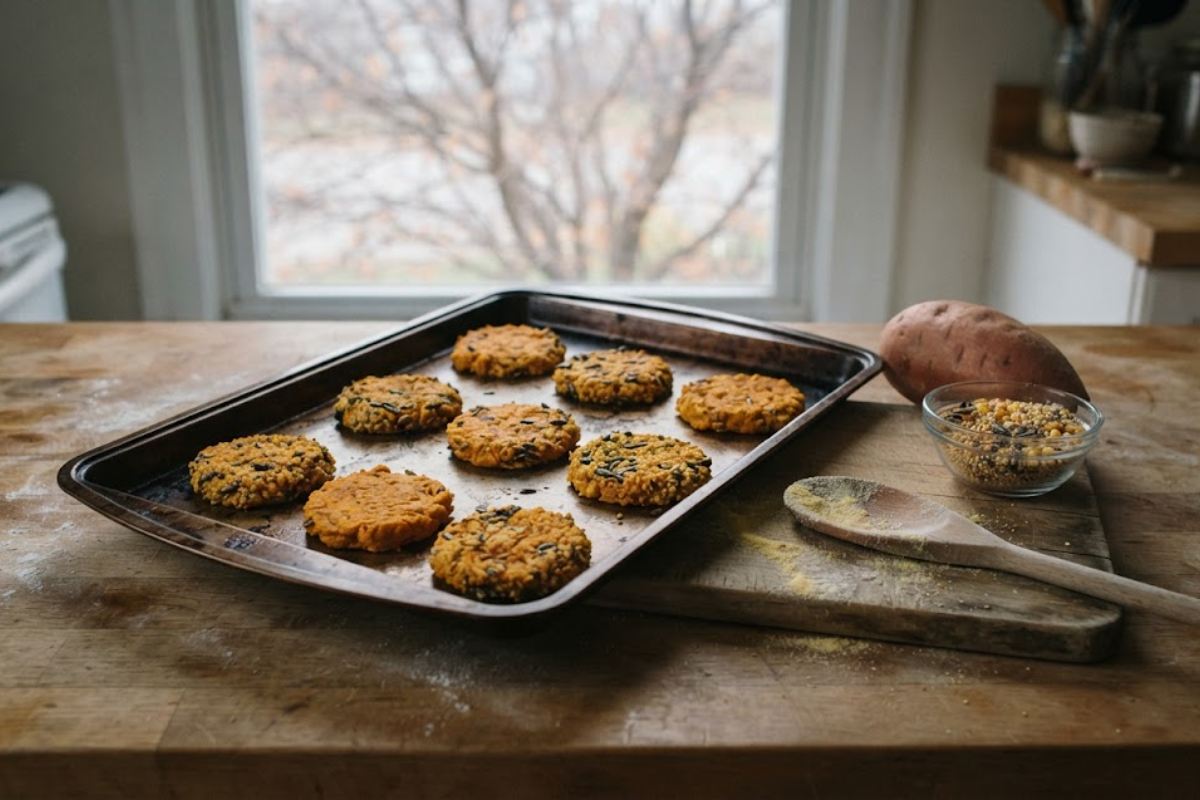
Crafting sweet potato bird feeder trays offers an innovative, fully biodegradable feeding station designed to sustain migratory and resident birds throughout chilly autumn weather. Utilizing natural root vegetable slabs provides both a sturdy, edible platform and supplemental complex carbohydrates that backyard birds eagerly peck apart once the surface seeds are exhausted.
Unlike synthetic hoppers or commercial mesh bags, these slow-baked vegetable bases integrate seamlessly into your yard without leaving microplastic debris behind. When prepared with avian physiological safety in mind, they present a zero-waste resource that delivers dense nutrition for wild flocks preparing for harsh winter conditions.
Quick-Glance Field Summary
Transforming raw sweet potatoes into rigid feeding platforms requires precise moisture extraction to maintain structural integrity under avian perching weight.
By baking uniform root slabs at low temperatures and filling them with natural lipids and high-energy seeds, you create a zero-waste fall feeder that withstands cool weather without harboring moisture-driven pathogens.
- Slicing baseline: Cut crosswise into uniform 0.5-inch to 0.75-inch planks to avoid curling
- Oven temperature: Bake at 200°F (93°C) for 3.5 to 4.5 hours for optimal leathery rigidity
- Perforation setup: Punch 0.25-inch suspension holes prior to baking to avoid brittle splitting
- Core lipid binder: Use 100 percent pure rendered beef tallow or gelatin; avoid honey, syrup, and peanut butter containing palm oils
- Placement distance: Mount within 3 feet of exterior windows or beyond 30 feet to eliminate fatal strike zones
Slice Thickness Calibration and Warping Prevention
A common failure documented by backyard enthusiasts on birding forums involves severe warping during the drying process. On Reddit’s r/backyardbirds, community members frequently describe how standard quarter-inch slices curl into tight funnels in the oven, dumping their seed payloads immediately onto the ground.
Sweet potato parenchymal tissue contains high moisture concentrations, which shrink unevenly along the vascular ring if sliced too thin.
To maintain a flat, supportive basin, cut mature sweet potatoes crosswise into uniform rounds measuring between 0.5 inches and 0.75 inches thick.
Slicing lengthwise can create longer feeder boats, but these large profiles require internal structural scoring with a paring knife to relieve surface tension during thermal contraction.
Thicker cuts ensure the root retains enough internal fibrous density to support the physical weight of clinging nuthatches and woodpeckers.
Pre-punching your hanging attachments into the raw vegetable tissue is mandatory before exposing the roots to heat. Drilling or punching holes into a fully dried, dehydrated sweet potato slab fractures the brittle cell walls and splits the feeder tray entirely.
Use a standard stainless steel straw or a 0.25-inch leather punch to core clean suspension holes approximately 0.5 inches inward from the outer skin rim.
| Baked Treat Base | Nutrient & Vitamin Profile | Digestive Fiber Binding | Target Avian Visitors |
|---|---|---|---|
| Baked Sweet Potato | Rich in Vitamin A, beta-carotene, and slow-release carbohydrates. | Binds cleanly with cornmeal; creates a firm, dry crumb that will not mat feathers. | Cardinals, grosbeaks, mockingbirds, and robins. |
| White Potato Scraps | High in simple starches; lacks critical vitamin pigments. | Becomes sticky if over-cooked; raw peels contain hazardous solanine. | Not recommended for active backyard feeding. |
Non-Toxic Natural Binders Versus Feather-Contaminating Adhesives
Commercial DIY craft blogs routinely suggest using craft glue, corn syrup, or raw honey to attach wild bird seeds to vegetable bases. In specialized wildlife rehabilitation forums, certified rehabbers strongly warn against this practice because sweet adhesives transfer rapidly to avian contour feathers.
Contaminated feathers lose their microscopic barbule interlocking mechanism, destroying the bird’s natural waterproofing and inducing fatal hypothermia during wet fall nights.
Honey also creates an ideal breeding ground for harmful mold and bacterial pathogens, including Salmonella and Aspergillus fungi, which cause devastating gastrointestinal and respiratory infections in songbirds.
Peanut butter should likewise be used with extreme caution, as commercial spreads containing hydrogenated oils and added salt present severe gastrointestinal hazards to small passerines.
To anchor seeds securely into your sweet potato trays, use pure rendered beef tallow or unflavored food-grade gelatin. Melted tallow hardens into an opaque, calorie-dense matrix at fall temperatures below 50°F (10°C), providing accessible fuel without stickiness:
- Pure rendered beef suet: Melt gently, mix with seeds, and pour into pre-baked sweet potato indentations
- Unflavored bovine gelatin: Dissolve one packet in warm water to create a firm, feather-safe natural glaze
- Parboiled root pulp: Scrape and mash the central core of the potato to form a starch-rich adhesive paste
Allow the lipid-bound seed mixture to cool completely inside the sweet potato depression before exposing the finished tray to outdoor temperatures. inside the sweet potato depression before exposing the finished tray to outdoor temperatures.
Dehydration Dynamics and Fungal Spoilage Mitigation
Fall weather brings unpredictable spikes in ambient humidity that threaten the shelf life of homemade feeders. When moist sweet potatoes sit outdoors between 55°F and 75°F, damp seeds provide a fertile host for Aspergillus flavus, an environmental mold that produces deadly aflatoxins.
Ingesting even microgram levels of aflatoxin causes acute liver failure in small granivores such as pine siskins and goldfinches. True oven dehydration is therefore required rather than mere surface baking.
Preheat your conventional kitchen oven to 200°F (93°C), placing the prepared vegetable planks directly on wire baking racks suspended over sheet pans to ensure full air circulation above and below the slabs. Bake the rounds undisturbed for 3.5 to 4.5 hours until the edges feel firm, tough, and leathery without turning scorched or black.
The finished trays should exhibit minimal flexibility while remaining completely dry to the touch. Remove the trays from the oven and allow them to equilibrate on a counter in low ambient humidity for a full 12 hours before adding the seed coating. Never enclose partially cooled trays in plastic containers, as condensation triggers instant bacterial decay.
Suspension Geometry and Predation Defense Architecture
Deploying homemade feeders requires careful yard placement to prevent bird collisions and deter mammalian scavengers. According to standardized Audubon glass-safety protocols, wild bird feeding stations must be placed either within 3 feet of exterior windows or beyond 30 feet from glass surfaces.
Placements within the 3-foot threshold prevent birds from building fatal flight velocity if startled from the tray. Field observations shared on backyard wildlife forums emphasize that unshielded root vegetable feeders are prime targets for nocturnal raccoons and eastern gray squirrels.
If suspended from bare branches using thin twine, rodents quickly sever the cord or consume the sweet potato entirely within a single evening.
To protect your feeding stations from premature destruction, integrate protective barrier hardware along your hanging line:
- Natural untreated jute or hemp cordage: Avoid synthetic nylon filaments that can tangle around avian tarsi
- Wide-span squirrel baffles: Install a 15-inch to 18-inch smooth dome baffle above the feeder suspension point
- Free-hanging clear space: Suspend the tray at least 5 feet off the ground and 8 feet away from lateral launching perches
- Weather guard covers: Place a 12-inch clear polycarbonate dome shield over the tray to prevent rain immersion
Check the suspension cord daily for wear or fraying, discarding the entire unit immediately if the vegetable base exhibits any soft rot or sour odor.
Avian Forager Selection and Lipid-Dense Seed Formulations
The nutritional needs of autumn birds shift dramatically away from high-protein summer insects toward lipid-rich and carbohydrate-dense foods. Migrating species require readily accessible fatty acids to replenish depleted pectoral glycogen stores during extended stopovers.
Designing an optimal filling for your sweet potato feeder depends directly on the specific guild of foragers active in your local flyway.
Avoid using cheap commercial wild bird mixes dominated by red milo, cracked corn, and wheat grains, which backyard birds simply discard onto the lawn. Instead, fill your sweet potato trays with high-energy seed varieties favored by clinging fall foragers:
- Black oil sunflower seeds: Offers a thin hull easily cracked by small beaks, containing over 28 percent crude lipid content
- White safflower seeds: Provides high protein while naturally deterring non-target species like grackles and squirrels
- Shelled raw peanut fragments: Delivers exceptional fat density favored by downy woodpeckers, nuthatches, and tufted titmice
- Fine nyjer seed: Attracts American goldfinches and redpolls, seating cleanly into tallow-glazed root depressions
Carolina wrens, black-capped chickadees, and white-breasted nuthatches will frequently perch directly on the durable sweet potato perimeter. As they glean the rich seeds from the central tallow pack, they simultaneously pick at the fibrous, beta-carotene-rich vegetable edge, utilizing the entirely biodegradable tray as intended.