
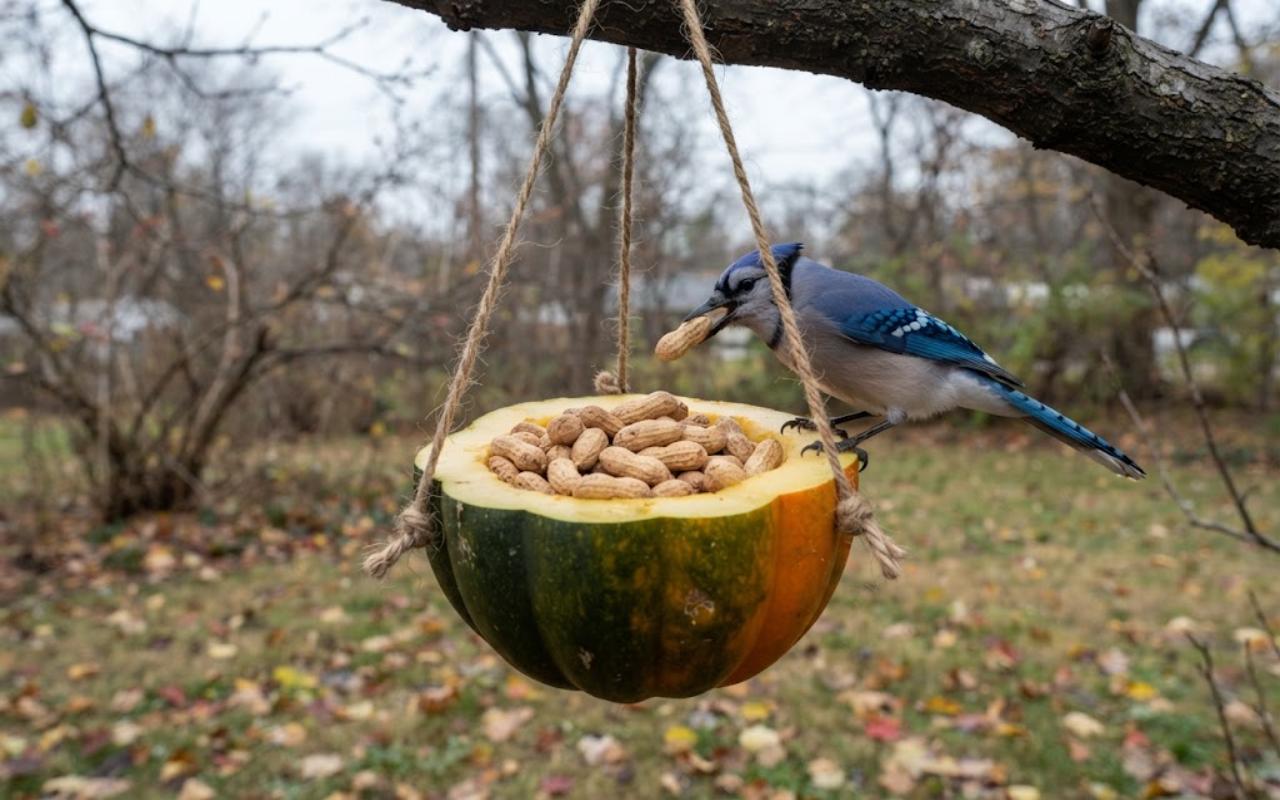
Transforming garden produce into an organic feeding station begins when you build an easy diy acorn squash bird feeder for autumn blue jays tailored specifically to support the mass and aggressive caching habits of corvids.
Backyard birders frequently struggle to accommodate heavier songbirds on lightweight commercial feeders that sway excessively or spill seed under abrupt landings. Utilizing dense autumn gourds solves this instability problem while offering a completely biodegradable feeding bowl that blends seamlessly into the fall landscape.
Blue jays require firm footing and reliable counterweights during foraging, which flimsy plastic seed trays fail to deliver during brisk autumn winds. By leveraging the natural rigidity of cured acorn squash, you create a high-capacity platform capable of supporting multiple birds caching food for winter survival.
Quick-Glance Field Summary
Constructing an organic squash platform requires gutting a cured acorn squash, drilling reinforced drainage holes, and anchoring heavy-gauge suspension lines to bear the impact of three-ounce birds without tilting. This setup delivers rapid lipid replenishment for caching corvids while eliminating the synthetic plastic waste of traditional seasonal feeding stations.
- Base material: Fully cured green or variegated acorn squash with minimum 1-inch rind wall
- Rigging line: 75-pound test natural jute twine or 16-gauge galvanized steel wire
- Suspension hardware: Four 2-inch stainless steel fender washers to prevent tear-through
- Drainage ports: Three 0.375-inch holes bored through the lowest floor ring
- Target bait: In-shell raw Virginia peanuts and unsalted black oil sunflower seeds
- Thermal service limit: Deploy between 28°F and 58°F; discard once pulp softens
Structural Sag and Perch Mechanics for Heavy Corvids
Blue jays (Cyanocitta cristata) weigh between 2.5 and 3.5 ounces, exerting significant kinetic force when landing on dynamic backyard perches. Community members on r/backyardbird frequently report that suspended fruit and gourd feeders invert or tilt drastically when larger corvids land, dumping entire seed reservoirs into the lawn.
A standard commercial cable often fails to balance an off-center load when a bird strikes the perimeter rim at a sharp descent angle. Rigidity begins with the geometry of the acorn squash itself.
Selecting an oblate squash with pronounced longitudinal ridges provides natural structural trusses that resist flex under point loads. Cross-drilling the rim to accept 0.25-inch hardwood dowels creates exterior perching struts, keeping the bird’s center of gravity outside the hollowed food basin to prevent premature rind collapse.
- Minimum squash diameter: 5.5 inches across the widest equatorial axis
- Perch dowel extension: 2.5 inches beyond the outer rind perimeter
- Wall thickness threshold: 0.75 inches minimum after scooping to prevent structural buckling
- Anchor points: 4 equidistant suspension holes placed 1 inch below the carved rim
Distributing the bird’s weight through a four-point wire harness rather than a single center stem loop prevents the pendulum effect observed on local birdwatching forums.
When a jay lands, the four-point array limits lateral deflection to under five degrees, keeping the platform steady. This stability encourages prolonged visits and allows jays to extract whole nuts without losing their balance.
| Organic Feeder Style | Structural Weight Capacity | Avian Foraging Benefit | Primary Weather Risk |
|---|---|---|---|
| Acorn Squash Bowl | High; thick, rigid rind easily supports multiple large, heavy birds simultaneously. | Provides an expansive open tray space ideal for caching nuts and whole peanuts. | Thick bottom flesh can trap standing rainwater if drainage holes get blocked. |
| Apple Slice Ring | Low; thin vertical fruit loops built only for lightweight songbirds. | Supplies instant fructose and fiber energy for migratory winter thrushes. | Absorbs ambient humidity rapidly, rotting and dropping flesh after heavy rains. |
Pulp Excavation and Drainage Port Geometry
Improperly carved squash retain moisture, rapidly fermenting seeds and cultivating dangerous environmental pathogens. Wildlife rehabilitators consistently caution against standing moisture in temporary feeders, as damp seed hulls harbor Aspergillus flavus, an insidious mold that generates fatal aflatoxins in avian digestive tracts.
Concurrently, trapped moisture invites soft-rot bacterial pathogens like Pectobacterium and water molds, which rapidly break down pectin to compromise the gourd’s structural integrity. Ensuring rapid fluid transit out of the basin is mandatory for bird safety and feeder longevity.
Field tests shared by members of the Cornell Lab of Ornithology yard-experimentation threads indicate that small puncture holes inevitably plug with seed meal within forty-eight hours.
Using a 0.375-inch brad-point drill bit prevents pulp tear-out and leaves clean, round drain holes that remain open through heavy autumn precipitation. Angling the drill bit slightly outward forces rainwater to run along the lower exterior contours rather than pooling inside the core.
- Clean-out tool: Serrated grapefruit spoon or melon baller to scrape pulp clean down to firm flesh
- Interior wall drying time: 24 hours in a well-ventilated space before baiting
- Anti-microbial wash: 1:9 ratio of white vinegar to water rinse to inhibit immediate spore and bacterial germination
- Interior floor design: Conical center mound sloping downward toward perimeter drainage channels
Scraping the inner walls until no fibrous placenta or wet pulp strings remain removes the primary substrate for cellular decomposition. Leaving wet squash fibers behind accelerates these bacterial soft rots, causing the bottom of the feeder to drop out under the weight of autumn rains.
Once dried, the firm, leathery inner surface serves as an inert, moisture-resistant cup.ves the prime vector for bacterial decay. Leaving wet squash fibers behind accelerates soft rot, causing the bottom of the feeder to drop out under the weight of autumn rains. Once dried, the firm, leathery inner surface serves as an inert, moisture-resistant cup.
Lipid Caloric Density and Autumn Cache Nutrition
Autumn corvid biology focuses relentlessly on caching high-energy mast to survive the approaching winter freeze. Ornithological nutritional surveys confirm that autumn blue jays shift their feeding ecology toward high-lipid nuts, actively selecting foods that provide maximum caloric yield per transport trip.
Loading your feeder with filler grain like red milo or cracked corn results in unwanted birds kicking seed onto the ground. Reddit backyard birding contributors frequently note that jays will meticulously weigh multiple nuts in their beaks, discarding lighter specimens to select the heaviest payload.
Whole, unroasted, unsalted peanuts in the shell provide the exact structural and caloric properties jays require for efficient throat pouch storage. Mixing these with oil-dense black seeds guarantees that visiting birds expend fewer flight calories for their daily energetic intake.
- Raw in-shell peanuts: 45 to 50 percent fat content for rapid fat reserve accumulation
- Black oil sunflower seeds: 28 percent crude protein and over 40 percent lipid profile
- Striped sunflower seeds: Thicker pericarp shell, discouraging small house sparrows while engaging jay bill mechanics
- High-yield suet nuggets: Rendered beef fat chunks cut to 0.5-inch cubes for sub-freezing morning energy
Avoid roasted or salted culinary products, as excess sodium damages avian renal systems and causes severe dehydration. Providing intact shells also stimulates the natural caching behavior of jays, who hammer the nuts into the ground or lodge them in tree bark crevices. This natural activity keeps the feeder moving and reduces congestion around the platform.
Rigging Twine Degradation and Hardware Failure Points
A frequent failure point documented by forum hobbyists involves using thin organic twine that decomposes rapidly when exposed to persistent autumn moisture. Standard garden hemp or light jute strings degrade within two weeks under the acidic juices of decaying squash combined with atmospheric humidity.
Catastrophic rigging breaks typically occur at the squash rim interface, where abrasive rind edges saw through softened fibers. Employing 16-gauge vinyl-coated wire or 75-pound test braided marine-grade cord eliminates drop failures throughout the multi-week lifespan of the fruit.
Passing the support line through a broad stainless steel washer under the squash wall spreads the upward tension over a broader area. This hardware configuration prevents the suspension lines from slicing upward through the rind when a heavy bird alights on the rim.
- Bottom support hardware: 2-inch stainless steel fender washers placed against exterior rind base
- Line feed pathway: Threaded from underneath, running externally through carved side notches
- Top terminus loop: Heavy-duty 2-inch welded steel ring hung from a fixed branch hook
- Cable protection sleeve: 0.25-inch aquarium airline tubing over wire points to prevent rind friction wear
By utilizing mechanical stops beneath the base, the fruit sits in a structural sling rather than dangling by its fragile upper rim. This construction supports up to five pounds of wet seed and fruit mass without ripping. The assembly survives driving autumn winds and sudden, aggressive landings by competitive corvids.
Sciurid Exclusion Baffles and Feeder Longevity
Any feeding station offering whole peanuts immediately attracts gray squirrels, fox squirrels, and chipmunks. Live community discussions regularly highlight squirrels chewing directly through the squash flesh within hours of deployment to reach the seed reservoir.
Protecting your organic station requires rigid spacing parameters and slick barrier mechanics. To protect the squash from gnawing rodents, position the station using the strict clearance standards established by wildlife extension specialists.
Suspend the squash at least five feet above the ground, ten feet horizontally from overhanging tree branches, and four feet away from adjacent structures. Installing a wide, smooth acrylic or metal baffle above the feeder redirects descending tree squirrels before they reach the rigging lines.
- Torpedo or stovepipe pole baffle: Minimum 8-inch diameter and 24-inch length on supporting uprights
- Overhead dome baffle: 18-inch polycarbonate hemisphere positioned 12 inches above the squash rim
- Clearance boundary: 10-foot radius clear of lateral launch perches or shrubbery
- Natural deterrent barrier: Ground cayenne pepper dust applied exclusively to seed mix (harmless to avian receptors)
Mammalian oral receptors react aggressively to the capsaicin found in ground chili peppers, while avian species lack the receptors required to register the heat.
Lightly dusting the peanut load keeps rodents at bay without compromising the health or appetite of visiting corvids. When squirrels cannot access the perch, the organic acorn squash remains intact for three to four weeks of clean autumn feeding.