Learning how to make a pinecone peanut butter bird feeder with kids gives children an engaging introduction to ornithology while providing wild birds with high-density winter fuel. Standard craft blogs routinely gloss over the serious physical hazards associated with toxic ingredients or weak construction. When executed correctly, this simple project transforms a basic craft into a safe, highly effective supplemental feeding station.
Understanding avian mechanics ensures your local feathered visitors gain clean calories without risking feather damage or nutritional illness. Establishing defined workspace boundaries keeps the seed-rolling process tidy, organized, and highly educational for young children. This quick tutorial details the exact safe ingredients required to keep your backyard birds secure through winter freezes.
Quick-Glance Field Summary
Constructing a safe feeder requires thermal preparation of the cone base and tempering sticky fats to prevent plumage fouling. This balanced approach protects avian feathers from grease saturation while securing high-energy seeds against moisture degradation.
- Base material: Open, mature female pinecone such as Ponderosa, Eastern White, or Loblolly
- Thermal treatment: Bake at 200 degrees Fahrenheit for 30 to 45 minutes
- Fat binder: Salt-free, xylitol-free, single-ingredient roasted peanut butter
- Fat tempering ratio: 1 part peanut butter blended with 1 part yellow cornmeal or rolled oats
- Seed mixture: 70 percent black oil sunflower seeds, 20 percent safflower, 10 percent white proso millet
- Suspension hardware: 18-gauge craft wire or thick 3-ply natural jute twine
- Spatial placement: Within 3 feet of windows or greater than 30 feet away
Pinecone Thermal Decontamination and Scale Expansion
Collecting wild pinecones introduces hidden biological variables directly into your foraging station. Fallen cones harvested from the forest floor frequently harbor dormant spider egg sacs, bark beetles, and lingering saprophytic fungal spores.
In community discussions on r/backyardbirds, experienced birders frequently caution against hanging unwashed, raw cones that weep sticky sap directly onto avian foot pads and primary flight feathers.
Heat treatment resolves both hygiene concerns and physical feeder geometry. Placing pinecones on a foil-lined baking sheet at 200 degrees Fahrenheit for 30 to 45 minutes liquefies and sets the tacky sap into a glassy, inert finish. This low heat also drives out residual moisture, forcing the woody scales to fully open and creating deep chambers for packing food.
- Eastern White Pine: Long, flexible scales ideal for chickadees and nuthatches
- Ponderosa Pine: Heavy, rigid scales that support larger visitors like woodpeckers
- Loblolly Pine: Deep internal seed pockets providing maximum packing volume
Allow the cones to cool completely to ambient room temperature before handling them with children. This structural prep work ensures the woody scales do not snap off under the pressure of spreading food into the gaps.
Lipid Viscosity and Avian Plumage Contamination Hazards
Pure peanut butter poses a severe, documented physical hazard to small songbirds when deployed without modification. Wildlife rehabilitators across regional rescue forums report seeing downy woodpeckers and tufted titmice admitted with breast feathers heavily matted by pure peanut butter.
When fats coat a bird’s feathers, the microscopic barbules unlock, destroying the plumage’s waterproofing and thermal insulation, which can quickly lead to fatal hypothermia.
Pure commercial peanut butter also carries a risk of bill-clogging and aspiration if consumed too quickly by small passerines. You can eliminate this hazard by cutting the peanut butter with dry ingredients to form an avian pastry dough. Blending coarse yellow cornmeal or finely ground rolled oats directly into the peanut butter lowers its tackiness and absorbs free oils.
- 1 cup natural, unsalted, smooth peanut butter free from hydrogenated oils
- 1 cup plain, non-degermed yellow cornmeal
- 0.5 cup coarse-milled rolled oats or suet shreds
Mix these dry ingredients thoroughly until the paste holds a stiff, clay-like consistency that does not stick to your fingers. Never use peanut butter containing artificial sweeteners like xylitol, which is lethal to domestic pets and poses unstudied metabolic risks to wild birds.
Structural Rigging Hardware and Avian Entanglement Prevention
Applying the hanging loop after the cone is coated in food is a messy mistake that creates loose, insecure knots. Threads, sewing line, and lightweight fishing monofilament must never be used. Discussions on r/birdwatching reveal repeated accounts of squirrels chewing through light synthetic thread in minutes, causing the feeder to drop, while fine mono-filament loops present lethal toe-snagging hazards for clinging birds.
Anchor your suspension line directly to the core of the cone before introducing any edible ingredients. Wrap an 18-gauge coated craft wire or a length of heavy 3-ply natural jute twine securely around the base scales of the pinecone. Twist the wire down or cinch the knot tightly between the deepest crevices near the stem base to create an immovable connection point.
- Natural 3-ply jute or sisal twine cut to an 18-inch working length
- 18-gauge galvanized floral or utility craft wire
- 0.25-inch screw eye anchored into a pre-drilled pilot hole for hard cones
Creating a rigid, double-twisted wire harness leaves a clean loop at the top for branch attachment. This structural anchor eliminates swaying slack and gives children a clean handle to hold during the coating process.
Seed Adhesion Ratios and Mycotoxin Mitigation
A successful coating relies on high-energy, oil-rich seeds that provide dense caloric returns for foraging species. Avoid cheap commercial seed blends heavy in red milo, cracked wheat, or flax, as backyard birds simply discard these fillers onto the damp ground below. Focus instead on native bird favorites that easily nestle into the peanut butter paste.
- 70 percent high-grade black oil sunflower seeds for primary lipid intake
- 20 percent safflower seeds to deter common feeder bullies like grackles
- 10 percent white proso millet to cater to smaller native sparrows
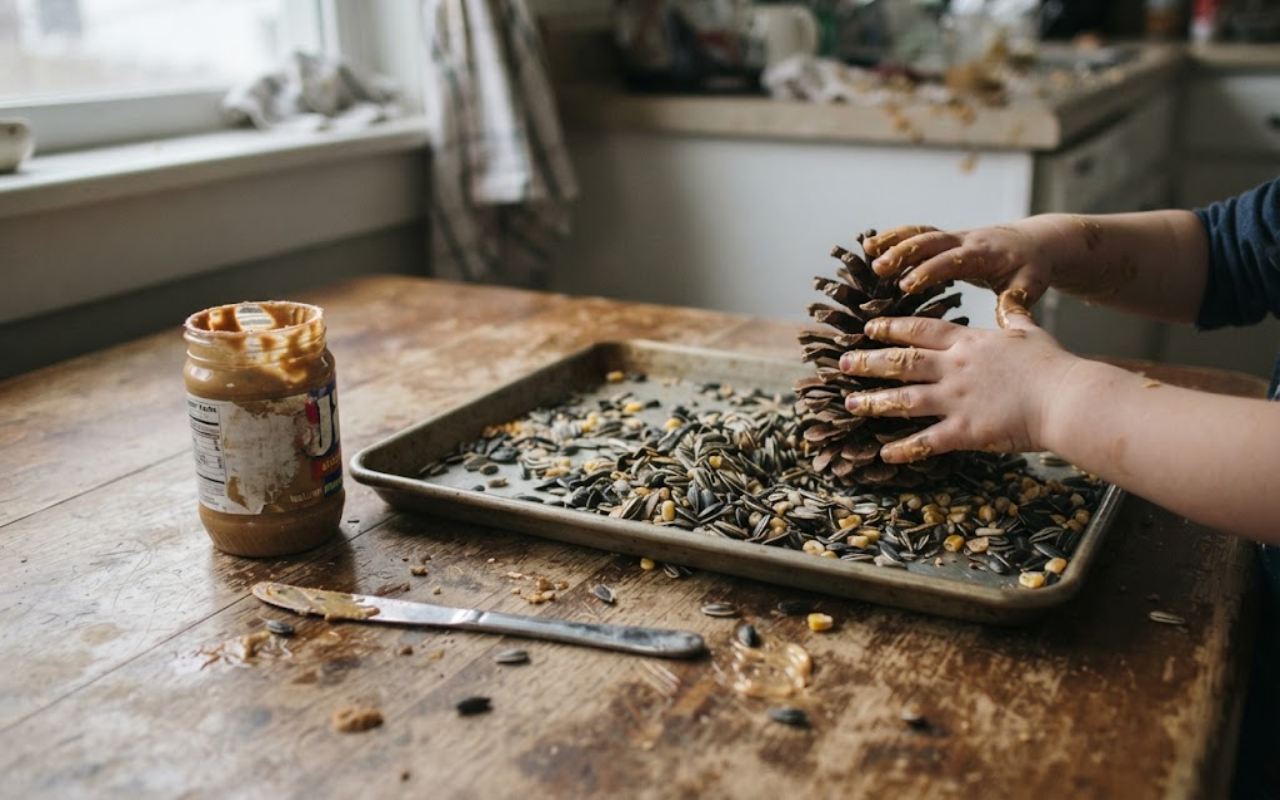
Have children roll the prepared pinecone firmly in a wide, flat tray filled with the seed blend, pressing the grains deep into the tempered paste. Once fully coated, place the feeder in a sealed container in the refrigerator for two hours to firm up the fat matrix.
Moisture management is critical once the feeder is placed outdoors. Damp, fluctuating winter weather encourages the growth of Aspergillus flavus, a fungus that produces lethal aflatoxins in stored seed and nut matrices. If the feeder gets caught in sustained rain or melting snow for more than 48 hours, discard it to protect birds from respiratory infection.
Spatial Placement Geometry and Collision Avoidance Rules
Where you choose to hang the feeder determines whether it becomes a safe feeding station or a hazard for local birds. Windows represent one of the leading sources of avian trauma in suburban backyards. To mitigate this hazard, follow the clear collision safety guidelines established by the Audubon Society.
Feeders must be installed within 3 feet of your windows or placed further than 30 feet away from any glass surface. At distances under 3 feet, birds taking flight cannot build enough momentum to suffer fatal impact injuries if startled. Beyond 30 feet, birds have sufficient air space to spot glass reflections and alter their flight paths safely away from the house.
- Mount the feeder 5 to 6 feet above the ground to deter climbing mice and domestic cats
- Provide a resting perch within 10 to 12 feet, such as a native deciduous bush or evergreen
- Position a standard 12-inch clear weather baffle directly above the cone to deflect rain and snow
This spatial geometry keeps your visitors safe from neighborhood predators and protects them from window strikes. Children can then monitor feeding behaviors from an indoor viewing station, turning a simple weekend craft into a rich, long-term ornithological study.