
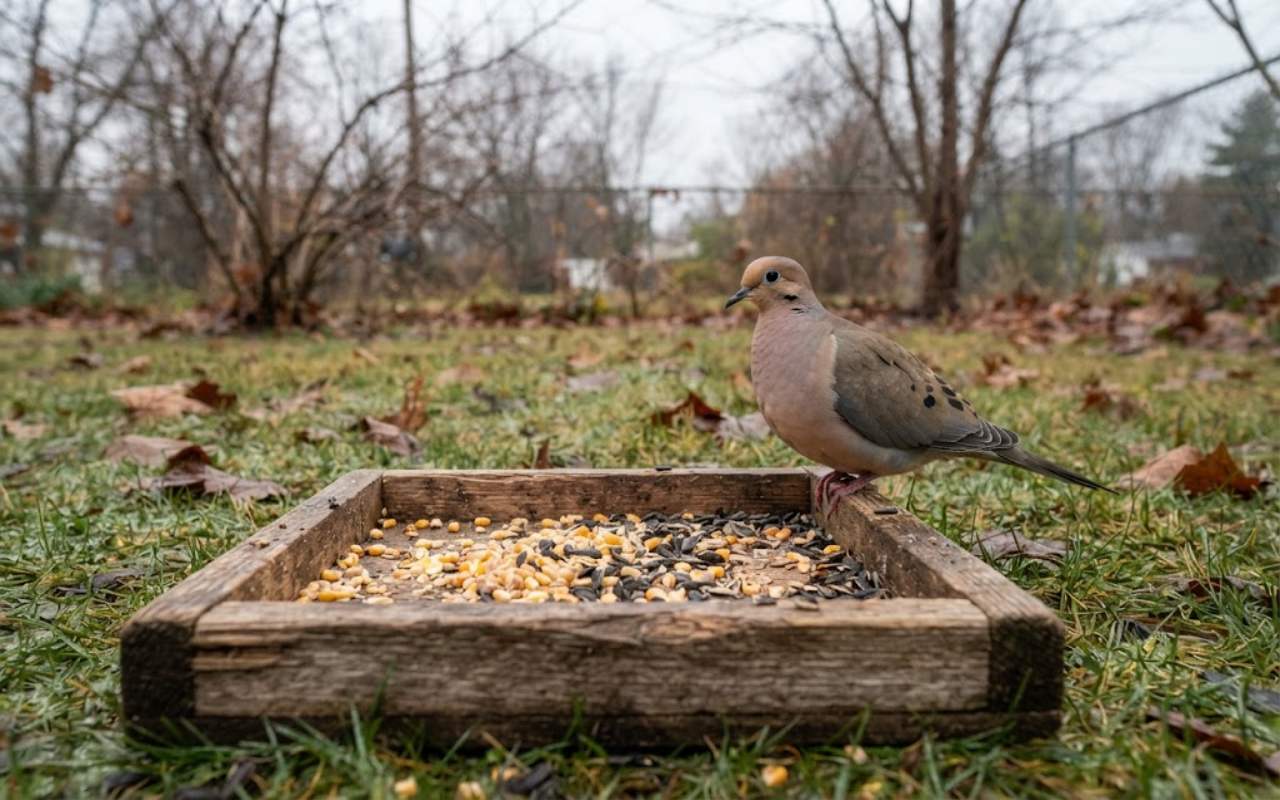
Deciding whether feeding corn to backyard birds is a safe choice this fall requires weighing inexpensive caloric bulk against serious nutritional and biological risks. While autumn drop-offs in natural forage push foraging flocks toward suburban feeding stations, corn represents a stark dietary departure from the dense lipids migratory songbirds urgently require.
Backyard birders often turn to cracked kernels as an economical way to fill large hoppers before freezing temperatures arrive. However, handling this grain demands tight sanitation controls, precise weather monitoring, and strict pest mitigation strategies to protect visiting wildlife from unintended harm.
Quick-Glance Field Summary
Deploying cracked corn during the autumn transition requires treating the grain as an occasional supplemental attractant rather than a primary fuel source. Field success hinges on offering small, weather-protected portions that birds consume completely before evening dampness triggers deadly mold proliferation.
- Recommended portion window: 24-hour consumable volume; never exceed single-day rations
- Target ambient moisture limit: Under 65 percent relative humidity during outdoor exposure
- Mesh hardware exclusion standard: 0.25-inch to 0.5-inch wire mesh to exclude mammalian pests
- Minimum tray drainage hole diameter: 0.125-inch perforations spaced every 1.5 inches
- Nutritional crude fat comparison: 4 percent in cracked corn versus 28 to 40 percent in black oil sunflower
Nutritional Limitations: Carbohydrate Starch Versus High-Lipid Fall Needs
Autumn brings an intense metabolic shift for non-migratory songbirds and departing neotropical migrants alike. During late September through November, avian physiology prioritizes dietary fats and crude proteins to rebuild muscle tissue and build lipid reserves for overnight thermoregulation.
Cracked corn consists of roughly 70 percent simple carbohydrates and starches, offering a mere 4 percent crude fat and roughly 9 percent protein.
In contrast, black oil sunflower seeds deliver upwards of 28 to 40 percent lipids, providing the concentrated energy density small songbirds require to survive sub-freezing autumn nights. A chickadee or nuthatch filling its crop with dry corn starch exhausts significant metabolic energy digesting low-yield carbohydrates while missing critical fatty acids.
- Cracked yellow dent corn: 4 percent crude fat and 72 percent carbohydrates
- Black oil sunflower seed: 38 percent crude fat and 16 percent crude protein
- White proso millet: 4 percent crude fat and 11 percent crude protein
- Whole sunflower hearts: 45 percent crude fat and 20 percent crude protein
When temperature fluctuations plunge below freezing, grain-heavy diets leave smaller passerines vulnerable to metabolic exhaustion. Starch provides quick thermal bursts, but it lacks the sustained energy burn necessary to carry small bodies through twelve hours of autumn darkness.
| Corn Preparation | Target Avian Visitors | Backyard Utility Benefit | Primary Nuisance Risk |
|---|---|---|---|
| Medium Cracked Corn | Native sparrows, dark-eyed juncos, towhees, doves, and wild turkeys. | Highly economical; fits small seed-cracking beaks perfectly without waste. | Aggressively draws in non-native house sparrows and european starlings. |
| Whole Shelled Corn | Blue jays, crows, ravens, grosbeaks, and wild quail. | Hard, dry kernels resist rain absorbency better than cracked pieces. | Triggers heavy mammal competition from squirrels, raccoons, and deer. |
Moisture Hazards: Aspergillus Flavus and Lethal Fall Aflatoxin Spikes
The single greatest physical threat associated with autumn corn feeding stems from moisture absorption and rapid fungal colonization. Once the protective fibrous outer pericarp of a whole corn kernel is cracked or crushed, the moist interior starch is exposed directly to ambient humidity and rainfall.
In local backyard birding communities across r/backyardbird and regional audubon forums, hobbyists routinely report finding caked, foul-smelling gray lumps at the base of their tube feeders within 48 hours of autumn rains. That gray or greenish film is frequently Aspergillus flavus, an environmental mold that produces potent, highly carcinogenic compounds known as aflatoxins.
- Lethal fungal pathogen: Aspergillus flavus producing dangerous aflatoxin compounds
- Target moisture trigger: Sustained relative humidity above 70 percent combined with temperatures above 50 degrees Fahrenheit
- Contamination prevention window: Discard unconsumed wet grain within 24 hours of rainfall
- Sterilization benchmark: Thorough soaking in a 1:9 household bleach-to-water solution
Avian livers possess exceptionally low tolerance for aflatoxins, and ingested doses cause acute liver necrosis, immunosuppression, and rapid death across entire foraging flocks. Standard wooden hoppers and enclosed plastic tube feeders trap condensation around broken kernels, creating optimal growth chambers for toxic spores.
Aggressive Foragers: Managing Grackle Swarms and Mammalian Nuisance Visits
Beyond internal health hazards, scattering cracked corn fundamentally alters yard dominance hierarchies. Community discussions on r/birdwatching frequently highlight the grackle trap, where an affordable bag of mixed corn inadvertently invites hundreds of Common Grackles and European Starlings that strip feeders bare in minutes.
These aggressive flocks monopolize feeding stations, bullying smaller native species such as Tufted Titmice, Carolina Chickadees, and Goldfinches away from essential food supplies. Furthermore, the strong aroma of broken corn starch acts as a long-range beacon for nocturnal mammals preparing for winter torpor.
- Common grackles and European starlings outcompeting native passerines
- Brown-headed cowbirds dominating open platform perches
- Striped skunks and Virginia opossums congregating beneath feeding stations
- White-tailed deer and black bears raiding high-capacity yard hoppers
White-tailed deer will dismantle lightweight hanging hardware to reach unharvested corn supplies, while suburban rodent populations multiply quickly around grain-littered turf. If regional black bear activity remains high during pre-denning hyperphagia, broadcasting grain on the ground creates immediate safety risks for both homeowners and wildlife.
Feeder Hardware Engineering: Elevated Trays Versus Ground Broadcast Strategies
If you choose to offer cracked corn this fall, your feeder architecture dictates whether the grain serves wildlife or breeds disaster. Deep hopper feeders, hanging tube feeders, and narrow mesh silos represent the worst equipment choices for cracked grain because they restrict interior airflow and trap bottom-tier debris.
A dedicated platform tray equipped with a fine stainless-steel mesh floor remains the safest deployment vehicle. The perforated bottom allows water to drain rapidly during driving autumn storms, while maximum surface exposure speeds up evaporation under intermittent sunlight.
- Install hanging trays suspended at least 5 feet above ground grade
- Fit an 18-inch clear polycarbonate baffle directly above the tray to deflect autumn rain
- Maintain a minimum 10-foot radial clearance from adjacent deck railings or overhanging branches
- Mount ground-level excluder cages made from 1.5-inch wire fencing around low feeding sites
Never dump large mounds of cracked corn directly onto damp autumn turf or decaying leaf litter. Soil contact accelerates mold development within hours, exposing ground-foraging birds to concentrated soil parasites and lethal fungal mycotoxins.
Species-Targeted Blends: Diverting Juncos and Native Sparrows Safely
Cracked corn can serve a constructive secondary purpose in a fall yard if applied through targeted diversion feeding. Native ground foragers such as Dark-eyed Juncos, Fox Sparrows, Eastern Towhees, and Northern Bobwhites possess robust gizzards capable of processing cracked coarse grain safely.
Rather than placing corn in primary feeding arrays, set up a dedicated diversion feeding station along the yard perimeter near natural brush piles. Experienced field hobbyists use small handfuls of cracked corn placed beneath open-sided shelters to occupy aggressive scrub jays, wild turkeys, and squirrels.
- Dark-eyed Juncos foraging along brushy ecotones
- Eastern Towhees and White-throated Sparrows scratching through dry leaf cover
- Northern Cardinals and Blue Jays utilizing heavy-beaked crushing mechanics
- Wild Turkeys consuming coarse grains away from delicate perching stations
This strategic buffering keeps high-energy sunflower and suet feeders open for smaller canopy feeders like nuthatches and woodpeckers. By rationing corn to single-day quantities and withholding it entirely during extended wet spells, you provide safe supplemental forage without endangering visiting migratory birds.