
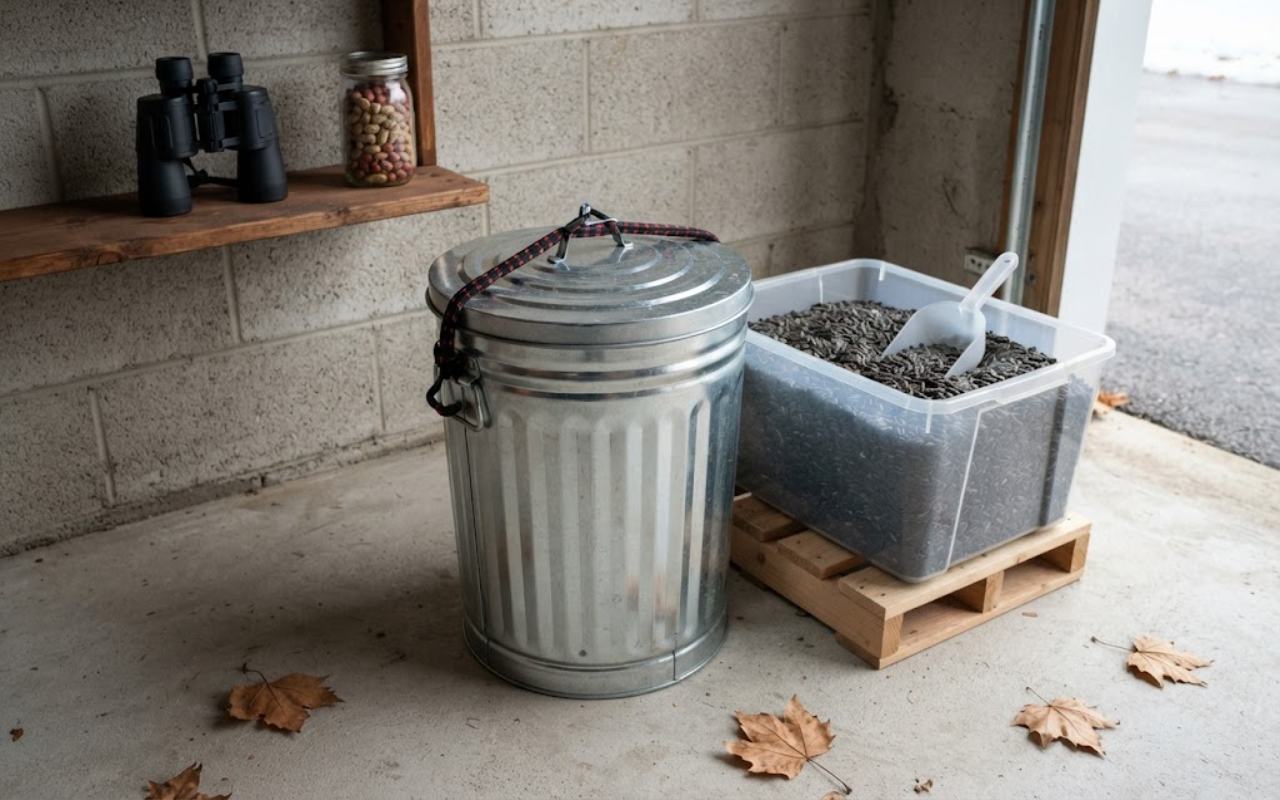
Mastering how to store large batches of bird seed without getting bugs requires understanding the life cycles of stored-product pests before they destroy your investment. Bulk purchasing forty or fifty-pound sacks of black oil sunflower, safflower, or millet saves significant money, but it also creates an ideal breeding ground for pantry invaders when storing bird seed for winter.
Most commercial bird seed already contains microscopic insect eggs straight from agricultural fields and distribution warehouses. Without deliberate intervention, warm ambient conditions will trigger rapid hatching, turning expensive seed into clumpy, webbing-filled waste that wild birds will completely reject.
Quick-Glance Field Summary
Long-term insect exclusion relies on a two-step defense that physically disrupts insect life cycles through mandatory thermal treatment followed by vapor-tight hermetic containment. Implementing this workflow eliminates existing egg populations at purchase and seals out external opportunistic pests like weevils, beetles, and rodents.
- Thermal quarantine baseline: Freeze bulk seed at 0 degrees Fahrenheit (-18 degrees Celsius) for a minimum of 72 hours.
- Primary containment: Food-grade high-density polyethylene (HDPE) buckets equipped with threaded, O-ring gasket Gamma Seal lids.
- Secondary container option: 20 to 30-gallon galvanized steel trash cans fitted with locking lid bails for unconditioned outdoor sheds.
- Target internal storage humidity: Below 12 percent seed moisture content to prevent fungal spore germination.
- Chemical prohibition: Zero synthetic insecticides, mothballs, or petroleum-based deterrents near any avian food stock.
The Entomological Vector: Identifying Larvae and Webbing in Bulk Bags
The most pervasive pest ruining large seed stores is the Indianmeal moth (Plodia interpunctella), followed closely by the granary weevil (Sitophilus granarius) and the sawtoothed grain beetle (Oryzaephilus surinamensis). In a recent discussion on r/backyardbirds, a community member documented how Indianmeal moth larvae chewed directly through multi-ply woven polypropylene seed sacks within two weeks of delivery. These pests do not need an open bag to infiltrate your garage or basement, as their tiny larvae exploit micro-perforations and stitched seams.
The earliest signs of an active infestation are silken webbing strings clinging to the inner bag folds, clumped seed clusters suspended by invisible filaments, and fine powdery frass at the bottom of the sack. Granary weevils operate differently by boring minute holes directly into individual seeds to deposit eggs, hollowing out high-lipid sunflower kernels from the inside out.
Once larvae emerge, their metabolic activity elevates the surrounding micro-temperature and generates local moisture pockets. This biological activity quickly ruins bulk feed, converting rich fats into foul, unpalatable waste that outdoor birds readily ignore.
| Container Storage Matrix | Pest Sealing Integrity | Backyard Conservation Benefit | Primary Environmental Risk |
|---|---|---|---|
| Galvanized Steel Bins | Elite; 100% chew-proof against rodents and permanently impenetrable to moths. | Blocks persistent pests entirely while eliminating localized grease odors. | Condenses interior moisture rapidly if exposed to sudden ambient heat flashes. |
| Heavy Polycarbonate Tubs | High seal; gaskets create airtight boundaries that suffocate insect larvae. | Clear walls provide an immediate, visual inventory tracking level. | Determined mice or squirrels can eventually chew straight through corner seams. |
Thermal Sterilization Protocols: Deep Freezing Cycles for Egg Neutralization
You should operate under the firm assumption that all commercial seed bags contain dormant pest eggs upon arrival. The most reliable, non-chemical method to neutralize these eggs before they hatch is cold-temperature exposure. Placing your seed inside a domestic deep freezer set to 0 degrees Fahrenheit (-18 degrees Celsius) for 72 consecutive hours halts metabolic development and kills larvae, pupae, and adult beetles.
Backyard birders working with high volume often split 50-pound bags into manageable 1-gallon or 2-gallon freezer bags to accelerate core freezing. If you place a dense, unbroken 50-pound paper sack into a freezer, the insulating properties of whole seeds can protect the interior core from critical temperatures for up to 36 hours.
Dividing bulk purchases ensures rapid thermal penetration to the very center of the batch. Once the 72-hour cycle concludes, allow the seed to warm back to room temperature inside an airtight container before opening it. Opening cold bags in warm, humid air draws immediate condensation onto the cold seeds, which introduces dangerous moisture.
Container Integrity: Gamma Seal HDPE Buckets Versus Galvanized Steel
Standard plastic storage totes with snap-on lids fail consistently because their edges lack airtight seals and flexible plastics are easily gnawed by mice. Experienced birders on community forums widely advocate for 5-gallon or 7-gallon food-grade HDPE buckets paired with threaded Gamma Seal lids. These retrofitted lids replace snap-on covers with heavy-duty, O-ring rubber gaskets that form an airtight, insect-proof barrier.
Galvanized steel trash cans remain the historical gold standard for rodent exclusion, but they present specific pest vulnerabilities in humid climates. Metal containers transfer ambient temperature swings rapidly, which often leads to sweat formation on inner walls if placed in non-climate-controlled sheds.
If you use large 20 to 30-gallon galvanized cans, pour the seed into food-grade liners rather than letting it touch the bare metal directly. Secure the lid with external tension bails or heavy rubber bungee cords to prevent raccoons and rodents from dislodging the lid and introducing outdoor moisture.
- Food-grade HDPE bucket: 90 mil wall thickness minimum to prevent rodent gnawing.
- Gamma Seal lid: Threaded double-gasket ring system screwed directly onto bucket rims.
- Galvanized steel trash can: 20 to 32 gallons, 24-gauge corrugated steel construction.
- Gasket maintenance: Inspect rubber rings semi-annually for drying, cracking, or trapped seed dust.
Clean the sealing tracks thoroughly between every bulk refill. Seed husks and oil residues caught in bucket threads compromise the airtight seal and give tiny weevil larvae a path inside.
Microclimate Control: Managing Moisture Condensation and Aflatoxin Risks
Insect outbreaks and fungal growth are deeply connected; damp seed accelerates beetle reproduction while unlocking harmful fungal pathogens. When relative humidity levels rise above dangerous thresholds, the fungus Aspergillus flavus colonizes high-lipid seeds like corn and peanuts, producing deadly aflatoxins. Aflatoxins are hepatotoxic mycotoxins that cause acute liver failure, suppressed immune response, and high mortality in songbirds.
A recurring complaint in localized wild bird groups involves metal bins kept in outdoor sheds sweating during mid-summer temperature spikes. That internal sweat drips down container walls, creating a foul mold ring along the bottom layer while activating dormant beetle pupae.
To mitigate this humidity trap, store your sealed buckets off damp concrete floors by using wood pallets or wire shelving racks. Concrete transmits dampness via capillary action directly into container bases, creating persistent internal humidity gradients.
- Food-safe silica desiccant packs: 50 to 100-gram rechargeable canisters placed inside dry storage bins.
- Maximum ambient storage humidity: Below 50 percent relative humidity within the storage space.
- Elevated platform clearance: Minimum of 3 inches of airflow clearance beneath container bases.
- Routine sanitation wash: Diluted 1:9 bleach-to-water soak, followed by total sun drying before refilling.
Never add fresh bulk seed on top of an older, diminishing seed layer. Empty the storage bucket completely, sanitize the container, let it dry entirely, and only then add your new batch.
Forum-Tested Yard Strategies: Bay Leaves, Pheromone Traps, and Quarantine Staging
Experienced hobbyists often rely on mechanical, non-toxic yard hacks to create extra defensive layers around their primary seed stores. A widespread technique discussed across homesteading forums involves taping dried whole bay leaves (Laurus nobilis) to container lids or scattering them around storage shelving. The natural cineole compounds in bay leaves act as a safe repellent for grain weevils and pantry moths without tainting the seed with synthetic chemicals.
Pheromone sticky traps should be deployed strictly outside seed bins rather than inside them. Placing an active Indianmeal moth pheromone trap directly inside a seed bin actually lures nearby male moths into your feeding supply.
Mount sticky traps on the garage or shed wall five to ten feet away from your bins to serve as an early warning system. If you catch two or more moths within a single week, it is time to inspect your lid gaskets and verify that no seals are compromised.
- Quarantine zone: Keep freshly bought bulk bags in an isolated garage sector for five days before decanting.
- Pheromone trap placement: Five to ten feet away from feed bins, mounted at human eye level.
- Physical barrier: Wrap heavy-duty adhesive weatherstripping around outer storage shelf legs to stop crawling larvae.
- Diatomaceous earth barrier: Light dusting of food-grade diatomaceous earth placed exclusively beneath storage pallets.
Never dust diatomaceous earth directly into the bird seed itself. While food-grade diatomaceous earth is non-toxic to mammals, the sharp microscopic silica particles irritate avian respiratory systems and harm sensitive eyes when birds forage in feeders. Keep these natural desiccants on the floor beneath pallets to eliminate crawling pests safely before they ever reach your clean feed bins.