
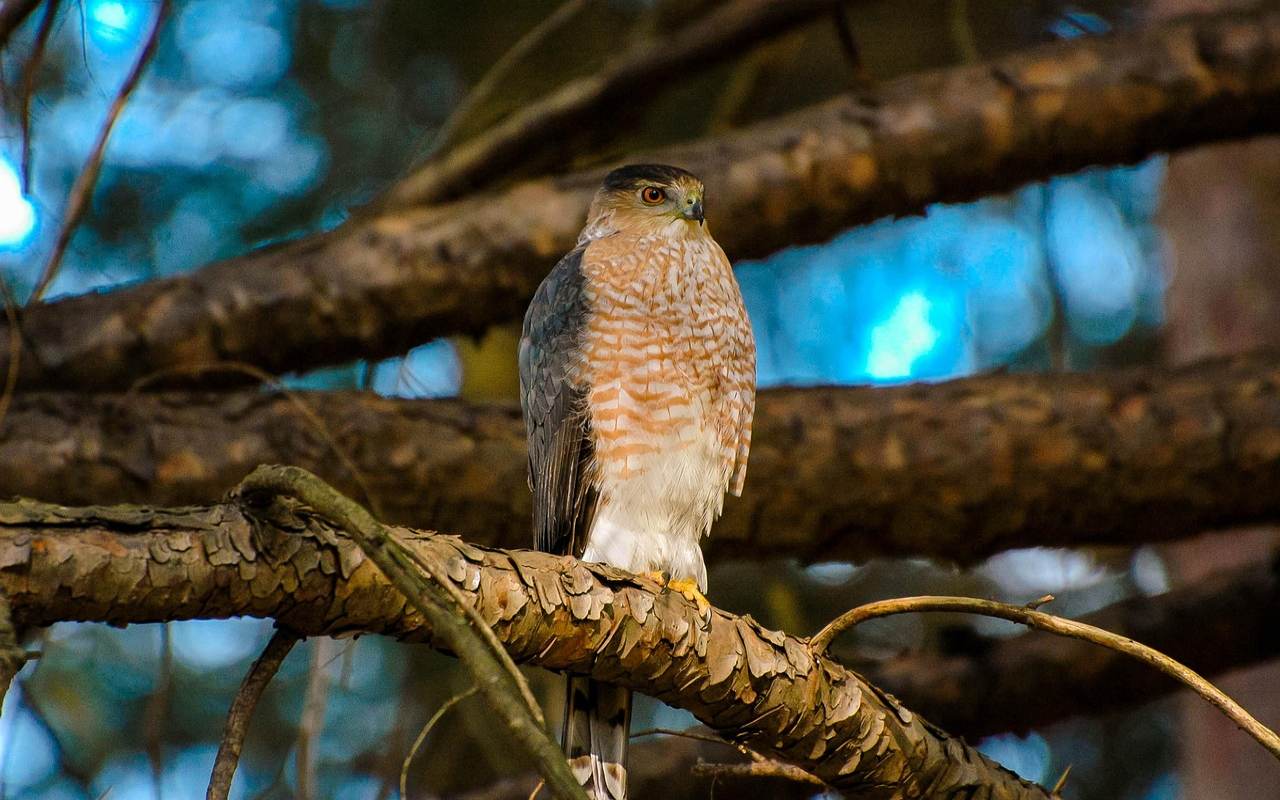
Discovering a Cooper’s hawk hunting your winter bird feeding station can feel alarming, but understanding the presence of hawks at bird feeder setups indicates a functioning, dynamic local ecosystem rather than a backyard failure. The presence of an apex woodland predator confirms that your habitat offers sufficient caloric resources to support multiple trophic levels during the harshest months of the year.
A persistent myth suggests that accipiter predation will permanently decimate your local songbird population or drive species away indefinitely. In reality, healthy songbirds possess sophisticated anti-predator adaptations, and raptors primarily cull diseased, malnourished, or genetically compromised individuals.
Species Profile and Core Behavioral Differences
Backyard feeding stations in winter primarily attract two morphologically similar accipiters: the Cooper’s hawk (Accipiter cooperii) and the sharp-shinned hawk (Accipiter striatus). Both species have evolved short, rounded wings and long, narrow retrices that function as rudders for high-speed maneuverability through dense brush. Differentiating them requires examining structural silhouettes rather than plumage alone.
- Cooper’s hawk (Accipiter cooperii): Body length spans 14 to 20 inches; displays a distinctly rounded tail tip with a broad white terminal band, a dark cap contrasting with a paler nape, and prominent supraorbital ridges that yield a fierce facial expression.
- Sharp-shinned hawk (Accipiter striatus): Body length spans 9 to 13 inches; features a squared or notched tail tip, a dark hood extending seamlessly down the neck, and center-set eyes on a round head.
- Red-tailed hawk (Buteo jamaicensis): Body length spans 19 to 25 inches; possesses broad, heavy wings designed for soaring rather than ambushing, rarely chasing small passerines through residential canopies.
Accipiters rely on surprise ambushes rather than sustained aerial pursuits. A Cooper’s hawk typically perches concealed inside evergreen foliage, assessing flight paths between feeding reservoirs and roosting canopies.
When an attack occurs, the hawk accelerates across open flight lanes to trap birds against fences, walls, or glass surfaces. Songbirds rely on collective vigilance and early acoustic warnings to escape into structural micro-refuges before the raptor closes the attack distance.
Habitat Layout and Feeder Setup
Proper station architecture prevents accipiters from treating your feeding area as a high-density trap. Installing defensive brush piles within tactical proximity to feeders provides immediate, dense cover for fleeing passerines. Without low-canopy shelter, visiting songbirds become vulnerable targets during rapid vertical takeoffs.
- Construct brush piles using a foundational grid of crisscrossed hardwood logs measuring 4 to 6 inches in diameter to prevent snow collapse.
- Layer smaller conifer branches, fallen twigs, and evergreen boughs across the top to establish interlocking, impenetrable corridors.
- Maintain an internal branch spacing of 2 to 4 inches, allowing sparrows and finches to slip through while physically blocking broad accipiter wing spans.
The positioning of protective cover must balance immediate escape access with raptor concealment risks. If cover is too far, birds cannot reach safety; if it is directly beneath the feeder, the hawk uses it as an ambush blind.
Place your primary brush shelter between 10 and 15 feet away from hanging reservoirs. This safe distance creates an unobstructed sightline that prevents the hawk from stalking on foot, while remaining close enough for a fleeing finch or chickadee to reach cover within one second of burst flight.
Structural Dimensions and Placement Guidelines
Window collisions constitute the greatest secondary mortality factor when a Cooper’s hawk raids a backyard. Panicked songbirds flushing from seed reservoirs mistake window glass reflections for open sky and collide at fatal velocities. Adhering to strict distance rules eliminates this fatal kinetic energy.
- Feeder-to-glass safety threshold: Mount window-adjacent feeders within 3 feet of the glass surface, or relocate them at least 30 feet away.
- Window treatment spacing: Apply external visual markers across exterior glass pane surfaces using a strict 2-inch by 2-inch grid pattern to break up exterior sky reflections.
- Pole suspension elevation: Elevate main hanging feeders at a height of 5 to 6 feet above grade to clear deep snowpack while deterring terrestrial ambushes.
- Caged feeder grid specifications: Deploy wire exclusion cages around internal hoppers with 1.5-inch square mesh openings to permit small birds while blocking raptor talons.
Do not mount bird feeders under low structural eaves or directly against solid perimeter fencing. These structures create dead-end flight funnels where accipiters easily corner fleeing flocks.
Orient the open sides of your feeding station toward prevailing downwind flight corridors. Songbirds taking off into a headwind generate lift rapidly, allowing them to dodge descending raptors with superior vertical agility.
Nutritional Biochemistry and Feeding Protocols
Winter passerines require energy-dense rations that maximize net caloric gain while minimizing foraging duration. Prolonged feeding times dramatically increase exposure to stalking predators. Providing feeds with elevated crude lipid profiles ensures visiting birds satisfy their daily metabolic demands rapidly.
- Black oil sunflower seed: 40 percent crude lipids, 16 percent crude protein, and under 30 percent carbohydrates; provides optimal caloric density per minute of active foraging.
- Rendered beef suet: 75 to 90 percent crude lipids, 5 to 8 percent protein, and 0 percent carbohydrates; offers critical thermal fuel during sub-freezing daytime weather.
- Shelled Virginia peanuts: 48 percent crude lipids, 25 percent crude protein, and 20 percent carbohydrates; supplies vital structural amino acids for winter muscle maintenance.
- White proso millet: 4 percent crude lipids, 11 percent crude protein, and 60 percent carbohydrates; lowest winter lipid value, requiring excessive ground foraging time that increases predation risk.
If an individual Cooper’s hawk establishes a permanent, persistent hunting perch at your station, institute a temporary foraging blackout. Cease all seed and suet distribution for 7 to 10 consecutive days.
This break deprives the resident hawk of easy target density without starving local songbirds, which naturally exploit diverse wild food reservoirs across their home ranges. The hawk will abandon the territory and relocate to alternative hunting grounds, allowing you to resume feeding safely.
Pest Mitigation and Sanitation Safeguards
High avian density creates severe transmission vectors for systemic pathogens, which directly threaten both songbirds and visiting raptors. Cooper’s hawks that capture sick prey frequently contract trichomoniasis, an infection caused by the protozoan Trichomonas gallinae. This pathogen induces necrotic, caseous lesions inside the raptor’s upper alimentary tract, ultimately causing starvation.
- Trichomonas gallinae: Transmitted through contaminated saliva deposited on shared perches and stagnant birdbaths.
- Salmonella enterica: Spread via accumulated fecal matter on horizontal feeding trays, causing acute enteritis and septicemia in passerines.
- Aspergillus flavus: Proliferates within wet seed husks at the base of hoppers, producing lethal aflatoxins that induce fatal mycotoxicosis.
Maintaining a rigorous equipment sanitation schedule prevents chemical contamination and disease transmission. Different cleaning compounds deliver varied disinfection efficacies while impacting plastic and metal hardware integrity.
- Sodium hypochlorite solution (1:9 household bleach-to-water ratio): Highest antimicrobial efficacy against fungal spores and bacteria; requires a 10-minute soak followed by thorough air drying, with minimal hardware corrosion if rinsed properly.
- Diluted white vinegar (1:4 acetic acid solution): Moderately effective against select bacterial strains, but completely ineffective against hard-shelled fungal spores; causes zero degradation to clear polycarbonate plastics.
- Pressurized boiling water rinse: Mechanically removes organic biofilm and eliminates protozoan trophozoites; carries high risk of warping thin acrylic reservoirs and cracking molded feed ports.
Rake the soil and turf within a 15-foot radius beneath your feeding gear weekly to clear accumulating hull debris and droppings. Eliminating damp waste removes the ground-level fungal reservoirs that attract rodents and compromise the immunological health of your entire backyard flock.