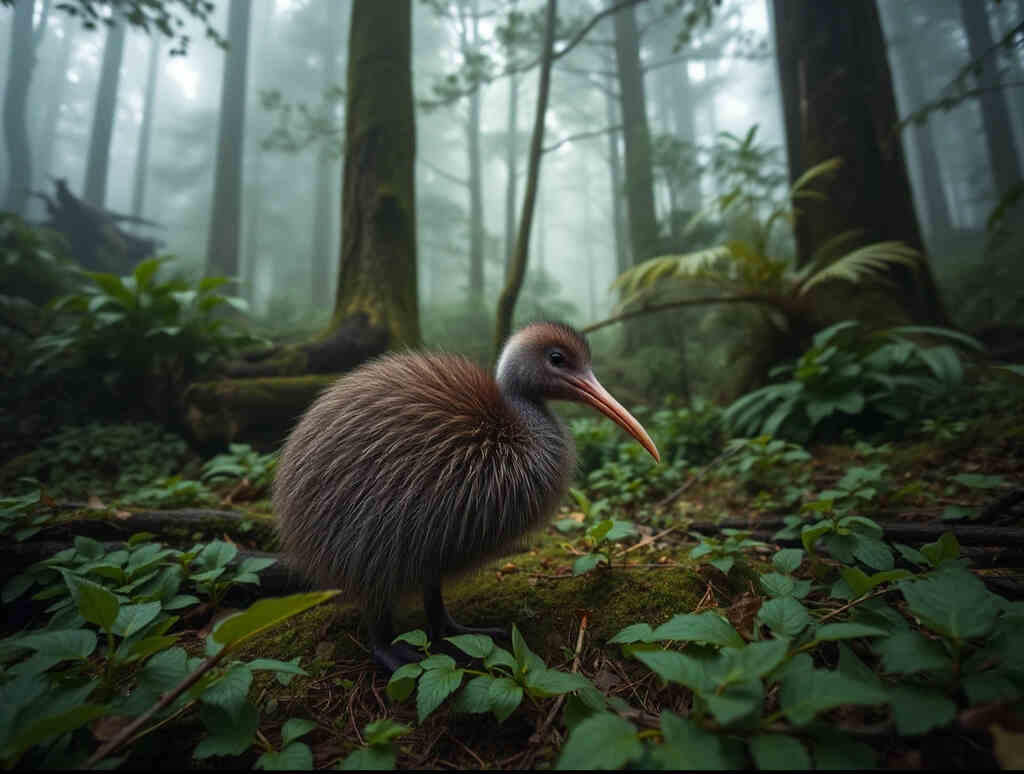
Ever met a bird that can’t fly, has whiskers, lays an egg that takes up 20% of its body weight, and basically acts like it forgot it was supposed to be a bird? 🤯 Welcome to the wonderfully weird world of the kiwi. I’ll be honest: the first time I learned about these creatures, I thought someone was messing with me. A flightless bird with hair-like feathers that hunts by smell at night? That’s not a bird, that’s a fever dream.
But here’s the thing: kiwis are real, they’re spectacular, and they’re fighting for survival in New Zealand. The more I learn about them, the more obsessed I become. These quirky little birds have captured the hearts of an entire nation and honestly, once you get to know their story, you’ll understand why New Zealanders proudly call themselves “Kiwis.”
Table of Contents
- 1 What Makes Kiwi Bird Facts So Fascinating
- 2 Kiwi Bird Size: Small But Mighty
- 3 New Zealand Kiwi Bird Habitat: Where These Oddities Live
- 4 The Legendary Kiwi Bird Egg
- 5 Baby Kiwi Bird: Survival Against the Odds
- 6 Kiwi Bird Predators: The Introduced Menace
- 7 Kiwi Bird Sound: The Calls of the Night
- 8 Conservation: Fighting for Kiwi Survival
- 9 Kiwi Adaptations: Built Different
- 10 Living Alongside Kiwis: What We Can Do
- 11 Why Kiwis Matter Beyond New Zealand
- 12 Wrapping Up This Weird, Wonderful Bird
- 13 Author
What Makes Kiwi Bird Facts So Fascinating
Let’s start with the basics, because honestly, there’s nothing basic about kiwis. These birds belong to the ratite family, which means they’re related to ostriches, emus, and cassowaries. But while their cousins grew huge and intimidating, kiwis went the opposite direction and stayed roughly chicken-sized. Talk about taking a different evolutionary path.
Show Transcript
All right, let’s talk about one of the weirdest animals on the planet.
We’re diving into the story of a bird that seems to have completely forgotten it’s a bird. It acts more like a mammal, and honestly, it seems to have just thrown the evolutionary rule book out the window.
We’re talking about one of Earth’s true originals — the kiwi.
I mean, just think about that for a second. A bird with whiskers, one that lays an egg that’s a full fifth of its entire body weight. It sounds like something made up for a fantasy movie, but nope — it’s 100% real.
And this is it — the kiwi. It’s the national icon of New Zealand, but it’s also a flightless, nocturnal oddball that breaks pretty much every rule you’d expect a bird to follow.
To really get what makes this creature so special, we’ve got to explore how it completely rewrote what it even means to be a bird.
So, first up — how did this bird forget itself?
To really wrap your head around the kiwi, you kind of have to set aside everything you think you know about birds.
See, in the super-isolated world of ancient New Zealand, the kiwi took a completely different evolutionary path than any other bird on Earth.
Just look at this list of quirks. Its feathers are more like hair. Its bones are heavy and filled with marrow, just like ours. It has the lowest body temperature of any bird. And it gets around in the dark not with sharp eyes, but with an amazing sense of smell.
You know, any one of these things would be weird for a bird, but all of them together paint a picture of a bird that literally evolved to be the forest version of a small mammal — kind of like a badger.
And if there’s one fact that just perfectly sums up how different the kiwi is, it’s this: most birds have incredible vision, right? Eagles, hawks — not the kiwi.
Instead, it sticks that long beak deep into the dirt and literally smells its way to its next meal. It is the only bird on the entire planet that does this.
Okay, so the mammal stuff is weird, right? But believe it or not, that’s got nothing on the kiwi’s most legendary feat — what I like to call the impossible egg.
Twenty percent. Just let that number hang in the air for a moment. What on earth could that mean?
Well, it represents one of the most extreme acts in the entire animal kingdom. Any ideas? That’s right — it’s the egg. It makes up a staggering fifth of the female’s entire body weight.
To put that into perspective for us, a human baby is only about 5% of its mother’s weight.
Can you imagine a female kiwi trying to walk around while carrying that thing? She’s so off-balance it’s a miracle she can move at all.
And her incredible effort doesn’t stop once the egg is laid. Oh no — the incubation period takes between 75 and 85 days. That’s nearly three solid months of sitting on a nest in the dark, which is a huge risk when there are dangers lurking.
But here’s the twist: after that heroic effort, the female’s job is pretty much done. It’s the male who takes over for almost that entire three-month stretch.
He dedicates himself completely to protecting that egg. It’s one of the most amazing examples of fatherhood you’ll find anywhere in nature.
So, all of these incredible adaptations — being flightless, nesting on the ground, having a unique sense of smell — they were perfect for the ancient world the kiwi grew up in.
But that perfection has now put the kiwi in a completely unfair fight for its very survival.
You have to remember, the kiwi evolved in a world with no land predators. The only thing it had to worry about was a giant eagle swooping down from above.
So when humans showed up and brought mammals with them, the poor kiwi had absolutely no defenses. It had no idea how to deal with them.
And the result of that is, well, it’s absolutely heartbreaking.
In areas where there’s no conservation help, 95% of all kiwi chicks die before they even reach adulthood. Think about that — only five out of every hundred baby kiwis actually make it.
The number one killer of these chicks is the stoat. Humans introduced them, and this little predator is an absolute killing machine.
It’s fast, it’s vicious, and it can slip right into a kiwi burrow, leaving the defenseless chicks with zero chance.
Now, for the adult kiwis, the biggest threat is actually much closer to home — our pet dogs.
A kiwi’s chest is incredibly fragile. It doesn’t have that strong breastbone most birds have for flight. This means even a playful nudge from a curious dog can be enough to crush them.
So, what’s the total cost of all these new threats? In the areas where kiwis don’t have our help, this is the number we lose: twenty.
Not per year, not per month — we lose twenty kiwis every single week.
But this is not a hopeless story — far from it.
Because this is the part of the story where people step in, and an entire nation rallies to save its most famous resident.
And this right here is the most important takeaway. Humans created this problem — absolutely. But we also have the solution.
This quote says it all: in places where people are actively working to save them, kiwi numbers aren’t just holding steady — they’re actually going up.
One of the main strategies is called Operation Nest Egg, and it’s brilliant.
Basically, conservationists collect eggs from the wild and raise the chicks in a safe place away from predators. Once a chick gets to about one kilogram in weight, it’s big enough to defend itself from a stoat.
Then it gets released back into the wild with a real fighting chance.
And this rescue mission is a massive team effort. It’s a whole nationwide movement — a real army of helpers.
You’ve got over ninety community and indigenous groups on the ground, entire islands turned into predator-free sanctuaries, and high-tech tools like radio transmitters and acoustic monitoring that listen for kiwi calls in the forest.
It’s an all-out effort.
So, in the end, the kiwi story isn’t just about a strange little bird. It’s a powerful symbol of hope.
It proves that with dedication, people can actually turn the tide and reverse extinction.
Even for a species that was never built for our modern world, the survival of the kiwi is possible.
The real question this story asks all of us is: what else are we willing to save?
According to the New Zealand Department of Conservation, there are five species of kiwi currently living in New Zealand: the North Island brown kiwi, the Okarito brown kiwi (rowi), the Southern brown kiwi (tokoeka), the little spotted kiwi, and the great spotted kiwi. Each species has carved out its own territory across New Zealand’s islands, and they’re all equally bizarre and wonderful.
Kiwis are nocturnal, which already sets them apart from most birds. They sleep during the day in burrows or hollow logs and come out at night to hunt. They have the lowest body temperature of any bird, sitting at about 38°C compared to the typical 40°C for most birds. Their metabolism is more similar to a mammal than a bird, which is just one of many ways they break all the bird rules.
Here’s something that blew my mind: kiwis have nostrils at the end of their long beaks. They’re the only bird with this feature. While most birds rely heavily on sight, kiwis hunt primarily by smell, using those nostrils to sniff out insects, worms, and other invertebrates hiding in the leaf litter and soil. They’ve basically evolved to be more like badgers than birds.
Kiwi Bird Size: Small But Mighty
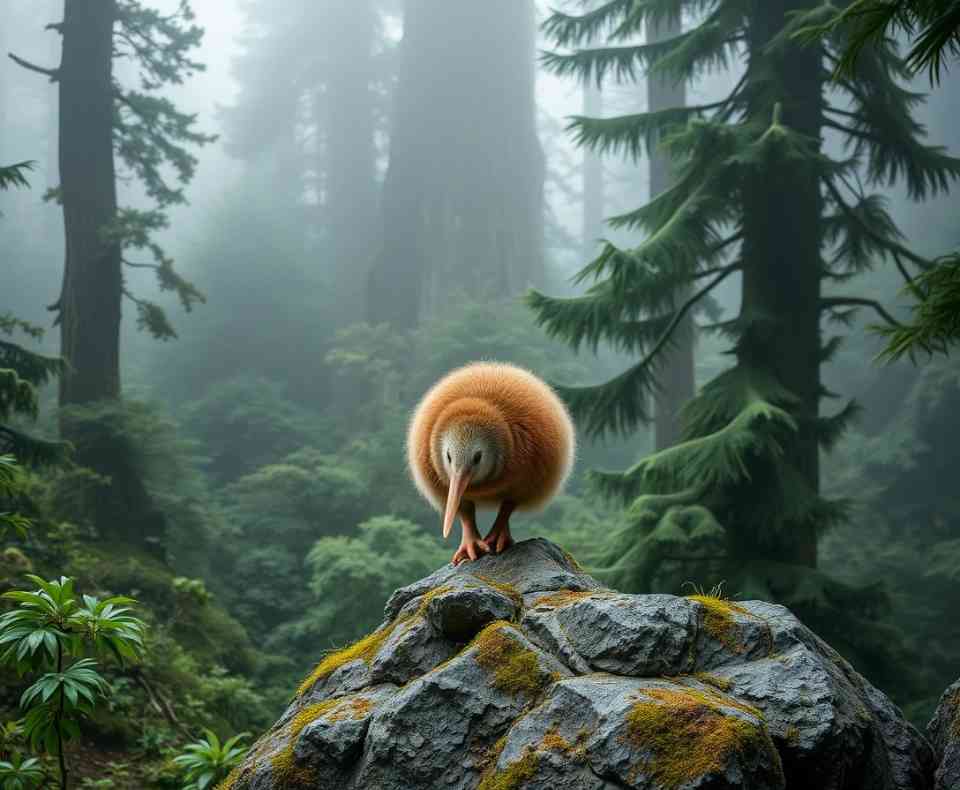
When we talk about kiwi bird size, we’re looking at something roughly comparable to a domestic chicken, though the exact measurements vary between species. The little spotted kiwi is the smallest, while the great spotted kiwi is the largest of the bunch.
Male brown kiwis typically weigh between 5 and 7 pounds and measure around 18 inches in height. Females are larger (because female kiwis don’t mess around), weighing between 8 and 9 pounds and standing about 20 inches tall. The sexual dimorphism is pretty pronounced, with females being significantly heavier than their mates.
Their legs are incredibly powerful relative to their body size. Kiwis need strong legs because they’re constantly scratching and digging through forest debris looking for food. Those legs can also deliver a serious kick if a kiwi feels threatened. I’ve read accounts of researchers getting tagged by defensive kiwis, and apparently, it’s no joke. These birds might be small, but they’re scrappy.
The beak deserves special mention here. It can be up to a third of the bird’s total body length. For brown kiwis, we’re talking about bills measuring between 3.7 and 4.7 inches long. That’s a serious piece of equipment for a bird this size. The beak is flexible, sensitive, and absolutely loaded with nerve endings, making it the perfect tool for probing soil and rotting logs.
What really gets me is how they move. Without the ability to fly and with those powerful legs, kiwis have this distinctive shuffling gait that looks almost mammalian. Research published in Journal of Anatomy examined how kiwis walk while carrying their enormous eggs, finding unique pelvic and leg adaptations that allow them to maintain mobility even when heavily pregnant. Nature really had to get creative with these birds.
New Zealand Kiwi Bird Habitat: Where These Oddities Live
The kiwi bird habitat is as specific as the birds themselves are weird. Kiwis are endemic to New Zealand, meaning they exist nowhere else in the wild. They originally evolved in moist coniferous forests dominated by kauri trees and tree ferns, according to the Smithsonian’s National Zoo. These forests provided the perfect combination of dense cover, moist soil full of invertebrates, and safe places to nest.
Unfortunately, much of New Zealand’s primeval forest has been cleared since human settlement. This has forced kiwis to adapt to partially timbered agricultural areas, scrubland, and whatever patches of native forest remain. Some populations have managed this transition better than others, but it’s definitely not ideal for them.
Kiwis prefer areas with steep terrain covered in dense vegetation. They need thick shrubs and trees for daytime roosting and protection, and they need moist, soft ground for foraging. You’ll find them in everything from coastal forests to subalpine scrub, depending on the species. The great spotted kiwi, for example, lives in mountainous beech forests and can handle colder conditions than its lowland cousins.
Each species has its own preferred habitat niche. The little spotted kiwi does well on predator-free islands where it can thrive without the constant threat from introduced mammals. The Okarito brown kiwi sticks to the West Coast of New Zealand’s South Island, where you’ll find some of the country’s most pristine remaining forests.
IMO, one of the saddest aspects of kiwi conservation is watching these birds try to survive in fragmented habitats. They’re territorial birds that need significant home ranges, and as their habitat gets carved up by development and agriculture, populations become isolated. Small, isolated populations face genetic bottlenecks and reduced breeding success. It’s a tough situation.

The Legendary Kiwi Bird Egg
Okay, let’s talk about the kiwi bird egg, because this is where things get absolutely wild. Kiwis lay the largest egg relative to body size of any bird in the world. We’re talking about an egg that makes up roughly 20% of the female’s body weight. To put that in perspective, research from Save the Kiwi notes that a human baby at full term is only 5% of its mother’s body weight.
The egg is about six times larger than you’d expect for a bird of the kiwi’s size. It’s enormous, smooth, and slightly greenish-white in color. A female kiwi carrying a fully developed egg looks comically unbalanced, waddling around with this massive bulge that makes you wonder how she even walks.
Why would evolution create such an absurdly large egg? Scientists have debated this for years. One theory suggests that kiwis descended from much larger ancestors (possibly related to the extinct moa), and they simply retained the large egg size even as their bodies shrank. Another hypothesis, mentioned in Audubon Magazine, is that oversized eggs allow kiwi chicks to hatch more fully developed and ready to fend for themselves in a dangerous environment.
The female typically lays only one or two eggs per breeding season, and here’s where it gets even more interesting: the male does most of the incubation. The male kiwi sits on that egg for 75 to 85 days (yes, almost three months), leaving only briefly each night to feed. It’s one of nature’s best examples of involved fatherhood 🙂
When the chick finally hatches, it emerges fully feathered and relatively developed. It doesn’t need to be fed by its parents; within about five days, it leaves the nest to start foraging on its own. The parents provide protection and guidance, but baby kiwis are remarkably independent from the start.
Baby Kiwi Bird: Survival Against the Odds
Speaking of baby kiwi birds, let’s talk about how heartbreakingly vulnerable these chicks are. Despite hatching fully feathered and relatively capable, kiwi chicks face absolutely brutal survival odds in the wild.
According to data from the New Zealand Department of Conservation, only about 5% of kiwi chicks survive to adulthood without human intervention. That’s a 95% mortality rate. Around 90% of wild-born chicks die within their first six months, with 70% of those deaths caused by stoats and cats.
The problem is that kiwis evolved in New Zealand before mammals arrived. For millions of years, their only predators were large birds like the now-extinct Haast’s eagle. They never developed effective anti-mammal predatory responses. When humans brought rats, stoats, cats, dogs, and other predators to New Zealand, kiwis were sitting ducks (well, sitting kiwis).
Chicks are vulnerable to stoat predation until they reach about 1 kilogram in weight, at which point they’re usually large enough to defend themselves. But getting to that weight takes time, and every night they’re out foraging, they’re at risk. It’s like a deadly game of chance that plays out across New Zealand’s forests every single night.
This is why conservation programs often use a strategy called “Operation Nest Egg.” Eggs or very young chicks are collected from the wild and raised in predator-free environments until they’re large enough to defend themselves. Once they hit that magic one-kilogram mark, they’re returned to the wild with much better survival odds. It’s intensive, it’s expensive, but it works.
Watching videos of baby kiwis is both adorable and heartbreaking. They’re these tiny balls of fluff with oversized beaks, poking around in the leaf litter, completely unaware of how precarious their existence is. Every chick that makes it to adulthood represents a conservation success story.
Kiwi Bird Predators: The Introduced Menace
Let’s get real about kiwi bird predators, because this is where the kiwi story gets frustrating and sad. Kiwis don’t have any natural predators left in New Zealand. All their current threats come from mammals that humans introduced to the islands, starting with the arrival of Polynesian settlers and accelerating dramatically with European colonization.
Stoats are enemy number one for kiwi chicks. These small, aggressive mustelids were introduced to New Zealand in the 1880s to control rabbit populations (which, spoiler alert, didn’t work). Stoats kill roughly half of all kiwi chicks on the mainland, according to research from the Department of Conservation. They’re fast, they’re vicious, and they’re everywhere.
Dogs are the biggest threat to adult kiwis. All dogs, regardless of breed, size, or training, can kill kiwis. A dog doesn’t even need to bite aggressively; a playful push or rough grab can crush a kiwi’s ribcage. According to the San Diego Zoo, kiwis lack the chest muscles and sternum that most birds have, making them extremely vulnerable to crushing injuries.
In Northland, dog attacks have reduced the average life expectancy of adult brown kiwis to just 14 years. That’s tragic when you consider these birds can naturally live for 25 to 50 years. Every year, dogs kill kiwis in areas where people walk their pets through kiwi habitat. It’s entirely preventable, but it keeps happening.
Cats and ferrets round out the predator lineup, with cats particularly dangerous to chicks and ferrets frequently killing adults. Even rats play a role, competing with kiwi chicks for food and supporting stoat populations by providing them with an abundant food source.
Here’s what really gets me: kiwis evolved for millions of years without mammalian predators. When confronted by a stoat or cat, they often don’t even try to flee. They just don’t have the instincts. It’s like watching someone who’s never learned to swim suddenly dropped in the ocean.
Kiwi Bird Sound: The Calls of the Night
The kiwi bird sound is one of those things you need to hear to fully appreciate. Forget melodious songbirds; kiwis sound like they’re screaming into the New Zealand night, and honestly, it’s both eerie and wonderful.
Male kiwis produce a high-pitched, repetitive whistle that sounds like “kee-wee, kee-wee” (hence the name). It’s a territorial call used to establish boundaries and communicate with potential mates. The call carries surprisingly well through the forest, and during breeding season, you’ll hear males calling persistently through the night.
Female kiwis have a lower, hoarser call that’s more guttural and raspy. Her call is less frequent than the male’s but just as distinctive. When a pair calls back and forth to each other, it creates this haunting duet that echoes through the forest.
The calls serve multiple purposes beyond just finding mates. Kiwis use vocalizations to maintain territory, warn off rivals, and keep tabs on their partners. In some areas with good kiwi populations, the night forest can be full of calling birds, each declaring their presence and defending their patch of forest.
There’s something primal about hearing a kiwi call in the wild. It’s a sound that’s been echoing through New Zealand’s forests for millions of years, long before humans arrived. When I think about how close we came to losing that sound forever, it hits differently.

Conservation: Fighting for Kiwi Survival
Let’s talk numbers, because they’re sobering. There are currently about 70,000 kiwis left in New Zealand. That might sound like a decent number, but consider this: we’re losing approximately 2% of unmanaged kiwi populations every year. That’s roughly 20 birds per week disappearing from the wild.
Without intensive predator control, wild kiwi populations decline steadily. But here’s the good news: where conservation efforts are active, kiwi numbers are actually increasing. On the Coromandel Peninsula, intensive predator control has helped the kiwi population double every decade. That’s huge.
More than 90 community and iwi-led groups now actively protect kiwis across an estimated 230,000 hectares of land. That’s an area roughly equivalent to what the Department of Conservation manages for kiwi protection. Community involvement has become absolutely critical to kiwi survival, with volunteers running trap lines, monitoring birds, and removing predators year-round.
Predator-free islands have become crucial sanctuaries. Little Barrier Island (Te Hauturu-o-Toi), for example, supports a thriving population of little spotted kiwis without any introduced mammalian predators. These islands serve as insurance populations and source populations for translocations to other protected sites.
The cultural significance of kiwis to Maori communities has also played a major role in conservation efforts. Kiwis are considered taonga (treasures), and many iwi and hapu have formal roles in kiwi management as part of Treaty of Waitangi settlements. This partnership between indigenous knowledge and modern conservation science has proven incredibly effective.
Technology is helping too. Radio transmitters allow researchers to track individual birds, monitor breeding success, and locate birds that get into trouble. Acoustic monitoring devices can detect kiwi calls across large areas, helping assess population sizes and distribution without disturbing the birds.
Kiwi Adaptations: Built Different
FYI, kiwis have some of the most unusual adaptations of any bird on the planet. Let’s run through what makes them so uniquely weird.
Their feathers look and feel more like hair or fur than typical bird plumage. Each feather is loose and shaggy, lacking the tight, waterproof structure of flying birds. This gives kiwis excellent insulation for cold nights but makes them vulnerable to getting waterlogged.
They have powerful legs with sharp claws designed for scratching through forest debris. Those legs can deliver kicks strong enough to deter predators or defend territory. The leg muscles are proportionally much more developed than in flying birds, which makes sense when running is your only escape option.
Their sense of smell is extraordinary for a bird. Most birds have terrible olfactory capabilities, but kiwis have a well-developed olfactory system that they rely on for finding food. They’ll stick that long beak into the ground and literally sniff out earthworms and grubs.
Kiwis have specialized tactile receptors at the tip of their beaks called Herbst corpuscles. These allow them to sense vibrations and detect prey underground without even seeing it. It’s like having a built-in metal detector, except it detects delicious worms.
Their bones are marrow-filled like mammal bones, rather than hollow like other birds. This makes them heavier and more robust but obviously precludes any chance of flight. They traded the sky for a completely terrestrial lifestyle and committed fully to that choice.
Living Alongside Kiwis: What We Can Do
So what can regular people do to help kiwis survive? Turns out, quite a bit.
If you live in or visit kiwi habitat areas in New Zealand, keep your dog leashed or leave them at home entirely. Seriously, this is the single most important thing dog owners can do. Even the best-trained, most gentle dog can kill a kiwi. It’s not worth the risk.
Support predator control efforts. Whether that means donating to kiwi conservation organizations, volunteering with local trap-running groups, or just spreading awareness, every bit helps. Predator control works, but it requires consistent, long-term effort across large areas.
If you’re driving in kiwi areas at night, slow down and watch for birds on the road. Kiwis are dark, low to the ground, and easily missed until it’s too late. Motor vehicle strikes kill kiwis every year, particularly in areas where roads cut through their habitat.
Report kiwi sightings to local conservation groups. Citizen science data helps researchers track population movements, identify new breeding areas, and allocate resources more effectively. Your observation might provide crucial information about kiwi distribution in your area.
Choose to support organizations doing kiwi conservation work. Groups like Save the Kiwi, Kiwis for Kiwi, and regional conservation trusts all do amazing work protecting these birds. Financial support helps them continue operating trap networks, running breeding programs, and educating the public.
Why Kiwis Matter Beyond New Zealand
Look, I’ll be honest: I’ve never been to New Zealand (it’s on my bucket list though). But kiwis have captured my imagination in a way that few other animals have. There’s something about their sheer improbability that makes them feel almost mythical.
They represent something larger than just one unusual bird species. Kiwis are a symbol of what we stand to lose when we don’t take conservation seriously. They’re a reminder that evolution creates wonders we could never imagine, and once they’re gone, they’re gone forever.
The kiwi conservation story is also one of hope. Unlike many conservation tales that spiral into inevitable decline, kiwi populations in managed areas are actually recovering. Humans created the problem by introducing predators, but humans are also fixing it through dedicated, sustained conservation effort. That’s encouraging :/
Every kiwi that survives to adulthood, every egg that hatches, every predator-free hectare that gets established represents a small victory. String enough small victories together, and suddenly you’re looking at population recovery. It’s not easy, it’s not quick, but it’s absolutely possible.
Wrapping Up This Weird, Wonderful Bird
Black-capped chickadees might have stolen my backyard, but kiwis have stolen my heart from halfway around the world. These flightless, nocturnal, whisker-faced, egg-laying extremists are proof that nature doesn’t follow anyone’s rules.
They’re birds that forgot how to fly, hunt by smell instead of sight, and lay eggs so absurdly large that it seems physically impossible. They’re fighting for survival against predators they never evolved to handle, supported by a nation that claims them as a symbol and communities that work tirelessly to protect them.
The kiwi story isn’t finished yet. With continued conservation effort, predator control, and public support, these bizarre birds have a fighting chance. They’ve survived for millions of years on isolated islands, and with our help, they’ll survive millions more.
So next time someone mentions kiwis and you think of the fruit, remember: there’s a way cooler kiwi out there, shuffling through New Zealand forests at night, being spectacularly weird and utterly wonderful. That’s the kiwi that deserves your attention, and honestly, the kiwi that needs it most.
Now if you’ll excuse me, I need to go research how one visits New Zealand’s nocturnal kiwi viewing programs. Some obsessions are worth indulging.