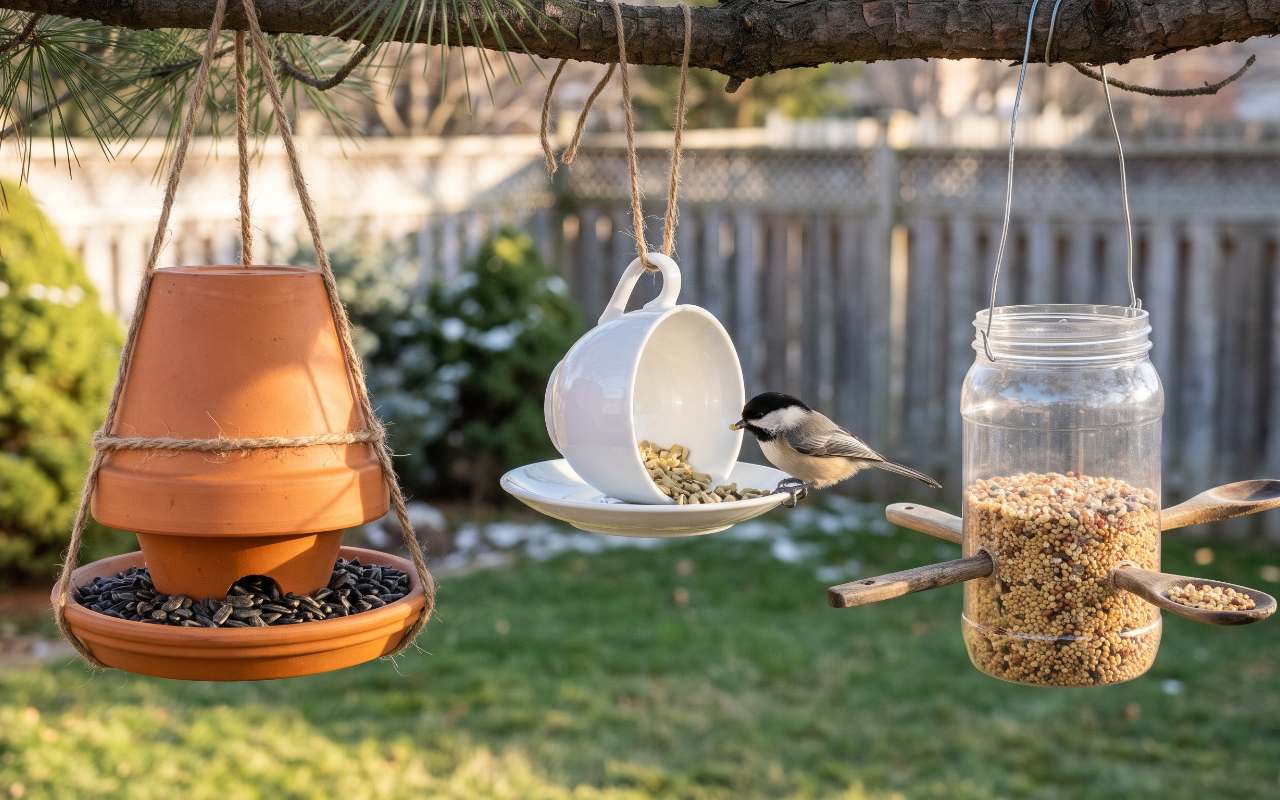
These 12 cheap DIY bird feeder ideas use everyday dollar store kitchen, craft, and garden supplies to attract songbirds for just a few dollars apiece without needing expensive cedar hoppers or metal tube feeders.
By pairing simple household items like ceramic teacups, metal cooling racks, and terracotta saucers with proper drainage and safe hanging hardware, you can tailor each station to the exact birds visiting your yard.
Building on a budget still requires following basic avian safety rules. Smooth plastic bowls need bottom drainage holes so wet seed never grows toxic mold, and hanging cords must stay short and taut so birds never tangle their wings or feet.
| Feeder Design | Main Dollar Store Supplies | Best Seeds to Use | Target Backyard Birds |
|---|---|---|---|
| 1. Baking Bundt Pan Wreath | Mini bundt pan, gelatin, jute twine | Black oil sunflower, millet, cranberries | Cardinals, Blue Jays, woodpeckers |
| 2. Teacup and Saucer Perch | Ceramic teacup, matching saucer, epoxy | Sunflower hearts, mealworms, suet nuggets | Chickadees, nuthatches, titmice |
| 3. Mesh Pen Cup Tube Feeder | Metal wire mesh pencil cup, small saucer | Black oil sunflower, safflower | Finches, chickadees, sparrows |
| 4. Plastic Salad Bowl Fly-Through | Two clear plastic bowls, wooden dowel | Mixed seed, cracked corn, peanuts | Mourning Doves, cardinals, grosbeaks |
| 5. Terracotta Pot and Saucer Tower | Clay pot, two saucers, nylon rope | Black oil sunflower, white millet | Juncos, towhees, cardinals |
| 6. Wooden Spoon Plastic Jar Feeder | Plastic wide-mouth jar, wooden spoons | Nyjer seed, hulled sunflower chips | American Goldfinches, House Finches |
| 7. Muffin Tin Ground Tray | 6-cup metal muffin tin, hanging chain | White millet, sunflower hearts, mealworms | Mourning Doves, robins, bluebirds |
| 8. Wire Suet Basket from Cooling Rack | Mini metal cooling rack, zip ties | Suet cakes, peanut butter pine cones | Downy Woodpeckers, nuthatches, wrens |
| 9. Plastic Soda Bottle Gravity Feeder | Clear 2-liter bottle, wooden dowels | Black oil sunflower, safflower | Finches, chickadees, titmice |
| 10. Mesh Strainer and Pie Pan Feeder | Wire mesh kitchen strainer, foil pie pan | Hulled sunflower chips, dried mealworms | Mockingbirds, chickadees, woodpeckers |
| 11. Popsicle Stick Log Cabin Tray | Jumbo craft sticks, water-resistant wood glue | Black oil sunflower, striped sunflower | Cardinals, Blue Jays, juncos |
| 12. Aluminum Loaf Pan Platform | Heavy-duty foil loaf pan, flat stones | Cracked corn, white millet, peanuts | Blue Jays, doves, squirrels (decoy) |
1. Mini Bundt Pan Seed Wreath
A small metal or silicone bundt cake pan from the baking aisle lets you mold loose birdseed into a hanging wreath that holds up well in winter winds.
- Supplies Needed. Mini bundt pan, unflavored gelatin packets, warm water, 2 to 3 cups of black oil sunflower and millet seed, and sturdy jute twine.
- How to Build It. Dissolve two packets of unflavored gelatin in half a cup of warm water, stir in your seed mix until coated, and pack the mixture firmly into a lightly oiled bundt pan. Chill in the refrigerator for 4 hours until solid, pop the ring out, and loop a short piece of twine through the center to hang from a tree branch.
- Durability & Safety. Lasts 2 to 4 weeks outdoors. Hang gelatin seed wreaths in cool or freezing weather only, as summer heat and humidity soften gelatin and encourage mold growth.
2. Teacup and Saucer Perch Feeder
Ceramic teacups and matching saucers from the dinnerware aisle create a charming, single-serving feeder ideal for small clinging songbirds.
- Supplies Needed. Ceramic teacup, matching saucer, waterproof two-part epoxy (from the hardware aisle), and heavy-gauge wire or chain.
- How to Build It. Clean both ceramic pieces with rubbing alcohol so the adhesive bonds cleanly. Lay the cup on its side near the center of the saucer with the handle pointing straight up, apply waterproof epoxy along the contact edge, and let it cure for 24 hours. Loop wire through the upward-facing handle to hang.
- Durability & Placement. Lasts 2+ years outdoors when protected from hard drops. Hang near dense evergreen shrubs at eye level so chickadees and White-breasted Nuthatches can dart in and out quickly.
3. Metal Mesh Pencil Cup Tube Feeder
In the office supply aisle, perforated metal mesh pen holders make instant ventilated tube feeders that keep seeds dry and airy.
- Supplies Needed. Metal wire mesh pencil cup, small plastic plant saucer (garden aisle), zip ties, and floral wire.
- How to Build It. Drill four small drainage holes in the plastic plant saucer and secure the bottom of the mesh pencil cup to the center of the saucer with two criss-crossed zip ties. Punch two small holes near the top rim of the mesh cup and attach a short wire hanger.
- Durability & Appeal. Lasts 1 to 2 years before thin mesh starts rusting. Woodpeckers, nuthatches, and finches can cling directly to the wire mesh walls while the bottom saucer catches dropped hulls.
4. Two-Bowl Plastic Fly-Through Feeder
Clear plastic serving bowls from the party aisle paired with a wooden dowel from the craft aisle convert into a weather-shielded fly-through feeder that lets you monitor seed levels from inside your window.
- Supplies Needed. Two identical clear plastic bowls, one thick 12-inch wooden dowel, waterproof two-part epoxy or 100% silicone sealant, and a drill.
- How to Build It. Drill a center hole matching your dowel width through the bottom of both bowls plus four tiny drainage holes around the bottom edge of the lower bowl. Slide the bottom bowl (facing up) onto the dowel and seal the joint with waterproof epoxy, leaving 6 inches of open feeding space before inverting the second bowl on top as a rain roof.
- Durability Note. Lasts roughly 1 season, as thin party-aisle plastic eventually turns cloudy and brittle under direct summer UV exposure.
5. Terracotta Pot and Saucer Tower
Unglazed clay pots from the garden section breathe naturally, preventing condensation from ruining sunflower seeds.
- Supplies Needed. One 6-inch terracotta pot, two 8-inch terracotta saucers, thick nylon rope, and two large wooden craft beads.
- How to Build It. Thread the rope through the drainage hole of one upside-down saucer (the roof), tie a large stopper knot underneath, run the rope through the inverted pot (the seed reservoir), and finish through the right-side-up bottom saucer. Tie a wooden bead under the bottom saucer to leave a half-inch gap between the pot rim and bottom dish so seeds trickle out gradually as birds eat.
- Durability Note. Lasts 2+ years in mild climates, though unglazed clay can crack if water freezes inside the saucer pores during winter thaws.
6. Wooden Spoon Plastic Jar Feeder
Clear plastic wide-mouth jars from the food storage aisle paired with inexpensive wooden spoons create a classic gravity-fed hopper with built-in perches.
- Supplies Needed. Wide-mouth clear plastic jar (such as a plastic Mason-style or snack jar), two wooden cooking spoons, heavy-gauge wire, and a utility knife.
- How to Build It. Carefully cut two matching oval openings on opposite sides of the plastic jar near the base using a sharp utility knife (never attempt to cut glass jars), making each opening wide enough for a wooden spoon handle to slide straight through. The bowls of the spoons sit just below the holes to catch spilled seed while giving finches a comfortable wooden perch.
- Durability Note. Lasts 1 to 2 years; poke four pinhole drains in the jar bottom so rainwater escapes immediately.
7. Six-Cup Muffin Tin Buffet Tray
If you want to test which foods your local birds prefer without mixing everything together, a metal muffin tin from the bakeware aisle acts as a six-compartment tasting flight.
- Supplies Needed. Standard 6-cup metal muffin tin, hammer and small nail, and four short lengths of chain or wire.
- How to Build It. Use a hammer and nail to punch two tiny drainage holes in the bottom of each muffin cup. Punch holes in the four corners of the tin, attach equal-length chains meeting at a central S-hook, and fill each cup with a different food such as safflower, mealworms, sunflower hearts, cracked corn, suet nuggets, and white millet.
- Durability Note. Lasts 1 to 2 seasons; wipe dry after heavy rain to slow surface rust on budget tin plating.
8. Cooling Rack Suet Basket
Small wire baking cooling racks from the kitchen aisle fold into a sturdy cage that holds standard suet cakes for woodpeckers and nuthatches.
- Supplies Needed. Two small wire cooling racks, heavy-duty zip ties, and wire cutters.
- How to Build It. Sandwich a suet cake between two small wire cooling racks, trim excess grid edges with wire cutters, and secure three sides permanently with zip ties. Leave the top edge fastened with a reusable twist tie or small carabiner so you can reload fresh suet in seconds.
- Durability Note. Lasts 1 to 2 years and handles heavy woodpecker clinging far better than plastic-coated mesh bags.
9. Clear Plastic Bottle Gravity Feeder
An empty 2-liter soda bottle or clear plastic juice carafe becomes a high-capacity tube feeder in under ten minutes.
- Supplies Needed. Clean, dry 2-liter plastic bottle, two wooden dowels or pencils, a craft knife, and an eye screw.
- How to Build It. Push two wooden dowels all the way through the bottle at right angles (one near the bottom, one 4 inches higher) to create four perches. Cut a half-inch feeding port 1 inch above each dowel so seeds stay inside until birds peck them out, poke four pinhole drains in the base, and twist an eye screw into the plastic bottle cap for hanging.
- Durability Note. Lasts 6 to 12 months before sunlight degrades thin beverage plastic.
10. Mesh Strainer and Pie Pan Rain Feeder
Fine-mesh wire kitchen strainers allow rainwater to drain instantly, making them ideal for moisture-sensitive foods like hulled sunflower chips and dried mealworms.
- Supplies Needed. Wire mesh kitchen strainer with long handle (kitchen aisle), shallow foil pie pan (catering aisle), and sturdy wire.
- How to Build It. Invert the foil pie pan 5 inches above the strainer along the hanging wire to act as an umbrella roof, keeping rain and snow off the open mesh basket below. Mockingbirds, chickadees, titmice, and Downy Woodpeckers quickly learn to visit hanging mesh baskets for mealworms and sunflower hearts.
- Durability Note. The stainless or tinned wire strainer lasts 1 to 2 years, while the foil pie pan roof should be replaced every few months.
11. Popsicle Stick Log Cabin Tray
Jumbo craft sticks from the craft aisle let you build a breathable, slatted wooden platform feeder that dries quickly after rainstorms.
- Supplies Needed. Two packs of jumbo wooden craft sticks, water-resistant ANSI Type II wood glue (such as Titebond II), and four lengths of jute twine.
- How to Build It. Lay 14 jumbo sticks side by side with tiny 1/8-inch drainage gaps between them, then glue two cross-sticks underneath to form a slatted floor. Stack additional sticks log-cabin style around the perimeter three layers high to create a seed lip, let dry overnight, and tie twine to all four corners.
- Durability Note. Lasts 1 season outdoors unless sealed with a non-toxic water-based exterior sealer before filling with seed.
12. Aluminum Loaf Pan Ground Decoy Tray
Deep foil loaf pans from the party and catering aisle are cheap enough to replace every few weeks and work well for ground-feeding birds like Mourning Doves and Dark-eyed Juncos.
- Supplies Needed. Heavy-duty aluminum foil loaf pan, a fork, and two heavy flat stones.
- How to Build It. Poke a dozen drainage holes across the bottom of the pan with a fork, place two clean flat stones inside the pan so wind cannot blow it across the yard, and fill with white proso millet and cracked corn. Setting a decoy ground pan 15 feet away from your main tube feeders also helps draw squirrels away from songbird stations.
- Durability Note. Designed as a short-term disposable tray lasting 3 to 6 weeks per pan.
Essential Safety Rules for Homemade Dollar Store Feeders
- Always Add Drainage Holes. Every solid bowl, saucer, pan, or bottle needs multiple bottom holes so rainwater drains immediately. Wet seeds ferment quickly and harbor Aspergillus mold, which produces fatal aflatoxins.
- Avoid Sharp Cut Edges. When cutting plastic bottles or metal tins, cover rough openings with outdoor electrical tape or sand them smooth so birds do not injure their bills or feet.
- Keep Hanging Cords Short and Taut. Long, dangling strings or frayed ribbons can wrap around a bird’s wings or legs in gusty wind. Use rigid wire or keep twine hangers under 8 inches long.
- Follow the 3-Foot / 30-Foot Window Rule. Place homemade feeders either within 3 feet of a window (so birds cannot build up fatal flight speed if startled) or more than 30 feet away from glass reflections.
- Clean Every Two Weeks. Following Cornell Lab of Ornithology feeder hygiene guidelines, wash DIY feeders every two weeks (or weekly during warm, humid weather) with a 1-part bleach to 9-parts water solution, rinse thoroughly, and let dry completely before refilling.
Frequently Asked Questions
What glue is safe to use on DIY bird feeders?
Once fully cured (usually 24 to 48 hours), waterproof two-part epoxy, 100 percent pure silicone sealant, and ANSI Type II water-resistant wood glues (such as Titebond II) are safe for outdoor bird feeders. Avoid standard white school glue (which dissolves in rain), heavy solvent adhesives not rated for food or aquarium contact, and hot glue, which softens in summer sun and causes feeders to collapse.
Are dollar store plastic bowls safe for wild birds?
Yes, food-grade plastic bowls and pitchers sold in dollar store kitchen and party aisles are safe for holding birdseed. Just make sure to drill bottom drainage holes and discard any plastic feeder that becomes brittle or cracked from UV exposure.
How do I keep squirrels off cheap DIY bird feeders?
Mount your homemade feeder on a smooth metal pole fitted with a wrap-around or torpedo squirrel baffle whose top sits 4.5 to 5 feet off the ground, and place the pole at least 10 feet away from horizontal launching points like tree trunks, fences, and deck railings. Filling your feeder with safflower seed instead of mixed seed also discourages squirrels while still attracting cardinals, chickadees, and doves.