Finding the safe distance between feeders and windows in winter requires balancing avian deceleration limits against structural strike hazards. Cold weather magnifies strike mortality because small songbirds flush aggressively under hawk pressure and burn critical fat stores when disoriented by window reflections.
Standard advice frequently recommends generic spacing without factoring in winter glass glare, sudden ice accumulation, or gear failures on freezing panes. Addressing these mechanical variables ensures wild birds feed safely without risking fatal blunt force trauma.
Quick-Glance Field Summary
Mount feeding stations closer than 3 feet directly to glass or pull them beyond 30 feet away from reflective panes. This spacing prevents birds from accelerating to lethal flight velocities if startled toward the building during low winter sun angles.
- Impact safety margin: Feeder surface mounted within 0 to 3 feet (under 0.9 meters) of the glass.
- Open deceleration zone: Pole systems placed beyond 30 feet (over 9.1 meters) from the exterior wall.
- Fatal collision zone: Feeder placement strictly prohibited between 3 feet and 30 feet.
- Visual barrier spacing: Exterior window markers spaced no wider than 2 inches by 2 inches.
- Hardware thermal limit: Standard rubber suction cups fail at sustained temperatures below 15°F (-9.4°C).
Where to Place Seed Stations to Stop Fatal Glass Strikes
Songbirds startled by predators or sudden noises accelerate rapidly across short distances. A chickadee or finch launching from a perch reaches lethal flight velocity within 4 to 8 feet. Installing a feeder within the fatal 3-to-30 foot danger zone gives birds enough runway to achieve speeds that break coracoid bones or cause fatal brain hemorrhages upon impact.
Feeders mounted directly on the glass or hung within 3 feet eliminate high-speed momentum. Even if a bird flushes straight into the pane from a 12-inch distance, it cannot build enough kinetic energy to cause physical trauma. Conversely, stations positioned beyond 30 feet give birds sufficient airspace to identify the glass as an impassable obstacle and flare their wings to change trajectory.
Backyard bird enthusiasts frequently ask if mid-distance placements work when partially shielded by porch overhangs. Field physics proves that overhangs do not prevent panic collisions; instead, they cast dark shadows that turn clear glass into complete visual mirrors. Setting gear strictly outside the collision corridor remains the only reliable metric for yard safety.
| Yard Placement Zone | Distance from Glass Pane | Avian Collision Velocity & Risk Rating | Mandatory Winter Safety Action |
|---|---|---|---|
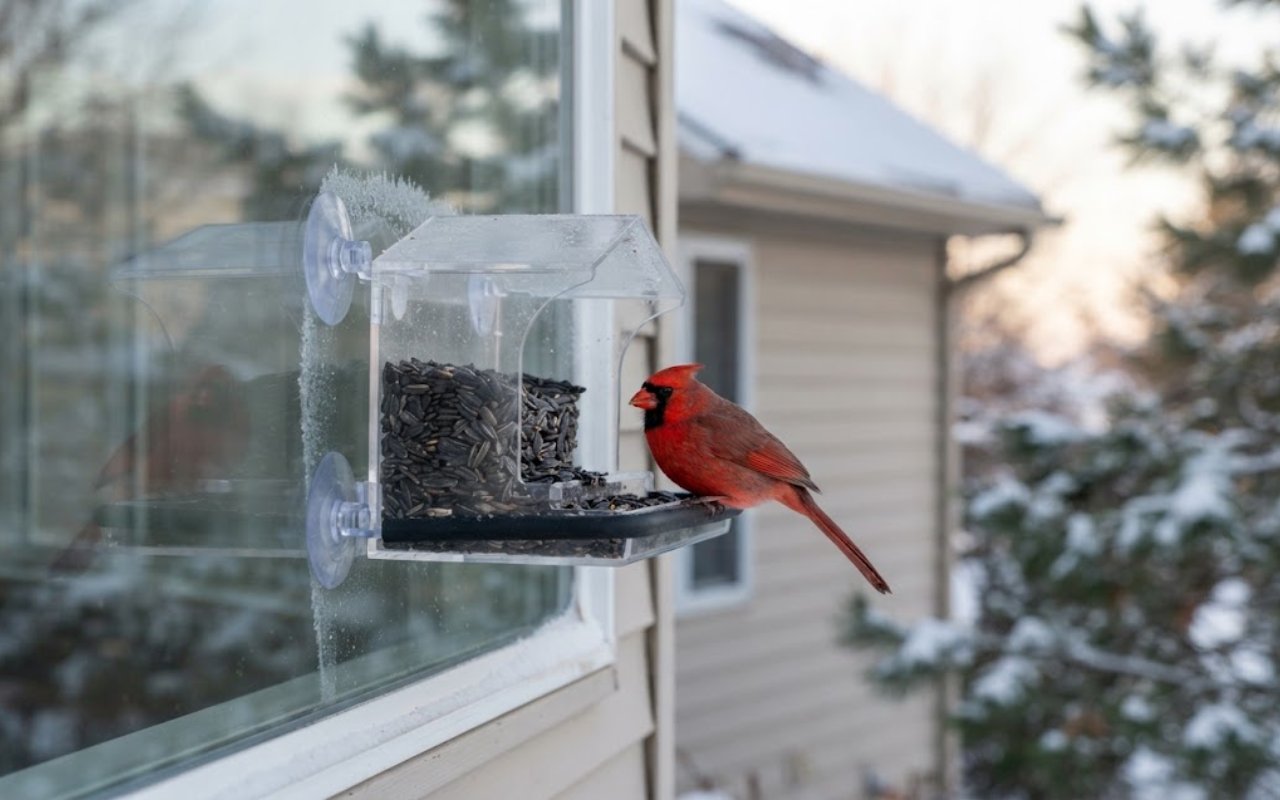
| The Immediate Proximity Zone | 0 to 3 feet (0 to 1 meter) away from the window pane. | Safe; birds launching from perches do not have enough runway momentum to cause impact trauma. | Mount lightweight suction-cup window tray feeders directly onto the glass surface to enjoy zero-risk close views. |
| The Fatal Impact Zone | 3 to 30 feet (1 to 9 meters) away from the house wall. | Dangerous; grants birds peak momentum to hit max flight velocity when fleeing backyard predators. | Ban all feeder post setups inside this range unless glass panes are heavily treated with external UV decals. |
How to Secure Suction Cup Feeders During Subzero Freezes
Discussions on r/backyardbirds show an ongoing frustration with window feeders falling off glass once temperatures drop below freezing. Standard silicone and polyvinyl chloride (PVC) suction cups lose their elastomer flexibility at roughly 20°F (-6.7°C). The stiffening plastic pulls away from micro-imperfections in the glass, dumping heavy seed loads and breaking feeder hinges on frozen ground.
Hobbyists on r/birdwatching frequently counter this hardware failure by switching from standard consumer PVC cups to multi-point lever-locking suction mounts made of all-weather polyurethane. Applying a light film of food-grade mineral oil around the cup rim before mounting creates an air-tight barrier that resists freezing contraction. Mounting should occur when ambient glass temperatures are warm, as suction cups applied to frosted glass fail immediately.
- Clean the contact glass with a 50/50 isopropyl alcohol and water mixture to strip road salt film and grease.
- Avoid warm water applications on freezing glass to eliminate thermal shock fractures.
- Tighten mechanical thumbscrew suction assemblies gradually to prevent stress cracking in thick acrylic hoppers.
Choosing lightweight acrylic window hoppers instead of heavy wood or metal combos reduces shear stress on cold glass. Keep perches cleared of ice rime each morning to prevent asymmetric weight shifts that pull mounts loose.
How to Break Glass Reflections Caused by Low Winter Sun
Winter sun sits lower along the southern horizon, casting intense horizontal light that illuminates tree canopies and reflects them onto glass surfaces. Birds do not perceive double-pane insulated glass as a barrier; they perceive the reflection of surrounding vegetation as continuous flight space. Standard interior blinds or half-drawn curtains do not eliminate these exterior reflections.
External visual deterrents are required to break the mirror illusion. The standard field spacing rule dictates that visual barriers must be placed in a grid measuring 2 inches apart vertically and 2 inches apart horizontally. Songbirds routinely attempt to fly through unpatterned glass gaps larger than 2 inches, especially when pursuing black oil sunflower seeds during freezing weather.
- Paracord Zen curtains hung externally at 3-inch intervals to break flight corridors.
- External UV-reflective tape patterns installed in 2-inch by 2-inch square grids.
- Exterior fiberglass insect screens tensioned over the entire pane to provide a physical arrest net.
DIY paracord installations, often referred to in wild bird forums as Acopian bird savers, provide an inexpensive mechanical fix. These hanging lines hang down the outer face of the window and physically tap against the glass in the wind, breaking reflection patterns without blocking indoor line-of-sight.
How to Protect Ground Feeders from Sudden Hawk Attacks Near Windows
Winter feeding stations attract regular ambush visits from Sharp-shinned Hawks and Cooper’s Hawks. When a raptor stoops into a feeding flock, songbirds panic and scatter along low trajectories toward open reflection corridors. Ground feeding platforms placed within 10 to 15 feet of large patio windows suffer the highest collision rates during these violent scatter events.
Establishing natural landing steps reduces direct panic flights toward reflective walls. Dense brush piles constructed from discarded evergreen branches placed 10 to 12 feet away from the window give ground foragers immediate low-cover escape routes. Birds dive sideways into tangled wood rather than banking upward into invisible window panes.
Seed choice also dictates how long birds linger in the open danger zone. Black oil sunflower and high-fat safflower seeds encourage birds to grab a kernel and fly away to shelter. Dispensing cheap red milo or mixed grains on open patio slabs causes excessive crowding, keeping flocks pinned in hazardous open spaces near low-level glass.
Best Cleaning Methods for Polycarbonate Feeders in Cold Weather
Cold, damp conditions combined with avian saliva turn feeder ports into hubs for pathogens like Aspergillus flavus, a fungus that produces dangerous aflatoxins. Damp winter seed cakes quickly in hopper corners, allowing mold to colonize plastic feeding ports within days. Routine sterilization is required, but cold-weather mechanics limit standard indoor cleaning routines.
Pouring boiling water onto frozen polycarbonate hoppers causes instant crazing, warping, and seam splitting. The rapid thermal expansion damages the molecular integrity of the plastic, leading to leakages that spoil future seed charges. Soaking equipment in tepid sanitizing baths prevents thermal shock while killing dormant spores.
- Use a 1:9 bleach-to-water dilution soak for 15 minutes to eradicate bacterial and fungal spores.
- Scrub tight corners with stiff nylon brushes to dislodge frozen seed residue and wet hulls.
- Air-dry components completely before refilling to stop residual moisture from freezing feeder doors shut.
Never add commercial chemical drying agents, petroleum jelly, or glycerin to plastic perches or feeding trays. Glycerin matts avian contour feathers, destroying their natural waterproofing and loft insulation, which leads to fatal hypothermia during subzero nights. Clean, dry hardware mounted at mathematically safe margins remains the baseline for winter bird survival.
Balancing Winter Hardware Integrity and Avian Safety
Managing a backyard feeding station throughout the winter is a dynamic balancing act between mechanical hardware resilience and wildlife preservation. Generic placement strategies fall short when confronted with subzero temperature drops, heavy ice loading, and the predatory pressures of cold-weather ecosystems.
By strictly enforcing the 3-foot proximity margin, swapping out brittle consumer-grade plastics for cold-resilient polyurethane hardware, and maintaining a rigorous chemical sterilization routine, you eliminate the primary hidden mortality traps of backyard birding.
Ultimately, winter bird conservation relies entirely on predictable physical margins. Taking the time to optimize your landscape placement layout and armor your window suction mounts against overnight hard freezes ensures local flocks can harvest high-energy fuel safely when resources are scarcest.
Monitor your regional morning temperature thresholds, clear away ice accumulation from structural acrylic tracks, and keep your visual grid boundaries clear to maintain a genuinely safe sanctuary right outside your glass pane.