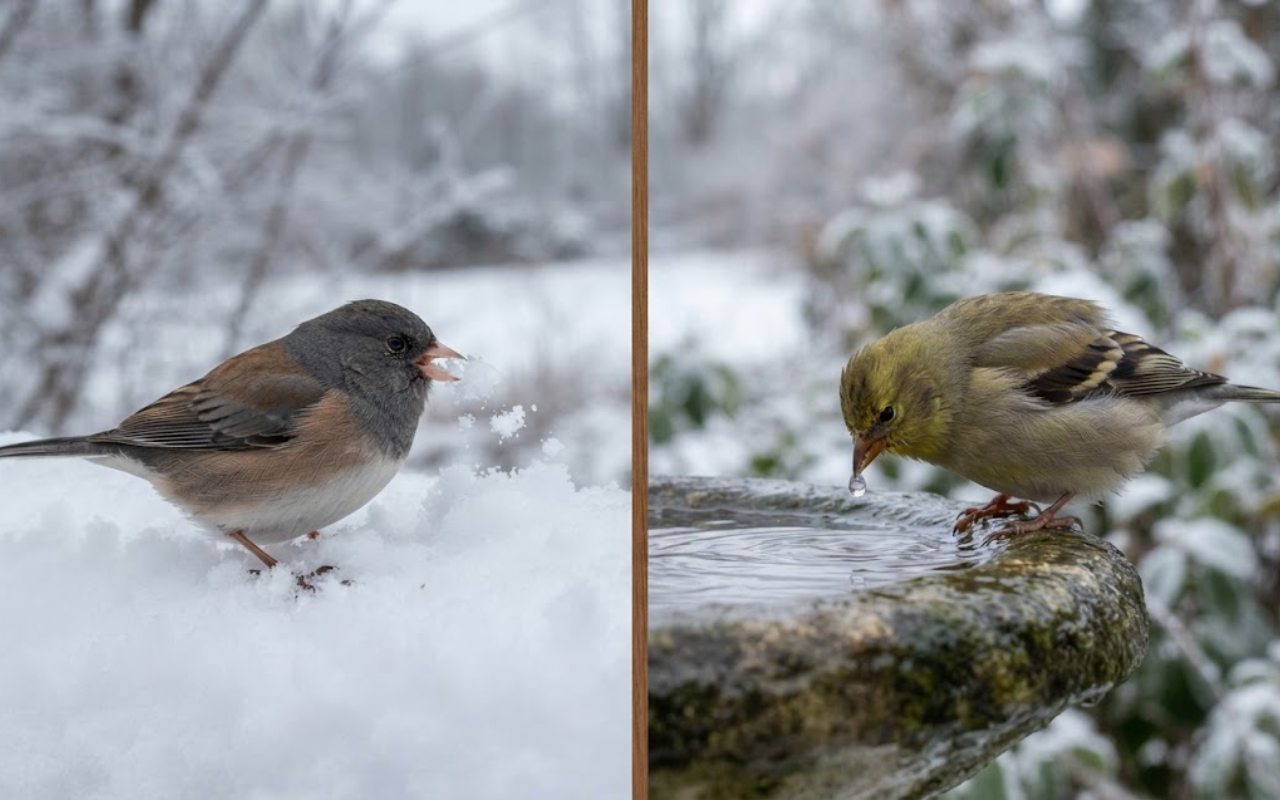
Observing how birds drink snow during freezing weather reveals a fascinating survival tactic with a hidden metabolic trade-off. Songbirds and winter residents do not swallow massive mouthfuls of ice; instead, they scoop tiny crystalline flakes with the tips of their bills to moisten their oral cavities.
While this allows birds to hydrate when lakes, puddles, and backyard dishes freeze solid, it is rarely their first choice. Ingesting frozen moisture forces an avian body to burn valuable fat stores simply to turn that solid ice into usable liquid.
Quick-Glance Field Summary
Eating snow provides immediate hydration during hard freezes, but melting ice internally requires significant caloric energy that otherwise keeps small birds warm overnight. Maintaining a reliable, shallow liquid water source allows birds to preserve their fat reserves and avoid the physiological shock of internal phase-change cooling.
| Environmental Parameter | Safe Technical Threshold |
|---|---|
| Safe Winter Water Depth Prevents feather submergence and accidental hypothermia. |
0.5 to 1.5 Inches |
| Critical Window Setback Eliminates deadly high-speed collision momentum. |
Under 3 Feet or Over 30 Feet |
| Standard Nectar Freeze Limit Standard 4:1 water-to-sugar solution behavior. |
Slush forms at 27°F |
| High-Energy Nectar Limit Concentrated 3:1 winter mix threshold. |
Resists freezing to 22°F |
| Safe Bath Sanitization Ratio Standard household bleach-to-tap-water dilution. |
1 Part Bleach to 9 Parts Water |
The Hidden Energy Cost When Birds Eat Snow for Water
A small bird like a Black-capped Chickadee or Dark-eyed Junco operates at an internal body temperature between 104 and 108 degrees Fahrenheit. When a bird consumes snow, physics dictates an immediate transfer of heat known as the latent heat of fusion.
It takes roughly 80 calories of energy just to convert one gram of ice at freezing point into liquid water, before any warming occurs.
To bring that melted water up to avian body temperature, the bird must burn even more energy. For a creature that weighs less than half an ounce, burning core calories to liquefy internal ice can deplete the fat reserves needed to survive cold winter nights.
Because of this steep energy tax, wild birds treat snow as a temporary emergency backup. They nibble clean, freshly fallen powder rather than dense crust, minimizing the contact surface against their bills to avoid frost injury.
| Moisture Source | Avian Consumption Mechanics | Internal Metabolic Energy Drain | Backyard Conservation Action |
|---|---|---|---|
| Fresh Powdery Snow | Rapid pecking or scooping up individual flakes with the bill. | Extreme; requires intense shivering and rapid core fat burning to melt ice to 105°F liquid. | Supply a shallow bird bath fitted with a specialized outdoor immersion heater. |
| Open Liquid Water | Standard dipping, scooping, and tilting the head back to swallow fluid. | Minimal; liquid is absorbed immediately by tissues with near-zero core temperature disruption. | Keep the bathing basin clear of ice sheets; clean the water daily to prevent pathogen loops. |
What Community Birders Notice When Snow Replaces Open Water
Discussions across backyard birding forums highlight distinct, localized behaviors when open water disappears. On platforms like Reddit’s r/backyardbirds, observers frequently report seeing American Goldfinches and Tufted Titmice systematically skimming hoarfrost from evergreen needles rather than dropping down into deep snow drifts.
Forum members in northern climates note that ground foragers deliberately target sheltered pockets under deck railings where powdery snow stays light and dry.
Another common field observation shared in local wildlife threads involves birds ignoring large expanses of clean ground snow to crowd around dark slate stones or black rubber mats. As the morning sun hits these dark surfaces, micro-films of melted runoff form along the edges.
Birds quickly crowd these spots to sip liquid droplets instead of swallowing solid snow. Experienced hobbyists consistently observe that providing even a tiny saucer of open water reduces snow-eating behavior instantly.
Why Ingesting Powdered Flakes Drains Daily Fat Stores
Small birds survive sub-zero weather by spending their entire daylight hours consuming high-calorie lipids like suet and black oil sunflower seeds. This food is rapidly converted into subcutaneous fat, which acts as fuel for nighttime shivering thermogenesis.
When a bird consumes dense snow, its internal core temperature drops, triggering premature shivering during the day. Shivering uses up glycogen and fat stores, creating an energetic deficit that forces the bird to forage even more aggressively.
If high-fat seeds are scarce or snow covers natural weed caches, this diversion of energy creates severe physiological stress. In heavy blizzards, birds that spend excessive energy melting ingested ice can fail to build the necessary fat pad needed for nocturnal survival.
How to Keep a Bird Bath From Freezing in Winter
Backyard birders can easily relieve this winter energy stress by providing liquid water safely. Installing a low-wattage, thermostatically controlled bird bath deicer keeps water accessible without heating it to an unnatural temperature.
Placement and setup require specific physical dimensions to protect winter visitors from accidental soaking:
- Choose heavy, shallow basins made of weather-safe resin, terra cotta, or unglazed ceramic.
- Keep the water depth between 0.5 inches and 1 inch so birds can drink without submerging their feathers.
- Place several large, flat stones across the water surface to serve as dry, elevated perches.
- Position the water station within 3 feet of your windows to eliminate deadly strike momentum, or push it further back past 30 feet.
- Install an 18-inch polycarbonate weather dome above the dish to deflect falling snow and falling debris.
Providing stones is critical because bathing in sub-freezing air can cause ice to form on contour feathers. When feathers freeze together, birds lose their insulating air layer and face rapid, fatal hypothermia.
Winter Water Maintenance Mistakes That Harm Backyard Flocks
Well-meaning hobbyists often make dangerous maintenance choices when trying to prevent outdoor water from freezing. The most dangerous mistake is adding chemical anti-freeze agents, alcohol, or glycerin to the bath water.
Glycerin breaks down the microscopic barbules of bird feathers, destroying water-repellent preen oils and allowing icy water to soak straight to the skin. Similarly, pouring boiling water into frozen plastic or polycarbonate baths creates sudden thermal shock, warping the material and releasing chemical odors.
Cleanliness remains vital even in sub-freezing weather, as stagnant winter dishes harbor dangerous pathogens:
- Scrub winter water dishes weekly using a standard 1 to 9 bleach-to-water dilution soak.
- Rinse the basin thoroughly with fresh cold water until no chlorine odor remains before refilling.
- Clear away moldy seed hulls promptly, since damp winter waste breeds Aspergillus flavus molds that produce toxic aflatoxins.
- Never use table salt or sugar in a general bird bath to lower the freezing point, as salt poisons songbirds.
If you maintain late-season hummingbird feeders alongside your water stations, monitor your nectar ratios carefully. A standard 4 to 1 water-to-sugar solution starts turning to slush around 27 degrees Fahrenheit, while a concentrated winter mix of 3 to 1 lowers the freeze point down to roughly 22 degrees Fahrenheit.