
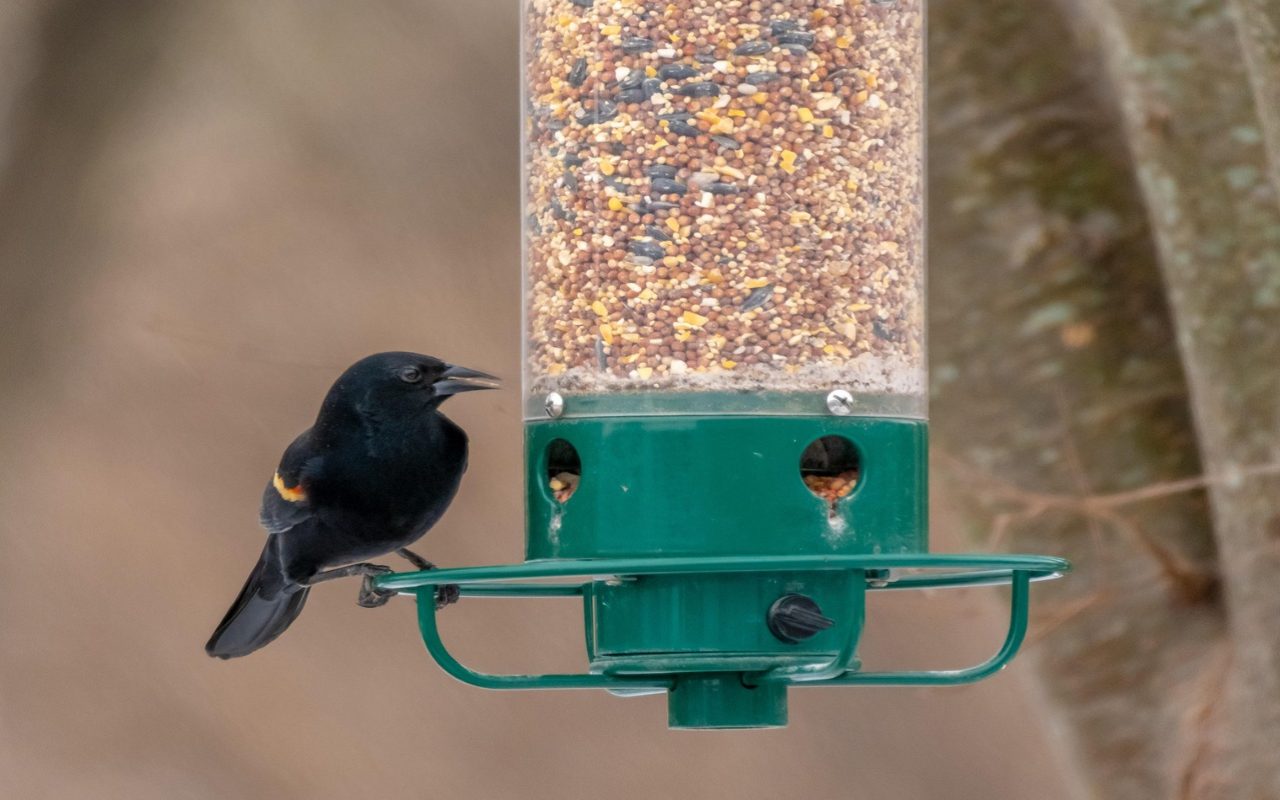
If you are wondering how to deter red-winged blackbirds from feeders across your property, you are certainly not alone this spring. These glossy, sharp-billed visitors can quickly overwhelm backyard feeding stations, bullying smaller songbirds and emptying seed tubes in mere hours.
Their sudden arrival often leaves birders feeling completely defeated after watching finches, nuthatches, and chickadees get chased away. Fortunately, several field-tested strategies can help you reclaim your yard without harming native wildlife.
Understanding Why Blackbirds Dominate Your Yard
Red-winged blackbirds operate on intense seasonal biology that dictates their high-pressure foraging habits. Early in the spring, males arrive ahead of females to claim nesting territory, and their bodies are flooded with testosterone. This hormonal surge makes them hyper-defensive, vocal, and willing to intimidate any bird that gets between them and an easy meal.
They are also gregarious flock foragers during migration. When a scouting group locates an open, high-calorie food source, they call in dozens of flock mates. Within a single afternoon, a peaceful backyard can transform into a chaotic staging ground for hungry, bickering blackbirds.
Their physical size gives them a major mechanical advantage over traditional backyard visitors. Weighing between 50 and 80 grams, they easily push aside 12-gram chickadees and 15-gram finches. Knowing that their visits are tied to seasonal breeding surges and specific food desires is your first step toward managing them.
Swap Out the Buffet for Seeds They Dislike
Blackbirds are notoriously opportunistic eaters that thrive on broad, cheap agricultural grains. Most standard grocery store seed blends are heavily packed with cracked corn, red milo, white proso millet, and wheat. Dumping these blends into an open feeder is essentially rolling out a red carpet for every blackbird in your county.
To push them toward other foraging grounds, you must switch to seeds with thick hulls or chemical profiles that blackbirds find unpalatable. Small songbirds handle specialized seeds with ease, but the conical bill of a red-winged blackbird struggles with certain shapes and textures.
Consider transitioning your backyard menu to these proven deterrent foods:
- Pure Safflower Seed: Features a tough outer shell and bitter oils that blackbirds actively dislike cracking.
- Nutra-Saff (Golden Safflower): A specialized variety with an even thinner, more bitter hull that songbirds love but blackbirds thoroughly reject.
- Nyjer Seed: Also sold as thistle, this seed is far too tiny for broad blackbird bills to manipulate efficiently.
- Whole Peanuts in the Shell: Requires the heavy, chisel-like beaks of blue jays or woodpeckers to open, leaving blackbirds locked out.
- Pure White Suet Cakes: Opt for blocks made with pure rendered beef tallow and zero embedded seeds or cracked corn.
(Note: Avoid relying on hot pepper or capsaicin-treated seeds to solve this issue; while capsaicin deters mammal pests like squirrels, birds lack the specific heat receptors to taste it, meaning a hungry blackbird flock will happily eat it anyway.)
When introducing safflower seed, give your resident songbirds a few days to adjust to the change. Cardinals, chickadees, nuthatches, and titmice will eagerly crack safflower once they realize it is available. The blackbirds, finding the white hulls bitter and difficult to crush, will quickly move down the block in search of softer grains.
Upgrade to Exclusion Cages and Weighted Perches
Physical feeder design plays a massive role in whether larger birds can access the seed. Open platform, hopper, and wide tray feeders give flocking birds an expansive staging area where they can feed shoulder to shoulder. Replacing these open buffets with exclusion-style equipment instantly levels the playing field for smaller backyard birds.
The most effective mechanical defense is a caged tube feeder. These feeders surround the seed ports with a rigid wire barrier featuring openings calibrated to approximately 1.5 inches.
Here are the key equipment specifications to look for when selecting blackbird-proof hardware:
- Outer wire cage grids with spacing measuring strictly between 1.25 and 1.5 inches.
- Adjustable, weight-activated spring mechanisms that allow you to manually fine-tune the tension settings.
- Feeders with short, stubby perches under one inch that prevent broad-winged birds from balancing.
- Recessed feeding ports that require a long, narrow reach through an outer wire barrier.
- Polycarbonate tube bodies that prevent birds from clinging to the sides and shaking down loose seed.
Weight-sensitive feeders, such as calibrated mechanical hopper or tube designs, are particularly effective if adjusted correctly. Because female red-winged blackbirds can weigh as little as 32 to 45 grams, a standard factory setting designed for 100-gram squirrels won’t always stop them. You must tighten the internal spring tension manually so that even the lighter, smaller blackbirds trigger the exterior metal shroud to drop down over the feeding ports.
After several unsuccessful landings where the food door repeatedly slams shut, red-winged blackbirds waste too much energy trying to feed and will abandon the unit.he food door repeatedly slams shut, red-winged blackbirds waste too much energy trying to feed and will abandon the unit.
Set Up a Decoy Feeding Station to Divert the Flock
Sometimes total exclusion from your yard is nearly impossible, especially if you live near wetlands, marshes, or agricultural retention ponds. In these environments, red-winged blackbirds are permanent seasonal neighbors. A practical compromise used by many experienced birders is establishing a sacrificial decoy station.
The strategy relies on simple bird psychology; birds will always choose the easiest meal requiring the least amount of physical work. By offering their favorite foods out in the open, far away from your primary feeders, you can direct traffic away from delicate songbirds.
Place an open ground tray or low platform feeder at the furthest perimeter of your property. Fill this decoy feeder with inexpensive cracked corn, white millet, and black oil sunflower seeds. Make sure it is completely visible from overhead utility lines and nearby tree canopies.
Meanwhile, equip your main viewing station near your porch with caged safflower and nyjer feeders. The blackbird flock will naturally gravitate to the easily accessible grain buffet on the perimeter, leaving the protected feeders quiet and peaceful for chickadees and finches.
Physical Modifications and Feeder Downtime Hacks
If you do not want to purchase new equipment, you can modify your existing feeders using simple household supplies. Blackbirds lack the extreme agility of nuthatches and goldfinches, meaning they cannot easily hang upside down to feed.
You can exploit this physical limitation through a few clever structural adjustments:
- Trim wooden dowel perches down to five-eighths of an inch so blackbirds cannot balance on them
- Invert commercial hopper suet cages so woodpeckers must cling from underneath to access the cake
- Attach rigid plastic domes directly over feeder ports to block larger birds from hovering or perching
- Wrap wide hardware cloth around open tube feeders to create an improvised external cage
- Install smooth seed catchers below feeders to eliminate fallen ground scatter that attracts large flocks
Ground cleanup is vital because fallen hulls and scattered millet act as a massive neon sign for foraging flocks. Rake or sweep the area beneath your poles daily, or use catch trays mounted securely directly under each feeder.
If a massive flock of dozens of blackbirds discovers your yard during peak migration, consider pulling down all your feeders for three to five days. Red-winged blackbirds burn through energy quickly and cannot afford to wait around an empty yard.
The flock will move on to new foraging areas along their migratory route within forty-eight hours. Once they clear out of the neighborhood, you can hang your specialized feeders back up for your regular resident birds to enjoy in peace.